
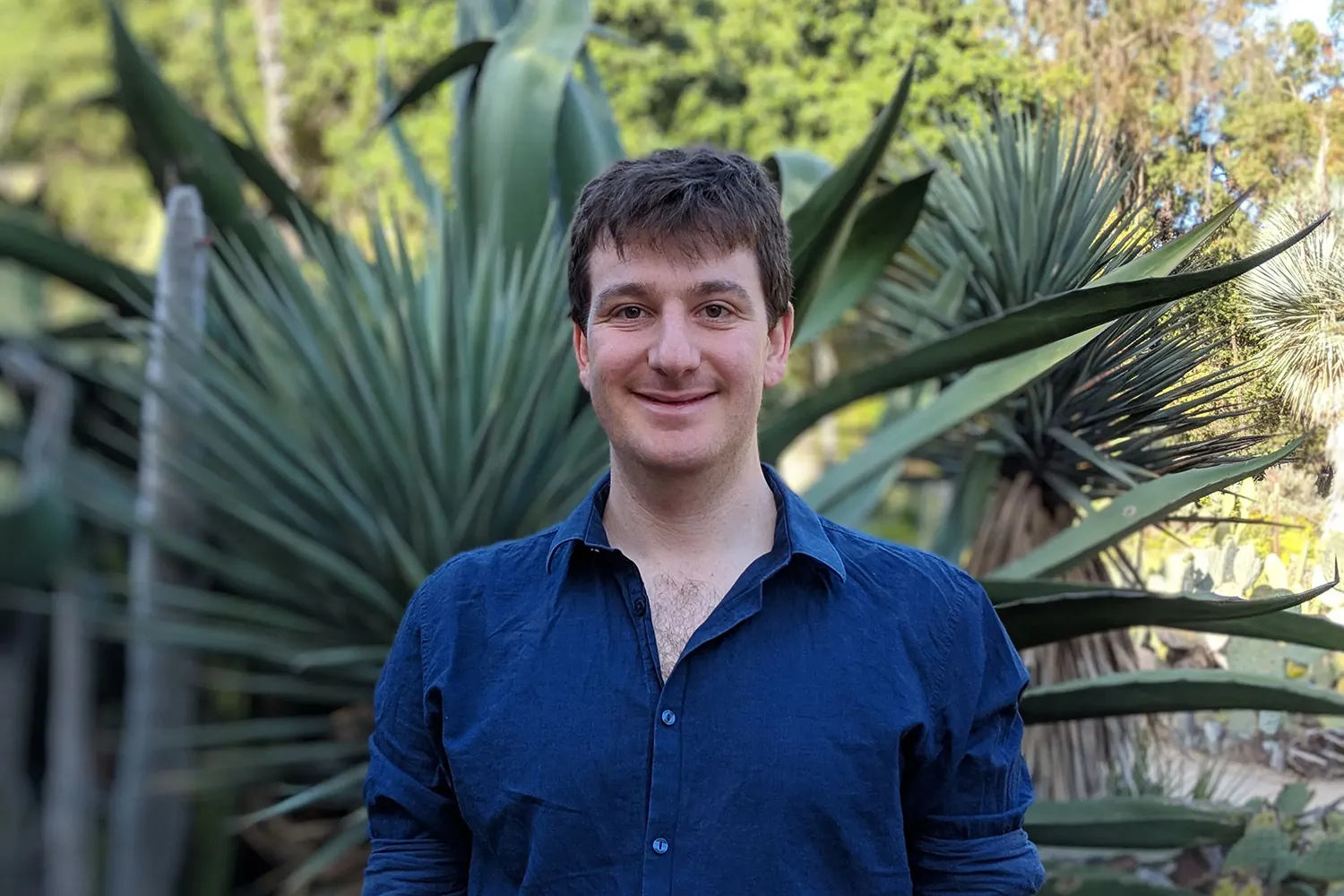
Associate professor of mathematics Otis Chodosh ’10 Ph.D. ’15 received the 2026 New Horizons in Mathematics Prize from the Breakthrough Prize Foundation.
The prize comes with a $100,000 award and recognizes promising early-career researchers who have already produced important work. This year, the Breakthrough Prize Foundation awarded six Breakthrough Prizes of $3 million each and recognized 15 early-career physicists and mathematicians with New Horizons Prizes, including Chodosh.
The prize recognized Chodosh “for contributions to differential geometry and the calculus of variations, including work on minimal surfaces and manifolds with positive scalar curvature.”
With New York University mathematician Chao Li, Chodosh proved a central conjecture concerning a broad class of higher-dimensional spaces known as “aspherical manifolds.” With Rice University mathematician Christos Mantoulidis, he resolved a key problem in the geometric analysis of minimal surfaces, which are surfaces that locally minimize their area, like soap films.
Chodosh’s work as a geometric analyst focuses on how mathematical objects curve or bend. He was recognized for settling several long-standing questions that have been studied for more than 50 years in the field of differential geometry — the mathematical study of smooth shapes, curves and surfaces.
Chodosh was a Veblen Research Instructor at Princeton University and the Institute for Advanced Study from 2016 to 2019 before returning to Stanford as a faculty member. In 2015, he was awarded the Walter J. Gores Award, Stanford’s highest award for excellence in teaching, while still a Ph.D. candidate.
Chodosh’s doctoral adviser Simon Brendle, now at Columbia, won the Breakthrough Prize in Mathematics in 2024. Mathematics professor Richard Taylor, who was a co-winner of the very first Breakthrough Prize in 2015, first informed Chodosh of the prize.
In an email exchange with The Daily, Chodosh said the recognition would not redirect his research so much as affirm the curiosity that has long driven it.
“The fun part about being a mathematician is trying to figure things out in situations where you really don’t know what’s going on,” he wrote. “This can be extremely frustrating, but it makes it very rewarding when you gain some insight, even if it’s small.”
That sense of unfinished discovery, he said, defines the broader state of his field. Geometric analysis is “an extremely rich field, with many talented people working in many different directions,” making it difficult to predict where it is headed “until it’s happening,” he said.
He likened the current landscape of the field to the tip of an iceberg. “At the moment, many parts of geometric analysis are kind of like an iceberg,” Chodosh wrote. “We see just a tiny portion of the truth, and do not have any idea how complicated the area is in reality.” According to Chodosh, mathematicians “don’t even have expectations” about the number or extent for many open problems.
Asked to translate the significance of his research for readers without a mathematics background, Chodosh pointed to the long history of his subject. Minimal surfaces, he said, are “beautiful objects” studied since the 19th century by “many of the mathematical greats,” and their “natural geometric form and nature make them extremely appealing.”
For Agniv Sarkar ’27, who is studying math, Chodosh’s manipulations of soap films were particularly interesting.
“It’s really cool that soap films that have to go on infinitely have to actually just be flat in low dimensions, but not large ones, and the fact that each dimension requires more new techniques is really mind bending,” Sarkar said. “It’s really cool that via a ton of estimates and smartly chosen smooth test functions Professor Chodosh was able to do it.”
Returning to Stanford as a faculty member after earning two degrees has meant moving through campus in very different capacities. Chodosh said he has “many fond memories” of his undergraduate years, though he added “campus certainly isn’t the same without my friends around.” Recently, he and his wife — who met as sophomores living in Durand — have “been experiencing the joys and exhaustions of having two young kids at home.”
For students drawn to pure mathematics, Chodosh offered an understated case for the field. He said that he enjoyed studying it without specific plans to become a research mathematician. “Mathematics is a wonderful career, one that is largely self-directed, even in the graduate school years, compared with much of academia,” Chodosh wrote. “Math has taken me to many interesting places and allowed me to meet many interesting people.”
Even as he accepted the recognition, Chodosh emphasized that the work behind it was not his alone. “I’m honored to win the prize but want to emphasize my debt to my broader mathematical community”, he said.
Colleagues had words of praise for Chodosh. “Otis is not only an outstanding mathematician continuing Stanford’s long-standing tradition of world-class excellence in geometric analysis, but also a wonderful mentor and teacher at all levels,” said math professor and director of undergraduate studies Brian Conrad. “His expertise and originality, together with his friendly and welcoming attitude, draws many students and visiting researchers to this campus.”