
Editor’s Note: This article is a review and includes subjective thoughts, opinions and critiques.
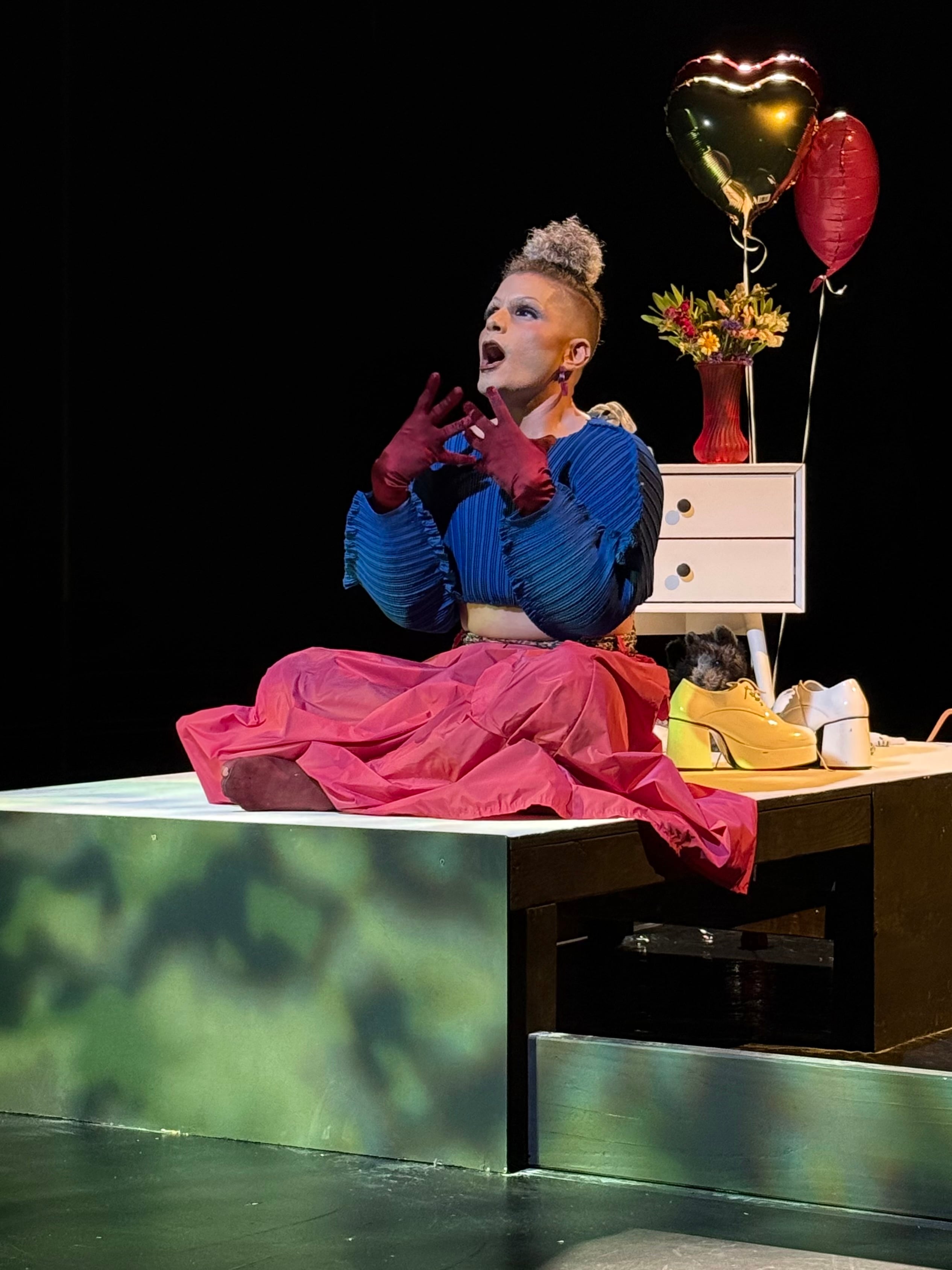
When the first footstep echoes on the floor of the Nitery Theater, the scene is already set. Antonio, played by César Valenzuela sixth year Ph.D. student, lays on of two platforms, breathing slowly. From April 30th to May 2nd, César took the stage in the one-man show “Twinks in Caracas: An Oil Fantasia,” Staged by Asian American Theater Project (AATP), “Twinks in Caracas” depicts the intimate story of a Venezuelan drag queen who explores his connection with his home country as he begins dating an unnamed twink and having enigmatic dreams.
From the very beginning, the show feels exceedingly personal, with Antonio speaking while facing the audience directly, as if they are his friend Laura. He humorously recounts his meeting with the twink, saying, “They’re hot because they like … like they could murder you, but they won’t.” While revealing that the twink is a Gemini and does CrossFit, he also giggles, saying, “His pecs are reasonably juicy.”
Nonetheless, the performance is one of disarray, fear and discomfort jumbled between these moments of happiness: a concoction of the Venezuelan experience. On the second platform, we see Valenzuela adopt another role as Miss Comandante, Antonio’s drag persona, who performs as Venezuelan dictator Hugo Chávez while accompanied by videos of Chávez’s speeches. Miss Comandante also regales the audience with stories of Antonio’s dreams. According to Valenzuela, these dreams were inspired by the dreams of Venezuelan immigrants he interviewed.
These dreams are all emotion-ridden and exceedingly vulnerable, including someone watching a lioness eat her own cub and giving birth to a dead baby, both being deeply disturbing imagery of the journeys motherhood can take. The tensions rising on the second stage carry over into Antonio’s waking life. He is getting engaged to the twink, whose refusal to speak of his parents back in Venezuela creates conflict between the lovers.
When Antonio finally drags it out of him, we find out that, in contrast to Antonio’s father and many other Venezuelans who fear getting arrested for treason over ridiculous claims, the twink’s parents actually work with Chavéz. During this tiff with the twink, things only get worse when the twink’s dog attacks Laura, leaving her in the hospital needing critical facial surgeries.
At this point, the twink threatens Antonio, telling him both he and his father will be thrown into jail. The story reaches its horror-filled end when Antonio kills the dog with a bag of powder and proceeds to chant “muerto el perro” on the drag stage. “Muerto el perro, se acaba la rabia” is a popular Spanish proverb meaning, “When the source of the problem is removed, then the problem will be solved.” The second half of the proverb remains unfulfilled; Antonio has killed the dog, but the threats of being imprisoned still remain. The ending leaves a haunting aftertaste, reflecting the position Venezuelans have long been in: They fight the regime, and still it persists.
Valenzuela said this scene (along with a chilling lip-sync to Chávez singing the Venezuelan military chant “Patria Querida”) “encapsulates how the play intends to portray Chávez: as a manipulative leader who promised ‘a new homeland,’ who insisted he was a ‘soldier willing to do anything for his country,’ and, instead, ensured the political and socio-economic dismantlement of Venezuela and built a brutal military regime.”
Alongside Valenzuela, whose roles included co-director, playwright, performer, video designer, sound designer and costume designer, María Zurita Ontiveros fourth year Ph.D. student was critical in helping the story come to life — acting as co-director, dramaturg, assistant costume designer and stage manager.
“This play makes a space to talk about the reality of many Venezuelans at home and in the diaspora beyond looking for political affiliations,” Ontiveros wrote in her director’s notes. “ It asks us, how can we push for what is right without normalizing violence along the way? How do we reckon with promises of freedom and democracy that never came? What is the role of art in times of war? Is this numbing the wounds, or treating them?”
These questions come to life in the story, which I particularly resonated with as a queer Latina. Other audience members felt similarly.
“I loved it!” Ariana Lee ’29 wrote to The Daily. “Very often in the media, marginalized classes are viewed through a politicized heuristic — in which their identity is placed before their humanity.”
Because of this, “I appreciated the piece’s characterization of Antonio — the ability to gain insights into their friendships, community, gossip, etc., made Antonio feel like a friend rather than a character,” Lee wrote.
In just 90 minutes, Valenzuela performed an evocative story that, while deeply central to the Venezuelan experience, reflects the struggles of many nations and their immigrants.