
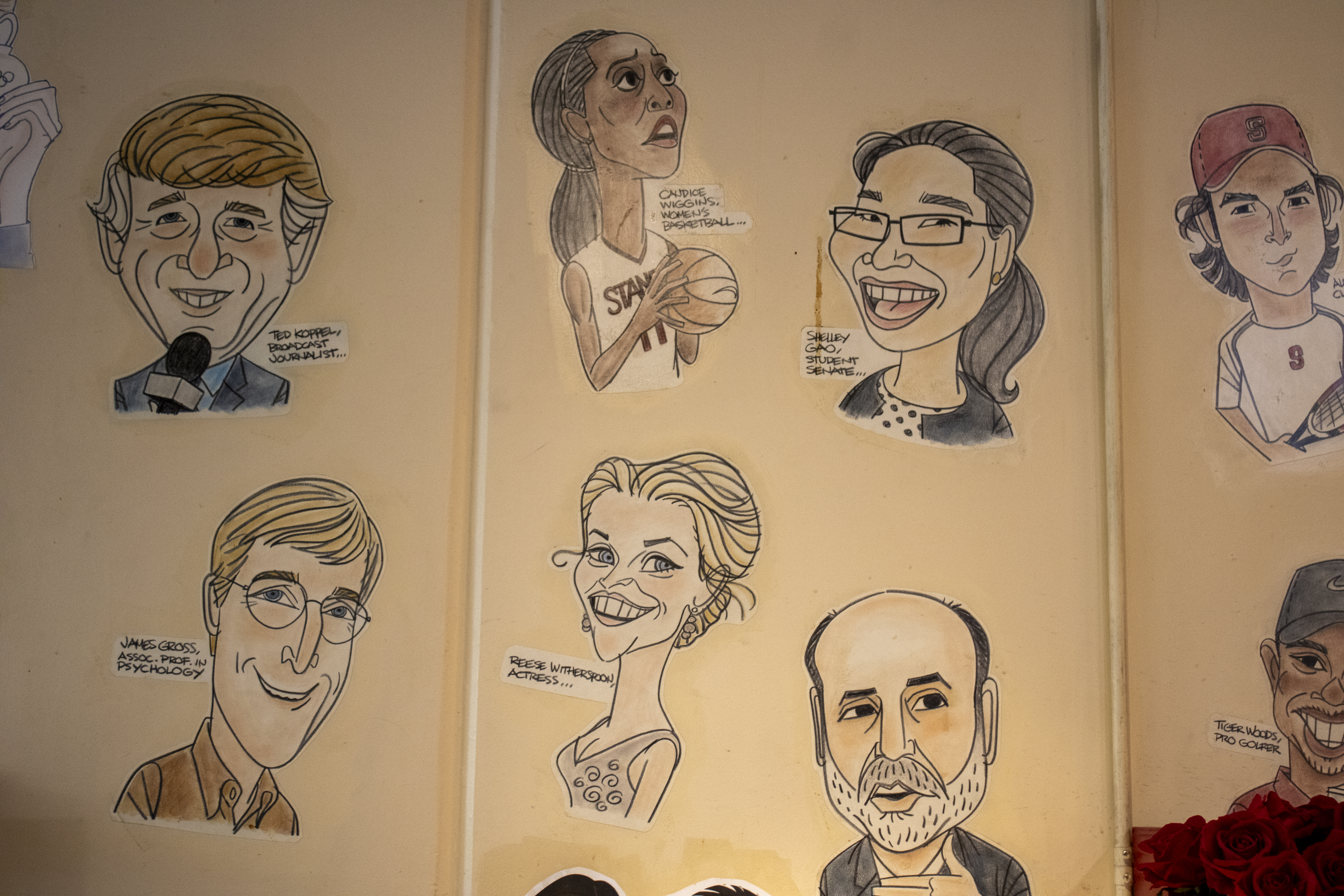
Walk into Coffee House (CoHo) on any given day at any given time, and you will be met by the same group of smiling faces. It’s not the employees taking your order, though they are very smiley, or that one group of friends who I swear is always on those couches near the piano. No, this is a group of Stanford legends, alumni and drop-outs alike, who have greeted decades of students and employees.
That’s right: I’m talking about the CoHo portraits.
Most of the portraits have been on the walls since 2008, when Ray Klein reopened the cafe. The owner of Treehouse, Ray’s Grill and both CoHo locations, Klein bought CoHo in 2007 following a brief closure where students had to fight to keep it alive during renovations in Old Union that threatened to shut it down.
“I got the idea [that] it would be interesting to put people who are in the University on the walls, or famous people who’ve been here — the Google boys or people, whoever,” Klein told The Daily. “I wanted to do something of interest.”
He commissioned 29 original portraits from San Francisco Chronicle graphics creator Zach Trenholm, though some were lost in a renovation. Trenholm even helped apply the portraits to the walls with the help of his wife.
Including the more recent additions, there are 33 total portraits up on the walls, or 35 if you count the Amazing Race winners and Google founders as individual portraits (even though they appear as one drawing) and 34 if you only count Director of Operations and Student Unions Jeanette Smith-Laws once (despite the same portrait of her appearing twice).
Not all are Stanford graduates, though all have some connection to the University, even if tangentially. Actor Ted Danson, for instance, attended Stanford only briefly before transferring to Carnegie Mellon. He is one of three actors, among a slew of University deans and professors, athletes, astronauts, journalists, founders and students.
The idea to portray these patrons as portraits was inspired by a visit to Sardi’s, a restaurant in Times Square known for its framed caricatures of movie and theater stars who have graced its premises and now line its walls.
“He’s an entrepreneur and the restaurant business is addictive,” Jenny Mountjoy said of her father, Klein. Mountjoy has been running the daily operations of the four family restaurants with her brother, Andy, for the past five years. “Since I was a teenager, we’d fly to another state to try pizza. So this guy will go everywhere and look and look and look and see what people are doing.”
On one of those trips, Klein saw Sardi’s caricatures and loved the ambiance they provided. “I believe that when he took over CoHo, he wanted to do just that and cover the walls,” Mountjoy said.
Sardi’s “is the ultimate, but this is how I copied it,” Klein said. “I’m a big copycat.”
His eclectic interior design aesthetic is not limited to the portraits. The chairs around most CoHo tables hail from Pennsylvania. The tables were slabs of wood refinished by someone Klein referred to as his “guy.” The line of beer handles against the window is straight out of an 1850s San Francisco.
“I’m a big guy [of] accumulating things. It’s called personality,” Klein said.
Most of the portraits went up before Klein reopened the cafe in 2008, as he wanted to open up with the walls done, though some (like Smith-Laws’) were added more recently after some gentle nudging.
“Boy, she got on me about not having a picture up,” Klein said of Smith-Laws, who can often be seen around campus in stylish clothes and bouncy white hair. Also by a now-forgotten artist, her first portrait went up just a few years ago under the television screen by the tray return, or as she said, “by the trash.”
“That’s the last thing they see when they’re throwing away their trash? Really?” Smith-Laws said she told Klein. “And then next thing I know, there was a second one that people actually see.”
She added: “I was tickled to no end when I saw my face. And I was tickled to no end the first time somebody walked up to me and said, ‘Oh my god! It’s you!’”
The difference in artistic styles between the newer portraits and the originals hasn’t gone unnoticed by Klein, who still favors the originals.
“I’ve had a very difficult time finding someone that can do characters like this,” Klein said. “People will do it too artistic. That’s not what I’m looking for. I’m looking for [something that] blends in.”
The atmosphere in CoHo revolves around blending in, from the soft browns of the tables, chairs and couches to the beige of the walls and portraits. Sometimes, even the students start to blend in.
“My dad’s done a great job of preserving, really, that feeling of CoHo where people can literally live there. I mean, people may live there, we have no idea,” Mountjoy said. “It’s a place on campus where you’re away from home, but you have this place that feels like you have a connection to.”
To that end, Mountjoy is looking to students and alumni for input on who should be next on the walls. She has already found an artist: Ariana Rodrigues ’26 M.S. ’27. Rodrigues approached Mountjoy in winter quarter after hearing the cafe was looking for a new artist.
“I was like, ‘No way. Guess what my favorite hobby is?’ Drawing pencil portraits of people’s faces!’” Rodrigues said.
Throughout spring, she has been working on portraits of astronaut Ellen Ochoa M.S. ’81 Ph.D. ’85, former National Football League (NFL) quarterback Jim Plunkett ’71 and alumni association president Howard Wolf ’80. Her style is also distinct from the two other styles represented on walls, which she called “caricature style” and “simple realism.”
Her own style is realistic pencil portraits, but what distinguishes them most is that they are black and white.
“They are meant to be different, and it’s okay that they are,” Rodrigues said. “I think the most critical thing someone could say is, ‘Ah, this doesn’t really look like them.’ But I’m not too worried about that.”
Rodrigues plans for Ochoa, Plunkett and Wolf to be up before the end of the academic year, and hopes to add more when she returns in the fall for her bioengineering masters degree. Mountjoy has already been approached by some alumni asking about the possibility of representing certain people.
“We still have a lot more portraits to put on the walls,” Mountjoy said. “What’s hard about that is, how do you choose? I inherited this but I’d like to have a fair and appropriate representation of alumni.”
The original portraits were chosen based on Klein’s personal discretion.
“How do I decide? Whoever’s famous. Or whoever I like,” Klein said. “Anything that I thought was interesting to the students.”
Today, the choice is less straightforward. Mountjoy and Smith-Laws both emphasized their desire to open up and democratize the decision making process.
“Putting people on the wall is a delicate act when it’s in a public space,” Smith-Laws said. “You have to know the cause and effect of these things… If some bad thing happens and that’s not a person we want to highlight in our community, you need to be prepared to take it down.”
To date, no portraits have been taken down, though Smith-Laws did bring up a rumor that a portrait went missing once after someone peeled it off the wall. She is, however, open to removing older portraits to make room for more. Her idea is to make the wall “almost like a collage,” adding new faces regularly until the wall is filled.
“It’s a fun tribute. I mean, I’m honored to be on his wall. I feel like CoHo is my baby. I care so much about it,” Smith-Laws said. She has thoughts herself on who should be memorialized next in the cafe, including Klein himself. The original artist, Trenholm, actually drafted a portrait of Klein in the process of making the others, though it never went up.
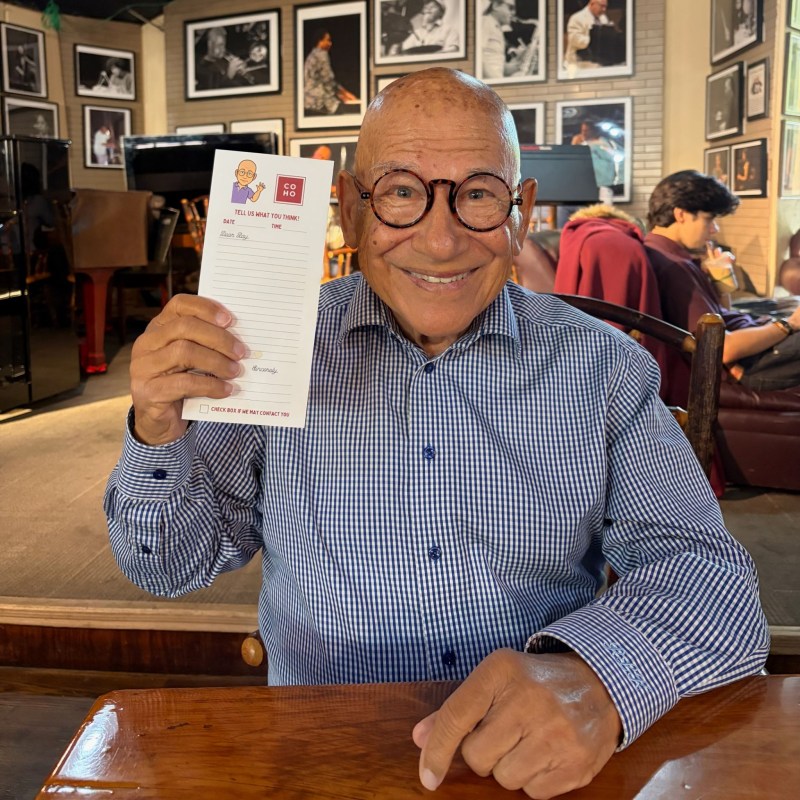
Klein said he does not want a portrait. He is content with the cartoon version of himself on the comment cards in CoHo and the legacy he created in the walls itself.
“It’s really famous,” Klein said of the wall. “I’m not famous, but this was famous. I think they’re insured for a lot of money, the walls, because you don’t want them painted over.”
This article has been updated to reflect the name of the original artist, Zach Trenholm, and that Smith-Laws’ title is Director of Operations and Student Unions, not Vice Provost of Student Affairs. The Daily regrets this error.