
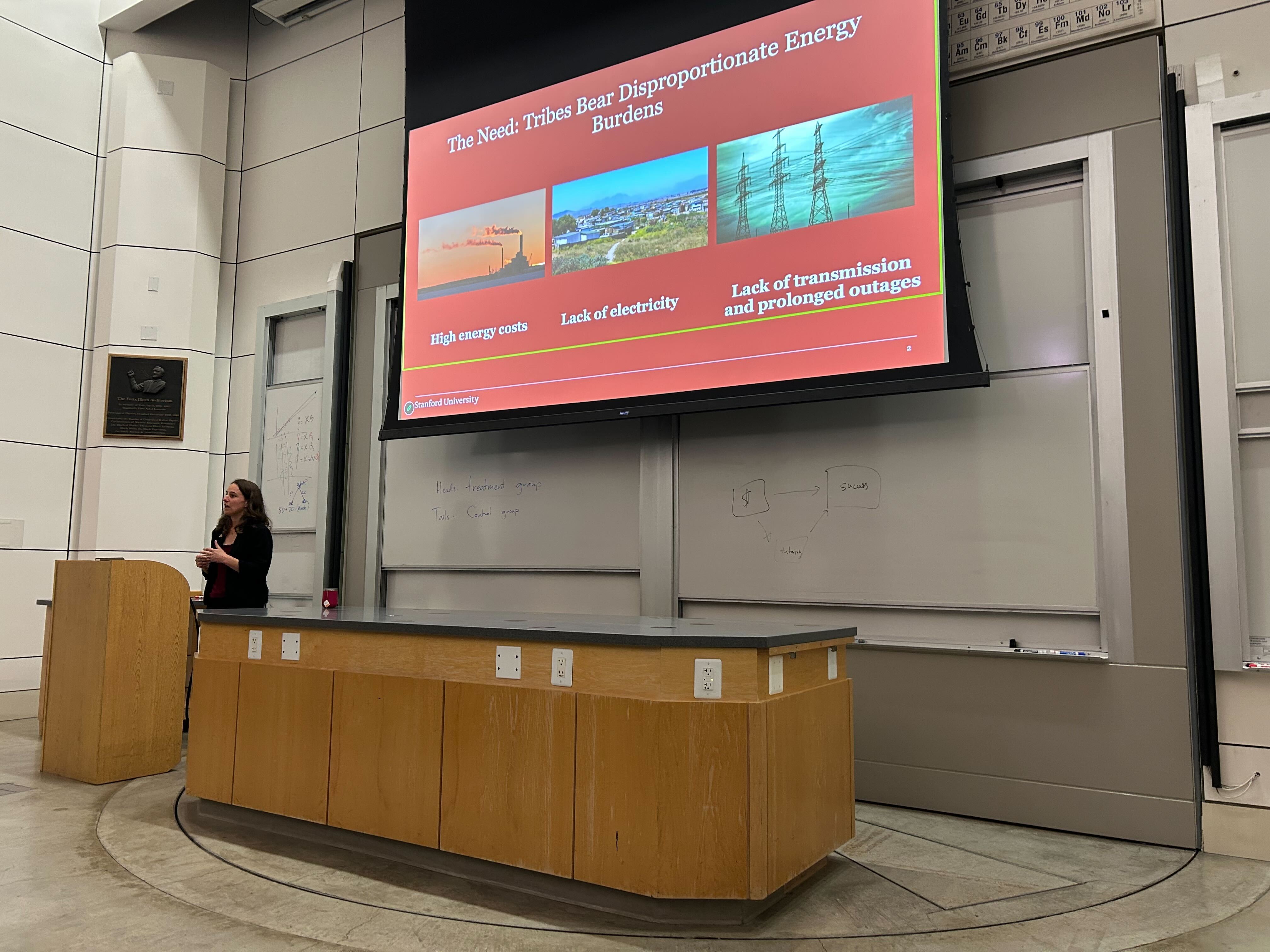
California’s clean energy transition is as much a social justice issue as an environmental challenge, said Kelsey Freeman — a Knight Hennessy Scholar and research scholar at the Precourt Energy Institute — at the Stanford Energy Seminar on Monday.
Freeman’s lecture at the Hewlett Teaching Center, titled “Powershift: Supporting Tribal Energy Sovereignty at the California Energy Commission,” focused on new policymaking methods that account for Native American tribal sovereignty during California’s shift to renewable energy sources.
The Precourt Institute for Energy regularly hosts the Stanford Energy Seminar, a series of events focused on contemporary issues in the energy world. An audience of about 40 attended Freeman’s lecture.
Through her role with the Institute, Freeman is working to involve tribes in state energy policy by introducing a new process to the California Energy Commission (CEC). The nonpartisan state body is dedicated to developing California’s clean energy infrastructure.
Among other changes, Freeman’s approach institutes a “co-writing” process, where policies are written through regional roundtables with tribal leaders’ direct input. This diverges from previous processes that sought tribal approval after drafting. The new process also requires the CEC to “uplift tribal energy goals,” Freeman said. With this change, various tribes’ energy priorities will have a bigger seat at the table.
So far, the program’s policymakers have implemented $130 million in funding toward tribal energy microgrids. The microgrids serve as clean energy sources that help tribes establish energy independence and can provide emergency energy to surrounding rural areas.
Due to their predominantly rural locations, tribes often face high energy costs. 14% of households on reservations lack electricity, compared to 1.4% of the U.S. general population, according to Freeman.
“Supporting tribal energy sovereignty is one of the California Energy Commission’s key priorities,” according to CEC Chair David Hochschild. The CEC has authorized $165 million for energy initiatives managed by tribes, focusing on climate research and infrastructure like heat pumps, electric vehicle charging stations and solar-powered microgrids.
“Stanford’s Precourt Institute for Energy is dedicated to developing knowledge, ingenuity, and leadership needed to realize the vision of sustainable, affordable, secure energy for all,” wrote Holmes Hummel, the event’s moderator and the Managing Director of Energy Equity and Just Transitions for the Institute. “Energy transitions sought by tribes are integral to that vision.”
Stanford announced that it had achieved 100% renewable energy in 2022, largely due to solar power. Many of those solar power sources are situated on the ancestral lands of the Tachi Yokut Tribe. The potential for clean energy development on reserved tribal lands has reached capacity, but the tribe has not been able to reap the monetary benefits of their land’s renewable energy, Hummel said.
Stanford can address situations like these “with the kind of collaboration Kelsey is inviting us to imagine,” Hummel added, stressing the responsibility for “Stanford and all members of our community to recognize, acknowledge, and honor the relationship of the university to native peoples” — not only to “recite” this acknowledgment, but also to “make it real.”
Attendee Eliza Ennis, a Knight-Hennessey Scholar and fourth-year health policy Ph.D. student, expressed hope in what Freeman’s success could mean for similarly service-minded Stanford students. “I’m really excited about the opportunity for Stanford to create more avenues for students who are thinking about California government-level work,” Ennis said.
For Stanford students seeking to make an impact in public service, Freeman advised, “At Stanford, it’s easy to get caught up in this quest to ‘be somebody’ rather than ‘do something.’ Stay rooted in the ‘doing something’ and you’ll land in the right place.”
Update: This article has been updated to clarify the location of clean energy development on tribal lands.