
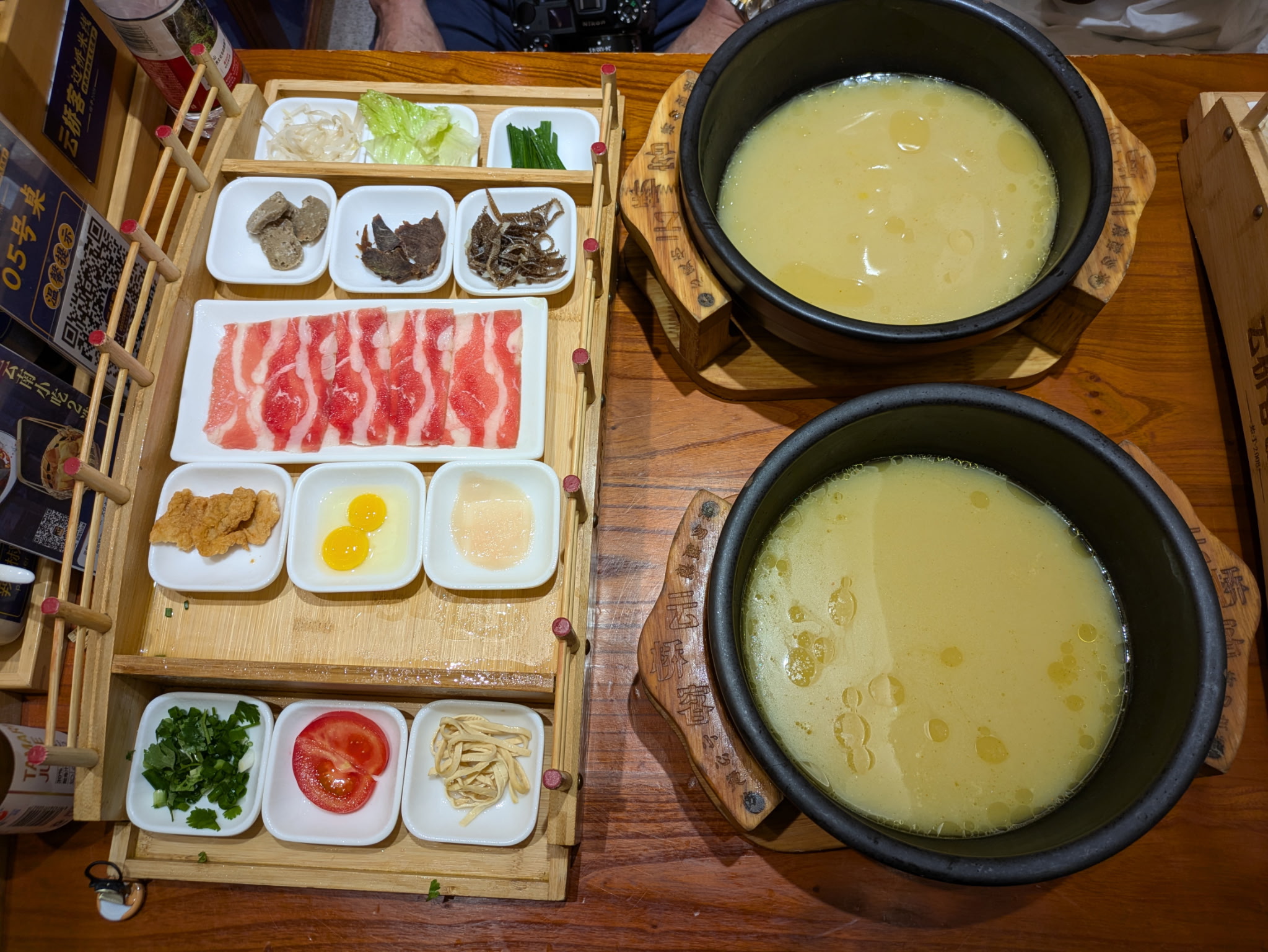
As a kid, I used to go to this rice noodle place with my grandma almost every week. The place was called Yún Nán Guò Qiáo Mǐ Xiàn, a small storefront that opened up into a constantly busy avenue, with a pedestrian overpass that overlooked the passing cars. Guò Qiáo means to cross the bridge; the restaurant name roughly translates to Yunnan over-the-bridge rice noodles.
The story goes that during the Qing dynasty, a dedicated scholar traveled to an island every day to study for his exam. His wife, always preparing meals for him, would carry his lunch across a bridge, a long walk that left the food cold by the time she reached him. To solve the problem, she made rice noodles and left them in a pot full of boiling hot chicken broth, covered with a layer of oil. The dish’s name was thus derived from this ancient Chinese tale, in homage to his wife’s love and intellect.
We frequented the restaurant so often that the restaurant owner, a middle-aged lady with a kind smile and gentle eyes, remembered my name. My grandma would order the traditional chicken rice noodles and I would order the sour beef rice noodles — a sour, slightly spicy soup made from tomatoes and beef broth. We would order sū ròu, a Sichuanese dish made of crispy strips of fried boneless pork, and I would order extra quail eggs, a dozen at a time. I would eat them before the boiling soup cooked them fully, feeling the egg yolks slide around on my tongue.
My father always jokes about how I have the worst memory out of everyone in my family. That is true, as my dad loves hiking and the outdoors; he had taken me to visit countless national parks in America by the time I was a teenager, yet I barely remember the experiences I had traveling with my family. Memories fade and elude our grasps as we age, and they distort every time we try to recall them and understand the past. Yet my memories of the four years I spent in Chengdu as a child, attending a Chinese elementary school, living with my grandparents as if I were a single child, remain uniquely crisp and palpable in my head, and the rice noodle place remains a core memory I have of my early childhood that never quite disappears.
I remember walking to the restaurant from our apartment complex, my tiny hand holding my grandma’s hand. I would wave and smile at the middle-aged lady who always worked as the cashier. She would smile back at me, waving down at my tiny self, asking me about what it was like to grow up in the United States, to go to school in America. My grandpa would often tell me that I ordered way too many quail eggs, that it was too much cholesterol, that it would make me fat. He would try my broth and wince in the way Asian grandpas always do, squinting his eyes and sucking in air, followed by an emphatic sigh — “ai yo” — telling me my soup was way too sour. Like my grandma, he would always order the original broth.
When I returned to the United States to begin fifth grade, I subconsciously searched for the taste I remembered from the rice noodle place. When my family drove an hour to Temple City every weekend for my siblings and I’s music lessons, debate lessons, drawing lessons and ballet lessons, we would often get lunch or dinner at this place called Yún Nán Guò Qiáo Yuán, a place that I was initially excited about because I thought they would have the same sour tomato and beef rice noodles I had back in Chengdu. But instead they had something that was similar enough to raise my hopes, only to silently dismiss them when I realized the taste was not quite the same.
Indeed, they also served rice noodles, and they even had a sour broth, but the sour came from sour cabbage instead of tomatoes. The soup was spicy, but only because of the chili oil that floated on top of the soup, the chili oil that made me cough and have diarrhea the following day. It wasn’t due to the intrinsic spice of the broth itself, a soft, gentle spice that I associated with Chengdu, grandma and childhood. I didn’t ask for an extra dozen quail eggs; I never even bothered to ask, perhaps because I now had siblings and worried they would make fun of me, perhaps because I thought my dad would criticize me and say no.
Last summer, I visited Chengdu. It was the first time I had gone back to China since middle school, when my weekends and holidays became perennially busy and the coronavirus put a pause in the world. I once again walked down the street to visit the rice noodle place I had loved growing up, this time with my entire family, no longer a pseudo single child with only his grandparents. The restaurant was still in the same location, with the same tiny storefront next to a forever busy avenue, a few stores down from the bridge that still overlooked the passing cars and mopeds.
But the inside had changed; instead of the shabby tiny front desk on the left side of the entrance where the middle-aged lady always smiled at me, a digitized machine on the right side of the entrance now demanded that we order and pay before sitting down. A fancy glass exhibit displayed various cooled beverages like coconut milk and beer, along with an assortment of cold dishes like zhū ěr duo and fū qī fèi piàn. The wallpaper was brand new, and the inside layout was also no longer the same: the rows of banquettes and booths that divided the restaurant into thirds were replaced by fancy chairs with blue cushions. Silky curtains draped from the ceiling, dashes of bright pink and green that complemented the ornate sliding screens.
The middle-aged lady was no longer there; a young lady slightly older than me greeted us instead. I wanted to ask her about the middle-aged lady, but I found myself struggling to speak the language I still speak regularly at home, the language that I grew up with, the language that I am no longer able to internalize the way I used to. Sometimes in high school, and now in college, I feel pensive, rueful, even slightly afraid, of the way I think, the way English now dominates my thoughts and internal monologue, the way Chinese is no longer the language with which I converse with myself, no matter how hard I try, no matter how many wǔ xiá novels I read during the summer. The two languages embody nuanced differences in feeling and personality; the same word, the same idea, when expressed in different languages, often carry distinct timbres and flavors. To me, Chinese has always felt more humorous, lighthearted and carefree; my problems were never as serious as they seemed when I vocalized them in Mandarin.
In a sense, my time in Chengdu was the only time I’ve ever been truly happy in life. This isn’t to say at all that I’m depressed or disillusioned about my life right now, or that I was never happy during middle school or high school.
I mean it in the sense that the four years I spent living in Chengdu — the time I spent chasing my friends around in a game of tag, dribbling a basketball on a court that was slippery from the rain, grinding The Glory of Kings with my friends until I had 18,888 coins, just enough to purchase my favorite hero; the time I spent crying and hugging my grandma because I was sad and missed my mom, and she’d call herself my nǎi mā mā; the time I spent in the supermarket with my grandma, begging her to buy me one of these unhealthy grilled sausages dipped in spicy peppers; the time I spent walking across the street with my grandma to buy popsicles for the summer, an entire bag at a time — were the only times in my life when I was truly worriless.
I was truly happy in the sense that I wanted to build rockets and fly my entire family to the Moon, that I didn’t know of stress, only the fleeting pressure of finishing my homework assignments due the next day. I was happy in the sense that I made daily schedules with my grandma, not so that I could go to sleep on time, but so that I would have hours upon hours in the evening reserved for play, for watching television, for riding my bike. I was happy in the sense that I was innocent, worriless, never in my head, never overthinking, always grounded in the moment, always marveling at the world around me.
My grandma used to tell me about fán nǎo — a word that roughly translates to worry. She told me it was something teenagers and adults have, something I would experience when I grew up, something that slips in to your life when you start worrying about college apps and internships, when you start worrying about your health and your family’s health, your friendships and relationships, when you begin to understand risk, stakes, meaning.
And before I moved back to the United States, before I crossed the bridge and became immersed in a lifestyle characteristic of immigrant families that I have grown to cherish, love and appreciate, a lifestyle that I nevertheless do not think pay full homage to the wild, precious thing called childhood, my grandma gave me the space to be a child. She gave me the type of space you don’t find here in Asian immigrant households: the space to order a dozen quail eggs at a time, the space to play a videogame my dad forbade me from playing, the space to babble about a cute girl I said I was going to marry in third grade. She gave me the space to be clingy and childish, the space to buy so many pretty pens and erasers until they no longer fit in my desk, the space to experience a different feeling of childhood than the one I had in the United States.
The truth is, my favorite rice noodles from Yún Nán Guò Qiáo Mǐ Xiàn was probably full of sodium, additives and MSG. It was also not at all authentic to Yunnan cuisine; the broth was never supposed to be sour. But my grandma let me indulge in them anyways, week after week.
Last summer, I visited Chengdu. I once again walked down the street to visit the rice noodle place I had frequented as a child. The restaurant was still in the same location, with the same tiny storefront that opened up to the forever busy avenue, a few stores down from the bridge that still overlooked the passing cars and mopeds. I sat down on a chair with a fancy blue cushion; I ordered the sour beef and tomato broth, with sū ròu and a dozen quail eggs. But when the waitress brought the boiling soup before me, I realized that it was never the dish I was searching for all these years in America. I thought I missed the sour broth and the tomatoes and eggs, I thought I missed the taste, but instead I was reaching for an ephemeral feeling, a déjà vu that is simultaneously nostalgic and pristine, a feeling that is perhaps almost, just almost, there.