
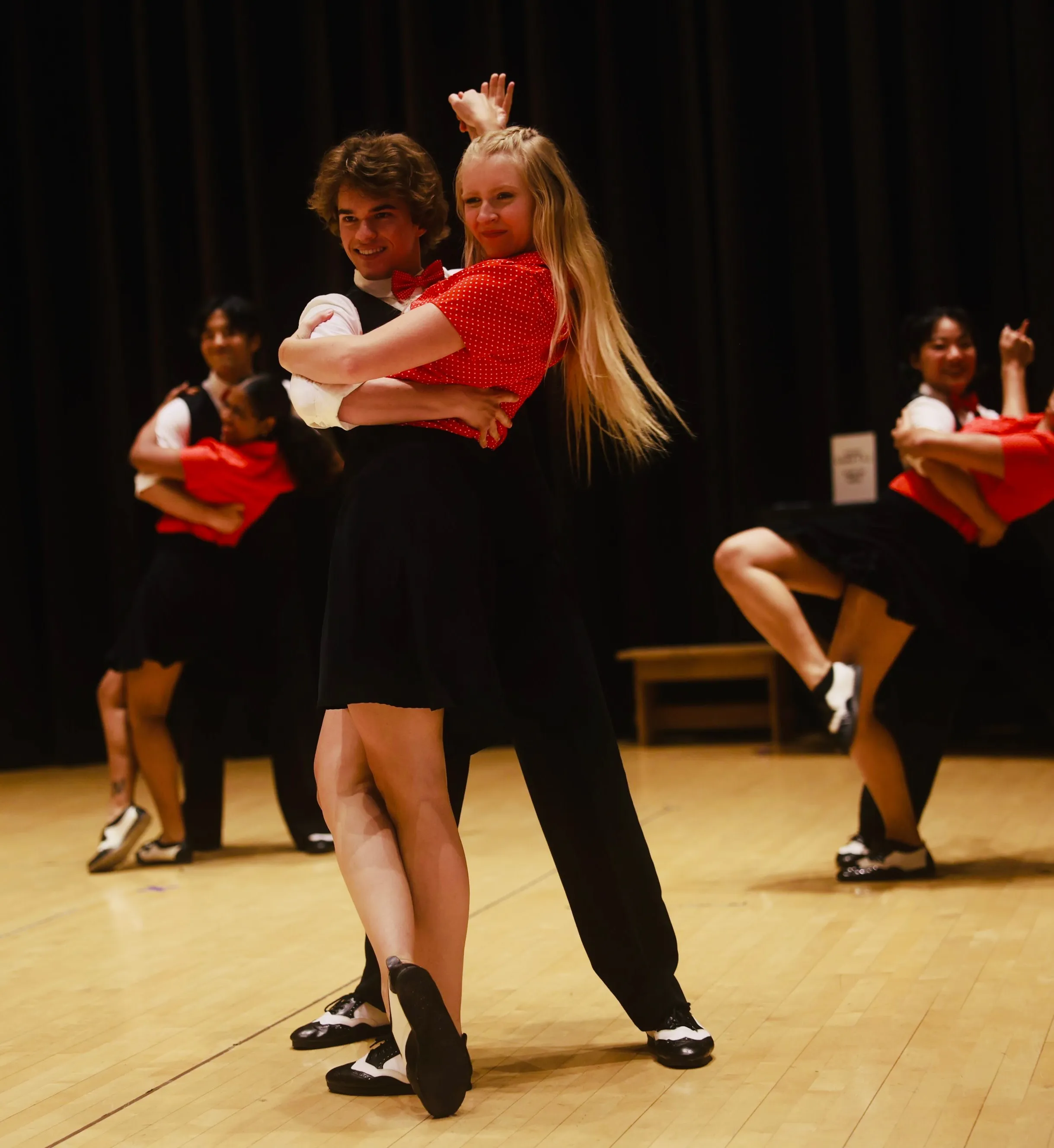
When I was asked to write about my experience with art, I wasn’t sure where to start (rhyme not intended). I’ve never considered myself an artist — I’m majoring in mechanical engineering, and most of my resume involves robotics to some degree — but if art required pedigree or some sort of criteria to be created, it wouldn’t be art in the first place. After all, are my robotic creations not art in their own special way?
Upon arriving on campus in the fall, I auditioned for and then joined Stanford Swingtime, a performance swing dancing team that specializes in Lindy Hop, a type of swing that was invented in Harlem in the 1920s and remains popular to this day. Before joining Swingtime, I had only ever done social dance at Stanford Sierra Camp, and I had little idea what I was signing up for.
Almost three quarters later, my entry into the world of dance has been dizzying amounts of work and even more fun. Learning Lindy Hop has not only been incredibly rewarding as a dance form, but has also introduced me to the wonderful community at Stanford, expounded by a more varied exposure to different dance forms in Social Dance I and II.
While I’m comfortable calling the dancing and prancing I’ve done in the past year “art,” I certainly don’t feel like an artist. While I believe that the purpose of art is self-expression, that it should be practiced as a means to spiritual and emotional fulfillment, there have admittedly been plenty of moments where I felt less-than-fulfilled by my time dancing (whether it be a failed aerial or a sloppy choreography run-through where I knew I could have done better). What’s more, in the beginning of the year, I often worried about my abilities, plagued by Stanford’s famous imposter syndrome; not about whether I was smart enough or hardworking enough, but instead about not being a good enough dancer.
What if I was a burden to my choreo partner because I was too behind? What if people in the audience, for all their lack of training, could execute this lift more easily than I could?
But in pursuit of this art form, I was equally determined to not let these doubts and fears drag me down.
Regardless of talent, the process of learning a skill is never easy, and it’s hard not to get discouraged when all you’re surrounded by is perfection. Whether it be piano or weightlifting or kalimba, I guarantee that someone on this campus is better at it than you are — which, in my opinion, can be a sobering and motivating fact.
This past year, I’ve thrown myself into learning Lindy Hop, to success (many great performances thus far!) and failure (I’ve relearned swingouts five times and I’m still not sure I get them) alike, and am undoubtedly the better for it. I’ve learned so much, gotten significantly better as a dancer and more importantly, made great memories and friendships along the way that I will look back on fondly when I am older.
In this, I’ve found that the process of practicing art here is no different than any other vocation: we come, see something new, practice it until it works and then move on, empowered by our new abilities and the satisfaction of having produced something beautiful along the way. It’s a decidedly fickle view of things, sure, but this year has made me realize that no matter if I’m doing work for a class, an extracurricular or a social gathering, I a) should not be surprised if the tiniest things turn out to require annoying amounts of effort and b) should engage in those activities all the same, for the reward (including the effort expended) is, simply put, worth it.