
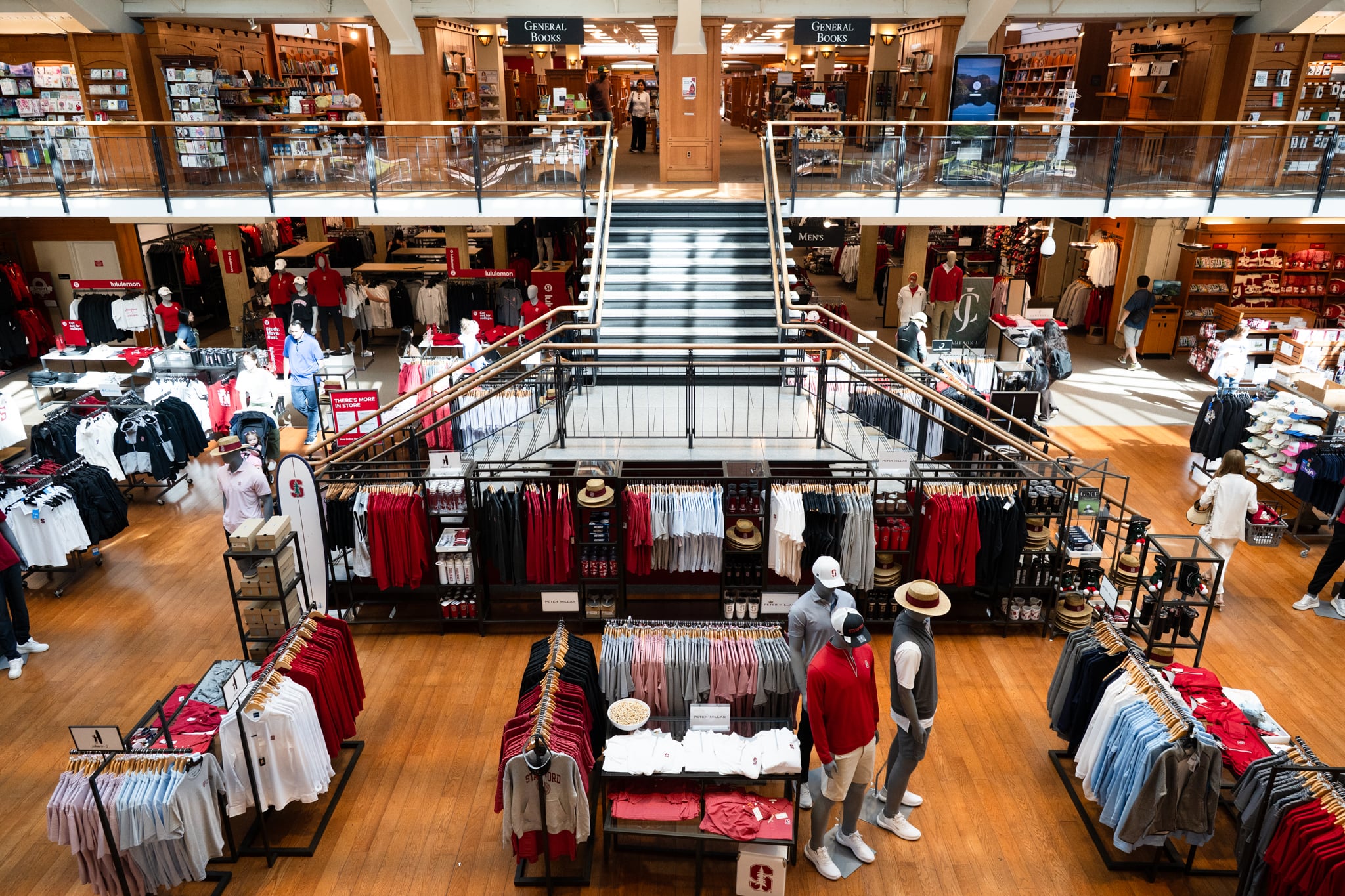
“When you first get to Stanford and when you’re leaving, I think [the bookstore] holds a special place,” Helen Bovi M.A. ’26 said as we stood in the merchandise section. “I remember coming here with my mom after the airline lost my luggage. I was so excited that I was going to have a Stanford t-shirt.” Now that Bovi is graduating, “I’m looking for souvenirs to remember Stanford by.”
Founded by Stanford faculty members in 1960, the Stanford Bookstore has long been a staple of White Plaza and campus life. Initially, the store was designed to hold around 4,000 books. Gradually, it expanded significantly, with entire floors dedicated to general interest titles, all kinds of Stanford merchandise and an extensive textbook rental service, which (as of 2018) had nearly crossed the 100,000-rental threshold.
Operated by Follett Higher Education Group, a large national retailer that runs other university bookstores such as those at New York University and George Washington University, the store has become a core part of campus, with the upstairs cafe and regular author events bringing in people from all over the Stanford community.
“The customers really make it fun,” said Elijah Estolano, who works at the bookstore part-time. “From people touring, to families, to students, you meet people of all different cultures and diversities.”
With the Town Center Project set to break ground in 2027, the bookstore and White Plaza will undergo some of its most significant changes to date. Aiming to provide improved gathering spaces, the new construction project will include both redesigns of existing spaces and the development of new ones. Promised additions include a new commons area, a Stanford Student Barn, a Garden Deck, a trellis and a reconfigured bookstore.
The new layout will transform the bookstore into an open-air, enclosed space. Offerings will be downsized, most notably by moving the store’s merchandise section to another frequently-visited part of campus. Once completed, a more intimate, curated bookstore will be available for socializing, events and classes.
But as I learned when I visited the bookstore, not everyone is excited about the new changes. Bovi, for example, voiced concerns about how construction will make White Plaza inaccessible and cause disruption to Stanford life.
“The project seems completely unnecessary to me — there is plenty of space all over campus to gather and no need at all to alter the bookstore,” Bovi wrote. “I’m unsure as to why Stanford would invest its money in this way and make the area inaccessible for however much time it takes to renovate.”
Mark Thomas Patterson, a Silas Palmer Fellow at the Hoover Institution, shared similar concerns while also expressing intrigue about certain aspects of the project.
“I hope that there is a minimum [level] of disruption to Stanford undergraduates and other members of the community,” he said. “However, I think making it an open air-area, especially given the broader climatic conditions of the South Bay, could be really nice and unique, and something that really gives an extra zing to the campus.”
The anticipated change to a space that has become a second home to workers has sparked mixed feelings among the bookstore’s employees.
“I know people I work with are very sad about it,” said Estolano as we sat looking over White Plaza. “It’s bittersweet: bitter that it won’t be as big, sweet because we’ll all get to hang out at another building, kind of like a third space, that I feel like we all need.”