
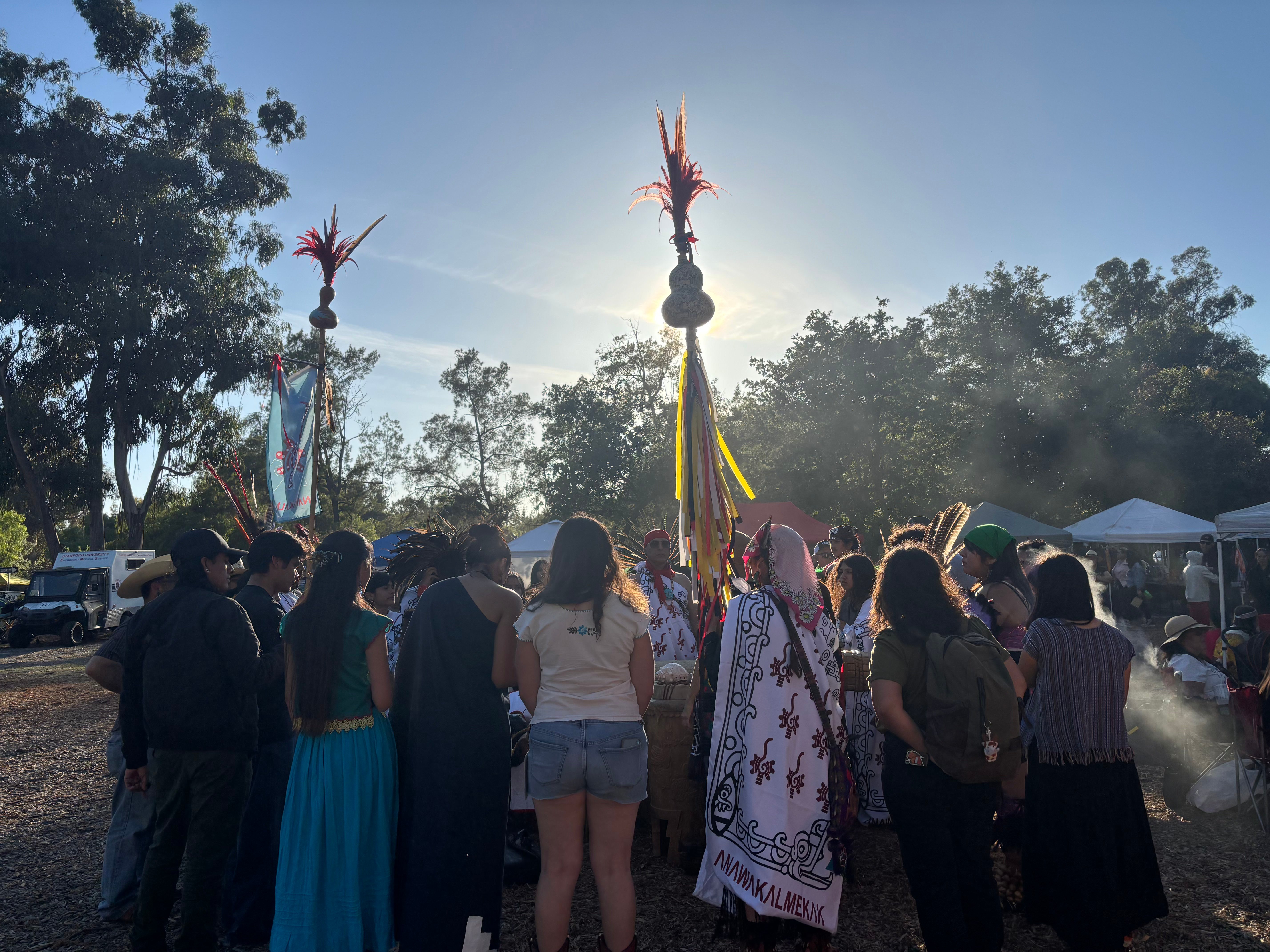
For many, the second weekend of May is associated with Mother’s Day brunches and festivities. For the past 55 years, however, that weekend has brought another celebration to campus: the Stanford Powwow, a multi-day celebration of Native American culture featuring traditional dance and drumming competitions and a variety of vendors.
As the largest student-run powwow in the country, the event draws thousands of attendees, from Stanford students to Native community members who travel cross-country to compete in the weekend’s competitions. “The whole Native community, everyone’s family comes out for Powwow,” said Angela Williams ’27, one of the Powwow’s three co-chairs.
This year’s Powwow, held from Friday, May 8 to Sunday, May 10, brought with it multiple rounds of dance and drumming competitions, a reception for Indigenous alumni and the opportunity for guests to camp in Stanford’s Eucalyptus grove.
Planning for Powwow begins during the second week of fall quarter and is spread across 15 different committees, according to Powwow co-chair Oteskwebeeksaki Shebala ’26. Each committee has two co-heads, and the Powwow’s co-chairs oversee each committee while also working closely with the Native American Cultural Center (NACC), outside partner companies and other funding sources, Shebala explained.
“Everything that goes into Powwow, students have to organize,” said Shebala.
Shebala is no stranger to powwows. “I grew up going to powwows all the time,” she said. “My summers would just be traveling [to powwows], we’d never be home.”
These experiences motivated her to become involved with organizing Powwow as a freshman, and helped her meet Bay Area Native community members who had attended the Stanford Powwow their whole lives and had seen “what worked and what didn’t.”
Their feedback, Shebala said, helped “foster Powwow spirit” this year, bringing back a focus on Native dancers and singers. “Sometimes we get lost in getting the technical side really organized and it’s a lot of work,” said Shebala, “but you want to remember that what Powwow is is a gathering for family and friends to come.”
The Stanford Powwow obtained around $60,000 in donations this year according to Shebala, allowing organizers to award cash prizes to winners of the dance and drumming competitions. These prizes are especially helpful in driving attendance and participation, Shebala said, since much of the powwow scene is in the Midwest and coming out to California can be a barrier for those who would otherwise attend.
Bay Area Native community members helped reconnect powwow organizers with local groups interested in donating to Stanford Powwow, Shebala said, as some of the “generational knowledge” of donation sources had been lost after COVID-19.
For Williams, another of Stanford Powwow’s three co-chairs, it was a special point of pride that the Bay Area Native community “really liked” this year’s Powwow. Being able to raise the prize money to match payouts awarded by the general powwow circuit brought more people and a record number of dancers and drummers, said Williams.
“Honestly, we’re all feeling gas prices, we’re all feeling everything, but to be able to come out to Stanford and drive your family across the country and compete for $1,000 or $800 in your category… I think that really means a lot right now,” Williams said.
The Powwow was also well-received on-campus. “I look forward to the Powwow every year and it seems to only keep getting better,” Caleb Ketchum ’26 wrote to The Daily. Ketchum volunteered for Powwow this year and was previously involved in Powwow planning.
“My family and I love the culturally significant food, goods and events as it celebrates who we are and where we come from,” he wrote. “I also enjoy the Powwow as it grounds the Stanford Native Community and maintains a strong community between all of us.”
Looking into the future, Williams hopes for more collaboration and partnerships, especially on campus. This year, University President Jonathan Levin ’94 ran in the Stanford Powwow’s Annual Fun Run, a 5k run/walk. Next year, she hopes he returns, and hopes that Provost Jenny Martinez and Vice Provost for Student Affairs Michele Rasmussen make appearances as well.
“There’s a lot of moving parts, so I’m always a proponent of more collaboration and partnerships to help support our beautiful gathering,” said Williams, noting that help from Stanford Event Services or other on-campus venues like Frost Amphitheater could prevent details from “slipping through the cracks.”
Also on Williams’ mind is how to better secure Powwow’s funds. “It’s a lot of money, frankly, that we’re handling,” said Williams. Though there are no active efforts to do so, Williams said better securing funds could look like endowing the NACC, noting that the NACC is one of three cultural centers not yet endowed out of the eight cultural centers on campus.
“The Native community in general, we’re just pushing for that institutional support that comes in the form of an endowment,” said Williams, acknowledging that endowments are based on outside donations to a specific group.
“We really do feel [the financial pressure], we need to keep the lights on every year, and it’s just on students to fundraise,” said Williams. “If Stanford wants [Powwow], we need more support in the financial area.”
Reflecting on successes of this year’s Powwow, though, both Shebala and Williams expressed gratitude for both the on-campus and larger Bay Area Native community. “There’s been so many hours put into [Powwow],” said Shebala. “People just really come together and help out, and it’s very great to see how much community we have.”