
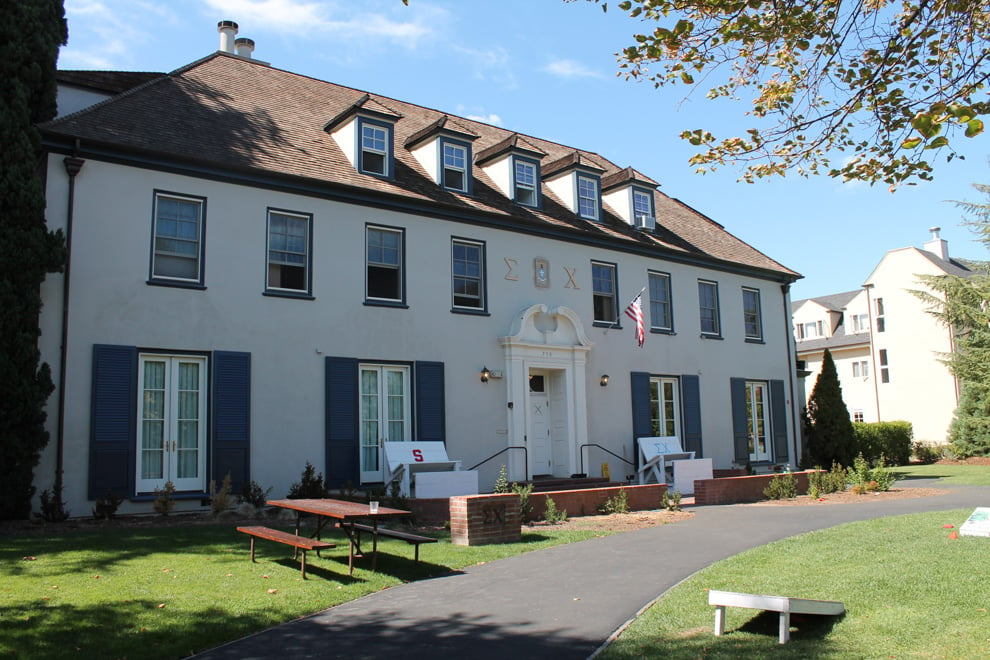
More than 60 years ago, Stanford Sigma Chi alumni broke an unspoken racial rule. Today, the chapter’s alumni are urging Stanford for historic recognition of their former house, citing their 1965 campaign for fraternity integration.
In April 1965, Stanford Sigma Chi offered a bid to Kenneth Washington ’68, a Black student. The national fraternity had never had a Black member, and the Stanford chapter was soon suspended from the national organization. While not explicitly stated, alumni noted that the suspension seemed to be in response to having a Black member. The decision, which came on the heels of the 1964 Civil Rights Act, generated a whirlwind of advocacy and national attention.
According to their campaign, the incident was the first major national test case involving de facto discrimination in a national fraternity.
According to Robert Ottilie ’77, Sigma Chi had ended its “whites-only provision” but introduced a provision called “social acceptability.
“We had to submit a photo of every student we gave a bid to. That’s how the national [organization] knew that this student was African American,” he said to The Daily. Ottilie is also the chair of the Alpha Omega Housing Corporation (AOHC), a Stanford alumni group formed in 1937 that manages the Sigma Chi fraternity chapter house located at 550 Lasuen Mall.
Sigma Chi alum Kent Hinckley ’65 remembers Washington fondly, noting his campus activism.
“We all liked Keni. He was a leader. He wasn’t a radical. I personally thanked him for protesting against Vietnam, and the [University] administration praised him for how reasonable he was,” Hinckley said to The Daily.
The chapter refused to revoke Washington’s bid, bringing the fight to the halls of Congress. Stanford Sigma Chi was supported by then University President J.E. Wallace Sterling Ph.D. ’38 and Stanford Sigma Chi alum Senator Lee Metcalf ’36. Near the end of April 1965, Stanford sent a letter to more than 130 educational institutions warning of the link between fraternity behavior and loss of federal aid over violations of the 1964 Civil Rights Act.
Metcalf pushed for a federal ruling on whether discrimination by fraternities violated the Civil Rights Act. In response, U.S. Commissioner of Education Frances Keppel said that “colleges that receive federal funds are legally bound to prevent discrimination in fraternities.”
In June 1965, the national Sigma Chi fraternity voted to continue the suspension of the Stanford chapter. It insisted that the suspension was caused by the chapter’s disregard for national regulations, not for pledging a Black student.
In early 1966, the Stanford chapter voted to leave the national fraternity. Stanford Sigma Chi was reinstated to the national organization in 1974, but only after Washington was removed from the organization after his grades had dropped to a level that prevented him from maintaining his membership.
“A few of us went back to the national Sigma Chi convention. We tried to make the point of the fact that this was not only morally wrong, but legally wrong, but we found a lot of deaf ears,” said Sigma Chi alum Pat Forster ’65.
Today, Sigma Chi alumni argue that their advocacy deserves historical recognition from Stanford. In August 2023, the California State Historic Resources Commission voted unanimously to forward the property’s national register nomination to the federal government, despite opposition from Stanford.
For 550 Lasuen Mall to be publicly listed on the National Register of Historic Places, Stanford would need to provide its consent. Alumni seek this recognition and advocate for the reinstatement of a plaque the University had installed in October 2022 to recognize the chapter’s civil rights actions. The plaque was removed in August 2023, soon after the AOHC ground lease on 550 Lasuen Mall ended.
Sigma Chi alums have not been in contact with the current University leadership, but are hopeful that University President Jonathan Levin ’94 and his administration will be sympathetic to their argument.
“They haven’t focused on this [issue] yet, but to the extent that they were amenable to putting the chapter back in the house, I think it’s a good sign,” Martin said.
While Stanford acknowledged that Sigma Chi’s actions in 1965 were “praiseworthy,” it “was not sufficiently groundbreaking either nationally or at Stanford to warrant a historic designation.”
The University noted that other Stanford fraternities had pledged members of previously excluded groups as early as 1947. However, Sigma Chi alumni push back on this narrative.
“It wasn’t that we were the first to try to admit a Black student. It’s that our principled stand resulted in a rule that you couldn’t discriminate or you would lose federal funding,” said John Martin ’80, AOHC board member and a former Sigma Chi president.
This isn’t the first time that Sigma Chi alumni have come into contention with the University administration. In August 2025, the AOHC filed a complaint against the University in Santa Clara County’s Superior Court. The suit alleges that Stanford’s Board of Trustees breached the University’s founding grant in terminating Sigma Chi’s lease of 550 Lasuen Mall, seeking more than $35 million in damages. However, Martin and Forster said that the lawsuit is unrelated to their pursuit of historical recognition.
“The Keni Washington story wasn’t what we thought it was. It wasn’t a Sigma Chi story or an Alpha Omega chapter story. This was a Stanford University story,” Ottilie said.