
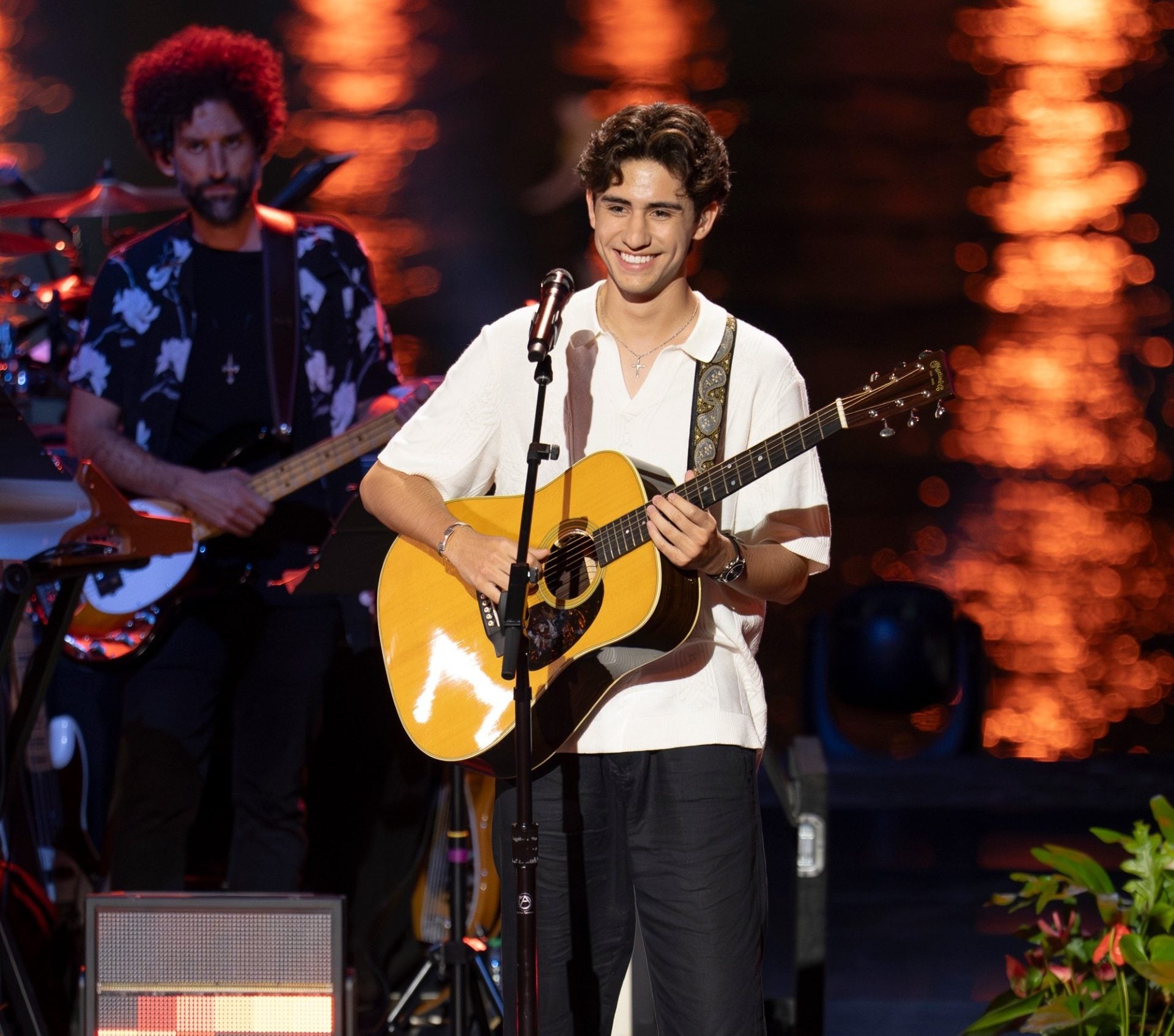
Julián Kalel Almanzán ’29 has spent the past few months flying between Nashville, Los Angeles and Palo Alto — recording original songs in professional studios and performing for millions on live television. For most Stanford frosh, adjusting to college is challenging enough. But Julián Kalel is doing it all while also building a national music career and championing mental health advocacy on one of America’s biggest stages.
“It’s been crazy,” Julián told The Daily, reflecting on the whirlwind of competing on Season 24 of “American Idol” from February to April. Taking a leave of absence during winter and spring quarters, he advanced to the top 14 before being eliminated from the competition.
But for the 19-year-old singer-songwriter — who performs under the artist name Julián Kalel, or Julián — the chaos has been worth it, with his platform allowing him to share a message larger than himself.
As a natural introvert, Julián didn’t initially plan to audition for “American Idol” this year. He had tried out for Season 23 but chose not to move forward after receiving his “golden ticket” — the show’s invitation to the next round. At the time, Julián wasn’t in the right headspace. “I was struggling with my mental health,” he said. “I wasn’t where I wanted to be.”
But a year later, something shifted. Julián realized his story could inspire others facing similar battles.
“I want to prove [that] one, it’s okay not to be okay,” Julián said. “And two, that I belong, despite struggling with anxiety and depression, and that [for] anyone with it, it shouldn’t limit them, it shouldn’t define them, and it shouldn’t hold them back from anything they want to do, especially when it comes to pursuing their dreams.”
This time, when he stood before the judges and received three “yeses,” Julián was ready. He knew he’d regret it if he didn’t give the competition one more shot.
“Thank God I did,” Julián said, “because I wouldn’t be here today.”
Even after elimination, Julián returned to Los Angeles for the “American Idol” Season 24 grand finale on May 11, where he performed live once again and released a new single titled “Heartstrings” the same day.
A meaningful moment in Julián’s “American Idol” journey came during the show’s “Ohana Round,” which emphasized family. In a performance with his sister Karyssa, Julián got the chance to “dedicate a song that I wrote from a conversation with my dad, to him in the crowd, which was just amazing,” he said.
Julián added that his parents have been his “rock” throughout. “I love making them proud,” he said. “I love performing for them. That’s what keeps me going the most. Even when I wanted to give up, they were the ones who told me, ‘You can’t, you gotta keep going.’”
Julián’s original songs “Surrender” and “Lone Guitar” gained significant national traction during his time on the show. The latter became an anthem for mental health awareness after he performed it on “American Idol.” In 2025, he partnered with the National Alliance on Mental Illness to center suicide prevention efforts around the song’s release, amplifying conversations about mental wellness.
For Julián, music isn’t just performance. It’s also a vessel for healing.
“I’m not some expert on this stuff,” he said. “I’m just sharing my survival guide, essentially.”
His catalog, which has amassed over one million streams, continues to evolve. And his impact extends far beyond streaming numbers. Fans regularly message him to share how his vulnerability has helped them through their darkest moments, he said.
“I can’t even begin to emphasize how much that warms my heart and gives me the confidence to be on a stage on live television in front of millions,” Julián said.
When Julián performs — whether it’s on national television or at intimate venues — he has a clear intention: he wants people to see him as human.
“I’m not on this pedestal,” Julián said. “I’m not some hero… I struggle, and I hurt, like anyone else. I’m just trying to be more honest about it because that’s what I think the world needs right now.”
Through the pressures of both Stanford and “American Idol,” songwriting has kept him grounded.
“No matter where I am, no matter if I’m away from the people that ground me, I have my music. I have my own voice that I can put onto paper,” Julián said.
His songwriting process begins the same way every time: with radical honesty. Julián described it as having “conversations with my own heart” — an attempt to understand why he feels a certain way. That writing turns into lyrics, and lyrics turn into songs.
Julián is excited to return to campus in the fall, and hopes to “just be out of my room more and kind of embrace Stanford as a community,” he said. He’s already grateful for the support system he found on campus before he took his leave of absence, including his Arroyo residential staff, academic advisor Cari Costanzo, Andrea Paz from the admissions office and his bandmates from a group they call “leband” — Dexter Cleveringa ’29, Carson Packard ’29, Matthew Yu ’29 and Jake Lee ’29.
Arroyo residents gathered weekly to follow Julián’s progress on “American Idol.”
“It was so much fun seeing [Julián] on that musical journey week after week, and to have a tangible way to support him through the voting system,” wrote Jill Patton, Arroyo’s residential fellow. “Every week his songs would be stuck in my head for days. How lucky we are to know such a talented artist, who’s also such a warm and inspiring person.”
His bandmates described that same passion and work ethic behind the scenes. “Julián is really dedicated to music, and he’s a true workhorse,” Cleveringa wrote to The Daily. “He’s always willing to sing and play. He’s such a strong songwriter too. I don’t know how he does it, he’s amazing.”
Since his time on “American Idol,” Julián hasn’t slowed down. He’s been recording and performing music with Jake Thistle, a close friend and fellow contestant from the show. He is also slated to perform at CMA Fest and the Franklin Summer Bash later this year.
For students or young artists hoping to pursue music seriously, Julián Kalel’s advice is both simple and profound: be yourself.
“We live in a world where it’s really hard to do that,” Julián said. “But if you stick to that, and you stick to yourself, you stick to who you are, you will find that community. Those people who are looking for you will find you, and that’s all I did.”
Julián’s advice echoes through his own story — a boy from El Paso who struggled with anxiety and depression, who almost gave up on his dreams but found the courage to try again.
“I’ve struggled with being myself. I struggled with caring about what other people think, like anyone else, and I would say ‘Idol’ was like a huge rocket ship to get me out of that.”