
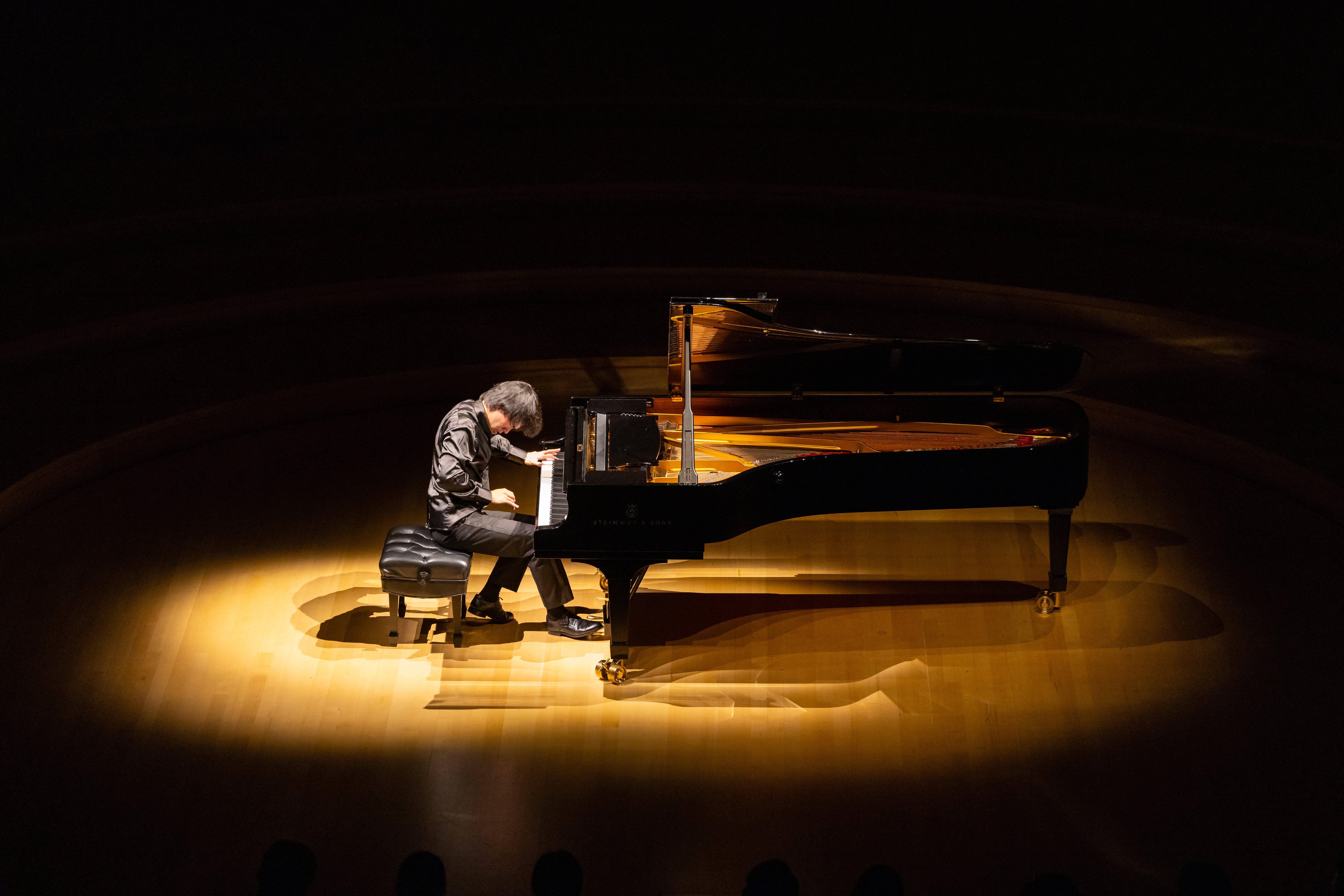
While I never played piano competitively like some of my peers, it’s been a part of my life for as long as I can remember. For thirty minutes a day, I would sit down at a piano and play — or attempt to play — music by the great composers of the Western classical tradition. I also dedicated a significant portion of time to learning music theory, as part of California’s Certificate of Merit curriculum.
But in retrospect, my relationship with classical music was quite ironic: I enjoyed playing it, but I had no interest in listening to it. Although my piano teacher encouraged me to listen to classical music in my free time, my Spotify playlists were ultimately filled with Willie Nelson and Howard Jones, not Beethoven or Mozart. I was like an actor who didn’t watch films, or a baker who didn’t eat bread.
During the first week of my freshman year, I decided on a whim to audition for Stanford’s Chamber Music Program. Only upon walking into the audition room did I realize I’d be playing in front of Stanford’s ensemble-in-residence, the acclaimed St. Lawrence String Quartet. Although I walked out feeling very inadequate about my abilities, by some miracle, I was accepted into the program. Over the next two years, mentored by my chamber music teacher Kumaran Arul, I had the privilege of playing some incredibly beautiful works by Rachmaninoff, Grieg and others.
More importantly, though, instead of leaving the music behind at the piano, I would listen to recordings of the pieces while I studied, biked, vacuumed, fell asleep — basically anywhere and anytime I could. Before long, I was listening not only to music I was currently playing, but also to music I wanted to play, music I would never be able to play and music I had never heard of before.
As a musician, I am arguably past my technical prime, yet classical music has increasingly come to dominate my musical taste. What my journey through the world of classical music seems to suggest is that firstly, technical skill may not always lead to enjoyment, and secondly, enjoyment may not always necessitate technical skill.
I may very well be an outlier. There are straightforward reasons why being technically skilled might lead to greater enjoyment. A musician needs to meticulously study the pieces they play, which tends to uncover layers of emotions that were not immediately apparent.
Furthermore, understanding the theory behind how something works allows one to better comprehend what others might take for granted. An architect who understands the principles of design most likely perceives and values the intricacies of a building more than the tenants inhabiting it.
My point here is not to argue against the value of music education. If you have the time and energy to invest in one, you will not regret it. Nevertheless, I stand firmly and unconditionally behind the second point: enjoyment does not always necessitate technical skill or knowledge, and as a result, the barrier to becoming a classical music fan is much lower than you think.
Interestingly, biology dictates why technical skill is not necessary to understand music. To appreciate a Steinbeck novel, one needs to know how to read. But the same is not true for music. Despite having dubious value in the context of evolution, the ability to understand and appreciate music is something almost all of us are born with. This is why music is found in every society across the world, and why we sing lullabies to babies to calm them down.
While elements of nurture might influence what type of music an individual tends to prefer, I would argue that these preferences have more to do with cognitive bias than a genuine inclination toward one style of music or another. Our musical tastes are oftentimes defined more by what we believe we enjoy listening to than what we objectively enjoy.
For example, in 1987, Paul Simon released his seventh solo album, Graceland, which prominently featured South African musical styles. South African music was largely unfamiliar to average Americans, and if you asked them what they thought about it, they would probably say, “not my cup of tea.” These same styles, when attached to Paul Simon’s songwriting and name, became a bestselling, era-defining album. While the success of Graceland raises interesting questions about cultural appropriation, it is nevertheless a wonderful reminder that our musical preferences are not inherently fixed.
What do you feel when you listen to the Star Wars soundtrack? Do you hear the impending doom of Darth Vader in the “Imperial March”? The yearning of the “Force Theme” as Luke Skywalker watches the sunset of Tatooine? Believe it or not, if you understand the Star Wars soundtrack, there is no reason you can’t comprehend the heroic symphonies of Ludwig van Beethoven.
In fact, I encourage you to listen to the first movement of Beethoven’s Third Symphony while reading the remainder of this article. Do you hear the hero’s optimism in the opening lines? The intense struggle building in the middle? And the triumphant victory at the end? You may have never picked up an instrument in your life, but you will likely have felt the same visceral emotions as a musicologist who has spent their entire career studying Beethoven’s life, or a professional musician who has practiced and performed the piece a thousand times.
In addition to the perceived technical barrier, I frequently hear people characterize classical music as exclusive to the upper echelons of society. While this may have been true centuries ago, the genre has become exponentially more accessible in the era of recorded music. The cost of watching classical music live has also decreased substantially. Tickets for most concerts, at least in the Bay Area, are absurdly low with a student discount. If Beethoven were alive today, he would be ecstatic knowing that any person of any class, race, or creed with access to YouTube could listen to his works for free, or that a student could see his symphonies live at Bing Concert Hall for the flat rate of $15 — which, by the way, falls under the price of getting lunch in the Bay Area.
Although anyone can be a fan of classical music, it does not come without effort. Enjoying it requires your patience, dedication and a lengthy attention span. There are a few things that made this process easier for me:
- First, trust the experts. Classical music is sometimes overwhelming to interpret from the bottom up. Musicologists spend their entire lives studying these composers, and I usually take advantage of their expertise to better understand what the composer was thinking when composing a work.
- Next, start with the heroic works. I have found that the most approachable classical works tend to be of the “heroic” style — grand, epic works that tell the story of an individual prevailing over struggle. Beethoven’s Eroica Symphony and the Emperor Concerto are the most prototypical examples, but the style also influenced many works after his time, such as Dvorak’s New World Symphony and Holst’s The Planets.
- And finally, watch it live. Across the twenty-some concerts I’ve attended since freshman year, I have discovered some of my favorite works live. For example, I had never heard of Bach’s Keyboard Concerto in D minor before watching the pianist Stephen Prutsman play it at Bing Concert Hall. It is now one of my favorite works for the piano.
The effort you put in will be beyond worth it. Before college, I primarily listened to artists from the 1970s and 1980s who were no longer producing new material. In the back of my head, I always worried there might come a time when I would have seen it all, and no song would be novel for me anymore. I don’t worry about that anymore. In the world of classical music, there is always something new to discover, something overlooked. There are certainly not enough hours on Earth to fully appreciate it all, and I find comfort in the fact that I will never find myself perpetually bored.