
“What Makes Us Human?” is a biweekly column in which Emi Sakamoto ’28 investigates the interdisciplinary criteria whereby we might better respond to this metaphysically contested question. Amid our rapidly evolving technological landscape, it is incumbent upon us to do so.
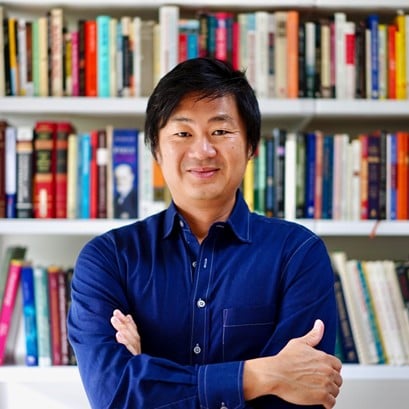
“Our roughly 3 pound brain has as many neurons as there are stars in our galaxy. That’s around 100 billion,” said Octavio Choi ’92, professor of neuropsychiatry at Stanford Medical School. This marvelously mundane fact doesn’t even begin to deconstruct the perennial ‘black box’ which has long predated machine learning algorithms: the human brain.
“Have you ever read ‘The Man Who Mistook His Wife for a Hat’?” Choi asked. Puzzled, I shook my head. This book, Choi explained, inaugurated his interest in investigating the human brain. In the book, neurologist Oliver Sacks chronicles vignettes about patients who suffer with compromised brains; as the title suggests, one involved a patient who quite literally mistook his wife for a hat due to a neurological condition: visual agnosia.
“Vision is processed from very simple to higher and higher elements. It starts with angles, colors, and lines then gets abstracted to features like noses and eyes,” Choi explained, sensing my confusion. “If you lose that part of your brain, you can still see angles and colors and lines, but you can’t put it all together to recognize who it is.”
Choi’s burgeoning curiosity for understanding the brain led him to complete his undergraduate degree in symbolic systems, with a self-designed neuroscience concentration at Stanford. Choi then completed an M.D., Ph.D. at UC San Diego. But his path, like neuronal pathways, was entangled and often shrouded in a myelin of uncertainty.
“I spent several years trying different things, wandering, being baffled, and not being sure,” Choi revealed. “But that’s an emotion we have to learn to deal with. And we have to be comfortable with that because actually most of life is like that.” This notion of being baffled reminded me of the Oblivion as captured by Pressly.
Choi explained that this sense of disorientation coincides with the brain’s maturation process: the pruning of synaptic connections. The process of forming connections between neurons is rapid until around age two, where we begin to lose these connections. This is a good thing: it allows for more efficiency in our everyday lives by allowing us to bypass unnecessary cognitive burdens. (Imagine if you had to think critically about tying your shoes or brushing your teeth in the morning.) The pruning of our synaptic connections is compatible with our capacious ability to learn and continuously develop new ones—well into our old age. This is a marked shift in our understanding of our brain, as neuroscientists previously believed that our ability to acquire new neural connections halted in our developmental years.
It wasn’t until Choi listened to a NPR episode about the criminal brain when he discovered that he could use his neuroexpertise in court through forensic psychiatry. As a neuroexpert, he is critical to informing the adjudication of culpability for justice-involved individuals with compromised brains caused by neurodevelopmental and neurocognitive conditions.
Moreover, working at Oregon State Hospital for six years, Choi was a first hand witness to those with psychiatric illness and brain trauma. “These people have sustained a lot of physical abuse and assault,” Choi remarked. “The more you know, the more you understand and see that it wasn’t so much what they did as much as it was what was done to them. Of course we have personal responsibility, but it’s not about zero or one.”
Our discussion on culpability naturally segued into the timeless philosophical question of moral responsibility and free will. Are we governed by free will, or are we bound to deterministic laws of the universe? Are these theories compatible or incompatible? I was curious about his perspectives—especially in relation to its most pressing case study: our carceral nation. “It’s hard for me to believe we do not have free will,” Choi responded. “My answer gets to your question about what it is to be human. There are two ways to look at this: what makes humans different from animals and what makes humans different from AI.”
“What makes humans different from animals is that we, as humans, can understand each other. An ant has little free will. It’s like a circuit. If you give it food it turns toward the food. If you shock it, it goes away from the shock. It’s just this machine that is stimulus-bound,” Choi reasoned. “But humans have these huge brains which allow us to self-reflect. And that self-reflection contains the kernel of choice in it.”
He then mapped out the brain in order to explain this distinction between stimulus-bound and self-reflective capabilities. “Inside our frontal lobe cortex are these massive data cloud servers that we have at our disposal to compute complex things like imagination. Because we can model the world, we can imagine counterfactuals, and changing reality in our heads allows us to understand how the world works. Without imagination there is no choice, it’s just stimulus and response. Even the best monkeys don’t have imagination. They are smart, but they can’t imagine conversations with their mates.”
Choi explained why this came to be. “When you look at the tribe size of humans versus monkeys ours is a lot bigger: 150. Robert Dunbar, an evolutionary biologist, discovered that the bigger the brain, the bigger the group size; the bigger the group size, the more advantageous because, for instance, you can protect your fig tree or attack another tribe’s fig tree,” Choi chuckled. “Dunbar’s theory of the brain is part of what drove that massive expansion of the frontal lobe, packing in machinery to understand models of other people to live harmoniously. Social awareness lowers the friction and allows us to be social.”
But this mental modeling is hardly innocuous or sterile as a survival tactic. Our mental modeling can also be harness in service to both compassionate and nefarious purposes. One application of our empathic brains is to utilize what Choi referred to as social glue. “I was really interested in fMRI based lie detection. It turns out that amongst all primates, humans lie the most. And the reason we can lie so well is because we have a model of another person in our head,” Choi explained. “When you look at primates at the level of deception they deceive at two orders of magnitude lower than humans. Humans, we can be very elaborate in our ability to lie and deceive is a direct outcome of our big brains which develop so we can live in social groups.”
I chuckled and asked Choi if this was his final answer: what it means to be human is our propensity towards deception. “Well, the ability to imagine the other person and what they are about might tell us something about the question,” Choi responded. He mapped out the very empathy which had been the undercurrent of our conversation on dissecting the internal minds of others. Neuroscientists have only recently traced empathic traits to the ventromedial pre-frontal cortex (vmPFC). “The vmPFC is a part of our empathy machinery. It allows us to wirelessly experience, not just intelligently understand, other’s emotions—like emotional wifi,” Choi explained. “Empathy is social glue. It allows us to feel what others are feeling, sympathize with them, allowing for social formation and working harmoniously in groups. And this is key to being human.”
The distinction between humans and animals segued well into the second part of his response which provided a distinction between humans and AI. “That’s what AI doesn’t have: feelings. It can summarize things quite well, but it doesn’t have feelings, drives. It doesn’t want to do anything, you are just poking and it responds, but it has no desire. When it gets up in the morning, there is nothing that motivates or drives it. That’s different from humans. We are full of drives and emotions and motivations… We don’t just wait around and wait for someone to prompt us with a query.”
Beyond our primal instincts and curiosities, we also have the capacity to harness the power of the collective. “LLMs cannot collaborate together in a way that humans can. Which is a really distinctive advantage. Not only are our brains the third fastest supercomputer in the world, but we can network our brains with each other. In terms of our processing power our brain is about 1 exabyte,” Choi said. “Not only do we have this supercomputer but we interface really well. Like we can work in groups of five, and our brains will be way more than five times brain output. So our ability to work together is based on empathy. That’s a distinctive advantage. AIs have no collaborative instincts or drives.”
In the spirit of our conversation, Choi ended with a reassuringly sanguine remark. “We are all worried about what AI is going to do, but I’m personally not too worried. I think AIs are very jagged intelligence, and we are going to adapt. We have adapted before and we are going to adapt again,” Choi contended. “After all, the core function of the brain is to change. Neuroscientists call that neuroplasticity: to rewire and to change. It is the core function of the brain, and it is why humans have adapted to every microclimate in the world. From living in caves to factory settings to now and into the future, the reason why humans are so incredibly adaptable is because our brains are so malleable. Humans are not going to be wiped out. There are seven billion of us, and we can all work collaboratively when we want to: that is more than any AI can do.”
Perhaps this is our collective enterprise.