
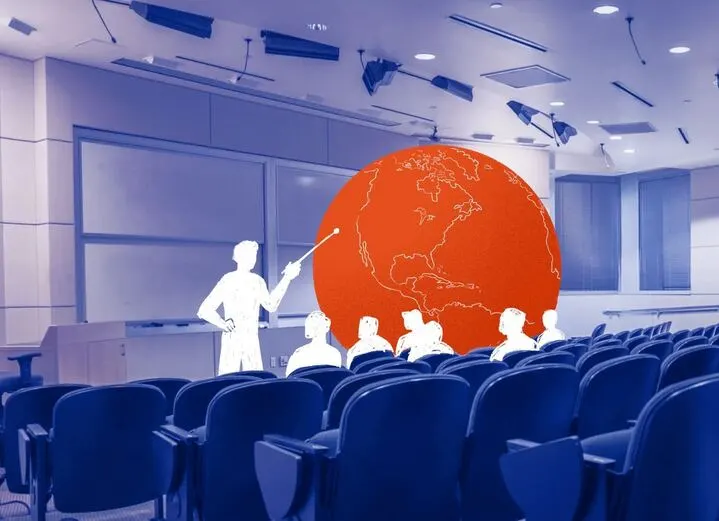
Once a week during winter quarter, six men and six women Stanford students gather in Escondido Village Graduate Residence (EVGR) to debate topics ranging from money to power and the tenets of a good life. The informal course is not publicized, has no enrollment code and can only be joined with a referral from a former student. What does draw attention to the class—both positive and negative — is its name: “Rule,” shorthand for “So You Think You Can Rule the World?”
When the class’s instructor Justin Lewis-Weber ’20 was a student, he arrived on campus with the expectation of meeting high-achieving intellectuals and engaging in vivacious conversation. But he found his experience lacking.
“What always seemed interesting to me was this idea that there are thousands of people at Stanford. I’m probably missing so many of the amazing people that are around,” Lewis-Weber said.
According to Estella Zhou ’26, a former student of the class, Rule was Lewis-Weber’s attempt to bring together “like-minded folks who dared to dream bigger together.”
Lewis-Weber began “Rule” in his junior year at Stanford seeking to change this perceived deficiency. The product is a class of students whom he personally selects, based on his assessment of their projected impact on the world.
“It’s filled with people who have very ambitious views of what they want the world to look like and don’t want to climb existing ladders to wait their turn,” said Zhou, who took the class in her junior year.
Students gain access to an expansive network of powerful alumni and students that Lewis-Weber has curated. Former students, who include Phoebe Gates ’24, often go into business with one another after taking the course together or being introduced through Lewis-Weber. According to one student, Gates conducts internal recruiting for her company Phia through the class.
Students who spoke to The Daily said that during the interview process, Lewis-Weber highlighted the billions of dollars in net worth that alumni have accumulated. When asked for an exact number, he said, “I don’t keep track of everyone so I honestly don’t know.”
To Alex — the pseudonym of a former student who requested anonymity to speak candidly — the class focuses on leveraging the systems of power that make the world turn. The goal, she said, is to teach students “how to essentially hack any kind of power structure or bureaucratic structure and get what they want in a system of people.”
“There’s sort of a cult of personality around this guy,” she added.
The class has also garnered attention recently for inspiring the title of “How to Rule the World,” a memoir by Theo Baker ’26 published on May 19. Baker, who interviewed for Rule but ultimately was not accepted, describes Lewis-Weber as “an egomaniacal CEO” in the book.
Some students see the class as Lewis-Weber’s way of giving back and providing students access to powerful figures who understand how the world works and leveraging their insight. For others, the class is Lewis-Weber’s way of formulating a secret society, emulating those in the Ivy League.
Taylor is the pseudonym of a student who interviewed for the class in her sophomore year, has several friends who took the class and requested anonymity to speak candidly. She said that Lewis-Weber represents “the cynical parts of Silicon Valley,” describing him as “power hungry, intellectual, but really focused on profit and power instead of doing good.”
For her, Lewis-Weber uses the class to “latch on” to people who are set up for success, attracting the “LinkedIn grinders” and students with some degree of success already, in order for him to make a “ton of money.”
***
Growing up in Southern California, Lewis-Weber was interested in space exploration from a young age. At six, he built and flew his first helicopter. At 12, he started an aerial imaging company, one of the first in the world. At 17, he published a peer-reviewed article proposing that solar panels be installed on the moon using lunar materials as an alternative to fossil fuels.
At Stanford, he majored in aeronautics and astronautics and was a part of several labs, including the Stanford Intelligent Systems Laboratory (SISL) and the Stanford Propulsion & Space Exploration Laboratory (SPaSE). According to his students, he is also a proponent of exploring and going to Mars.
Before starting Assured, an automated insurance claims company co-founded with other Stanford alumni in 2019, he was the CEO of a startup working on powered air flight and solving its energy paradigm. Outside of academics and work, he is also a certified sommelier and a deep-sea scuba diver.
Even after graduating and starting his own company, Lewis-Weber continues to teach “Rule,” often flying back and forth between New York and San Francisco.
The class operates somewhat underground. To be accepted, interviewees are asked to recommend their most accomplished male and female peers for an interview. Their choice of recommendations are also factored into their own evaluation.
Some students said the secretiveness of the class was not by design but a byproduct of its structure as a small, tight-knit course. When asked about the discreet nature of the course, Lewis-Weber said, “That’s news to me.”
Yet there exists an expectation of confidentiality that he and students share, encouraged not to disclose their involvement and even their referral to those outside of the class. Several students were unwilling or hesitant to speak to The Daily.
To Zhou’s knowledge, secrecy was not an explicit intention of the course, but arose more naturally. “Obviously, the more you shout things from the rooftops, the more scrutiny that you invite,” she said, “And I think keeping things peaceful is nice.”
For many, the interview process — which can begin as early as spring the year before and conclude by the fall — was the most memorable aspect of “Rule.”
“I remember leaving the interview and just spending that night questioning most of my beliefs,” said Dhruv Sumathi B.S. ’23 M.S. ’25. He was later accepted into the class and remains in regular contact with Lewis-Weber.
Interviews in the past year have taken place at Coupa Cafes across Palo Alto. There, Lewis-Weber will dig deep into interviewees’ worldview and purpose, asking questions such as, “You’re 80 years old looking back on life, what would have made it worthwhile?”, “What do you believe in?” and “What gets you out of bed?” according to several students.
The process has garnered a reputation for being demanding, with one student having left the interview in tears. Lewis-Weber tends to reply to every statement with “why,” and Alex described him as “interrogative” and creating an interview that was “pretty jarring.”
However, others enjoyed the conversation, including former student John Bailey ’24, who called the interview “refreshing,” breaking the mold of typical conversations at Stanford.
“A lot of conversations around what to do at Stanford cannot be couched in this very abstract sort of language,” Bailey said. “The most distinct feeling I had from [the interview] was this feeling of, ‘Wow, people here believe deeply that they can change the world.’”
Madison Ueland ’23 M.S. ’24, another former student, echoed this sentiment, saying the interview was an “awakening experience.”
By the end of the interview process, Lewis-Weber establishes a network of potential candidates. He then whittles that number down to 12. The class begins meeting in the winter.
***
Over the 10 weeks of the course, students learn about what Lewis-Weber calls “the underlying incentive structures and frameworks that govern how the world works.” According to students, the class begins with a short presentation from Lewis-Weber before transitioning into a Socratic-style debate forum.
“It ends up being an effort to understand the world and the overall chessboard that people are playing on,” Lewis-Weber said.
Taylor said that Lewis-Weber does not shy away from non-politically correct conversation within the class and is not hesitant to drop slurs, creating an atmosphere where students are comfortable with that.
“If you’re the kind of person that is offended when someone uses the r-word, you’re not going to be right for the class,” she said.
Every student used the word “frameworks” to describe the main subjects of discussion. Bailey explained these as globally applicable “mental thought models” that address how to create change in the world and solutions worth prioritizing.
“Stanford is this place where it’s really easy to get caught up in these hype cycles,” he said. “Folks [in Rule] were mostly concerned about what are important problems to solve, and ‘how can I begin to get compounding results after I choose that problem?’”
For many students in the course, the way to address these problems is through entrepreneurship. As Alex sees it, however, Lewis-Weber’s approach to building a company is “hackier” and “more opportunistic.”
“It’s more about identifying the vulnerabilities or loopholes,” she said. “I think he’s less concerned with the ethics of it all and the problem-solving elements.”
Lewis-Weber also brings in several guest lecturers. One of them is a startup lawyer whom, according to Alex, Lewis-Weber recommends students stay in touch with for their own startups. Another is Stan Christensen, a Stanford lecturer who speaks on effective communication based on his background as a professional negotiator mediating conflicts for over 75 countries.
Almost every student who spoke to The Daily mentioned the idea of multipolar traps, based on a blog post by effective altruist Scott Alexander titled “Mediations of Moloch.” Multipolar traps occur when multiple actors behave according to self-interest even when cooperation would result in a collectively beneficial outcome. Examples of common traps include the prisoner’s dilemma or the tragedy of the commons.
Alexander’s conclusion was that multipolar traps can be resolved by installing a benevolent superintelligent machine capable of optimizing for best solutions. Alexander makes this claim as a self-proclaimed “transhumanist.” When asked if he was a transhumanist, Lewis-Weber said, “I actually don’t know what that is.”
***
Aside from debates and lectures, many classmates have gone into business together, created companies as co-founders or formed close relationships. After the class, Sumathi and Bailey started a project together involving sensory augmentation for pilots. They later both worked at a company tackling reversible cryopreservation for organs. Zhou met her boyfriend through the class, while Bailey and Ueland are now engaged.
A product of the class has been a “search algorithm across the social graph,” Lewis-Weber said. When asked whether he keeps in touch with students after the class ends, Lewis-Weber said, “Students are always welcome to reach out to me. It’s up to them to continue the relationships with their peers.”
Lewis-Weber also regularly hosts reunions at his home in the Bay Area for alumni to connect. Students said that Lewis-Weber has offered himself as a mentor to students even after the class ended.
Sumathi and Lewis-Weber would often go on long walks when Sumathi was facing big questions in his life.
“Something [Lewis-Weber] does really well is push back,” Sumathi said. “He will usually disagree on something, and when he does, it’s pretty passionately.”
Sumathi’s older brother went to middle school in Calabasas with Lewis-Weber, so the two have known each other since childhood. However, Sumathi said he “didn’t realize how big you could dream” until he got to know Lewis-Weber at Stanford.
When describing him, Sumathi highlighted Lewis-Weber for his larger-than-life visions and his distinct energy and intensity.
“You just feel it in the way the guy talks,” Sumathi said.
Echoing Suamthi, Ueland described Lewis-Weber as an “ambitious dreamer” but also drew attention to his bluntness.
“He can come across as direct sometimes. Maybe that’s off-putting to some people, but I don’t think that’s necessarily reflected on his character,” she said. “I don’t know if everybody sees this, but I think he’s a really sweet and thoughtful person.”
For some, that same intensity and directness has made him a more polarizing figure.
“He’s sort of provocative,” Alex said. “Whatever it is that he thinks you think, he wants to disrupt that.”
When asked about whether Rule’s format or recruiting process will change with greater attention, most students remained skeptical. Yet they also expressed some trepidation about how the class will be publicly received amid competing narratives.
“[Rule] has given me a lot,” Zhou said. “I would hate to see that get damaged or for future generations to not have that opportunity.”
A previous version of this story inaccurately stated that the class takes place in the basement of EVGR. The Daily regrets this error.