
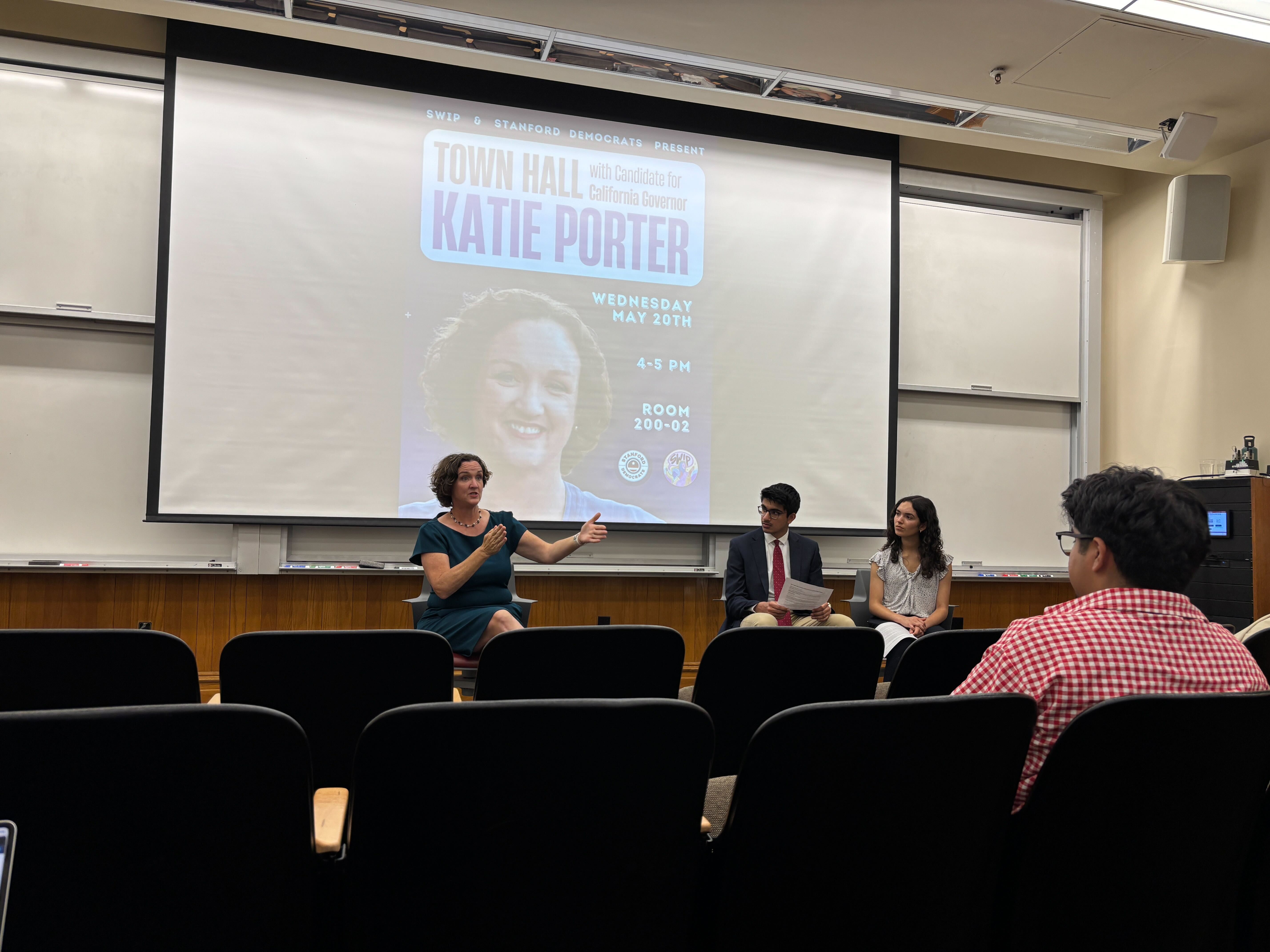
California gubernatorial candidate and former congresswoman Katie Porter held a town hall in association with Stanford Women in Politics (SWIP) and Stanford Democrats on Wednesday. Porter fielded questions on issues ranging from college affordability and housing to artificial intelligence (AI) regulation.
Stanford Votes tabled outside the event, helping students registed to vote and providing election-related information.
Rather than delivering prepared remarks, Porter opted for a question-and-answer format, beginning by answering questions from moderators from both clubs. She then transitioned to taking questions directly from the audience of around 50 student attendees.
SWIP president Ava Acevedo ’26 M.A. ’26 and Stanford Democrats communications director Waleed Haider ’29 moderated the event, and each began with a question of their own. Haider’s question focused on the state of education and affordability and was inspired by conversations with students leading up to the event, he said.
“We said, ‘If you have criticisms of the Congresswoman, if you have policy issues that you want to bring up, you should come here,’” Haider said.
Porter, a three-term congresswoman representing California’s 45th and 47th districts, drew on her experience as a law professor at the University of California, Irvine (UC Irvine). This position, she said, gave her a unique perspective on rising costs, especially for students, and political attacks on research and science.
“I have been on the ground in California watching these challenges in education emerge,” she said. Porter emphasized that policymakers have long focused on the rising cost of tuition, implementing policies that aim to provide more aid. However, Porter noted that many leaders haven’t addressed the rising cost of living itself.
In California, the average annual cost of living for UC or California State University (CSU) students has exceeded tuition, according to Porter. To address this, she proposes extending California’s existing tuition-free community college programs to the final two years at UC and CSU campuses, which would create a fully tuition-free pathway to a four-year degree.
“Housing is my top priority in this race, period, because it’s the number one expense that people have,” Porter said.
She argued that many politicians, including her opponents, frame affordability as a campaign priority without clearly explaining how they intend to reduce costs.
“Lots of times things fail because people do not articulate what the actual goal is,” Porter said. “Instead, they describe the problem to people.”
During the audience Q&A section, multiple students asked Porter about the rise of AI, specifically its regulation.
Porter argued that lawmakers have largely focused on what she described as the “low-hanging fruit” of AI governance, including AI-generated misinformation, nonconsensual explicit content and other applications of generative AI. However, Porter said discussions about AI have paid comparatively little attention to how the technology could reshape employment and concentrate economic power.
Instead, Porter suggested that policymakers should focus not only on regulating AI but also on ensuring that workers and residents benefit from the wealth generated by the technology. She criticized what she described as an assumption among some political leaders that AI-driven economic changes are inevitable and should proceed largely unchecked.
“The job piece really requires elected officials to decide who they’re going to fight for and whose side they are on,” Porter said. She acknowledged Governor Newsom’s efforts to use AI for improving government efficiency. However, she said that these efforts haven’t done enough for labor.
“What [Newsom] has not done yet, but is willing to do, is to go to battle with AI over who’s going to get the wealth…That’s where the Democratic Party — because we have too many people who are taking corporate money, and who have this kind of inevitability idea about AI — are not going to push back.”
Porter also said she would have signed Senate Bill 1047, an AI safety bill passed by the California Legislature in 2024 but later vetoed by Governor Gavin Newsom, into law. The measure would have imposed safety and testing requirements on developers of advanced AI models.
Another student asked Porter about free speech on college campuses, citing concerns about the University of California, Berkeley’s (UC Berkeley) reported cooperation with federal investigations into pro-Palestinian activism.
Porter argued that universities and elected officials have a responsibility to defend free expression, particularly amid what she described as increasing political pressure from the Trump administration.
“If [California’s] not going to hold the line on free speech, who is?” Porter said. “If we’re not going to stand up to Trump, who is?”
For Acevedo, hosting Porter carried particular significance because Porter is currently the leading female candidate running in California’s gubernatorial race.
During the town hall, Porter highlighted the rarity of women running for governor, and told students that California has not seen a competitive Democratic woman candidate for governor in decades.
“It was 1994,” she said. “I know it was before you were all born, because I was in college in 1994. And I have a kid in college.”
Acevedo said Porter’s perspective on gender made her visit especially meaningful for SWIP.
“Politics is an extremely male-dominated area, so it was a really special opportunity to hear directly from her,” Acevedo said. “Somebody that is continually pushing in as the only woman in this race.”
For both organizations, the town hall was an opportunity to connect students directly with a candidate seeking California’s highest office.
“[Porter] was the only one of the major candidates for governor [who] was able to come to campus, and we wanted to take advantage of that, to inform students at Stanford to ask questions about the future of the state their school is in,” Haider said.