
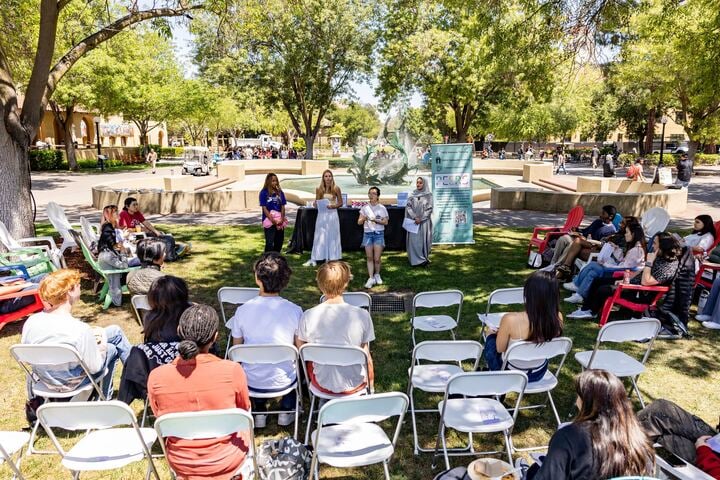
Dan Kubota ’27 first discovered the Prevent, Educate, Empower, Refer (PEERs) program in her freshman fall, after her father encouraged her to attend a naloxone training in order to “be careful in college.” There, she was excited to discover the tools to have important conversations about public health, and has since become a PEERs lead.
“The reason that I stayed was being able to have these conversations about substance use with other people my age, because it’s not something I grew up talking about, and I didn’t really have language to discuss this,” she said. Kubota is a writer for The Daily.
PEERs is a team of student public health paraprofessionals trained to prevent harms related to substance use, sexual violence and mental health. They work between the Office of Substance Use Programs, Education and Resources (SUPER) and the Sexual Harassment/Assault Response & Education (SHARE) Office to educate and empower students, as well as refer them to support resources.
“We have so many amazing resources on campus in these three pillars of mental health, sexual citizenship and substance use, but as students we don’t experience those in a vacuum,” said PEERs lead Katherine Healzer ’26. “They’re very interconnected.”
To become a PEER, which is a paid role, students must enroll in Peer Education and the Campus Culture in the spring. The course is taught by SUPER and SHARE professionals and covers the foundations of public health and the intersectionality of substance use, sexual citizenship and mental health.
PEERs focuses on outreach events such as naloxone trainings, where students can learn how to use NARCAN to reverse the effects of an opioid overdose, and upstander workshops that teach them to intervene in potentially harmful situations. Their workshops have reached more than 1000 students.
Branding and promotion coordinator Zeinab Zreik ’26 remembered being able to apply what she learned from an upstander workshop in a real scenario. “At CoHo, there was this person who was saying these uncomfortable things to somebody, and the person appeared uncomfortable in the situation, so I used the ‘distract’ method,” Zreik said. She asked the person if they wanted to watch her unbox her package to remove them from the situation.
PEER Nick Madibekov ’28 appreciates the flexibility of the organization in holding workshops that interest its members. After Madibekov noticed he was consuming high amounts of caffeine, he researched caffeine’s effects on the body and decided to share what he had learned with the community.
“My favorite memory of the year was the decaf tiramisu making events, making people aware of hidden caffeine in things such as tiramisu,” he said. “It was a really joyful event.”
Zreik also highlighted the collaborative nature of PEERs, with 43 partnerships this year. These include work with Cardinal Recovery and the Women’s Community Center. “I love that working with this group, you’re able to dip your toes in a lot of different campus resources and organizations,” Zreik said.
Above all, the program aims for compassion and community. “As PEERs, we really try to meet students where they are — in their homes, in their dorms, in their communities,” Healzer said.