
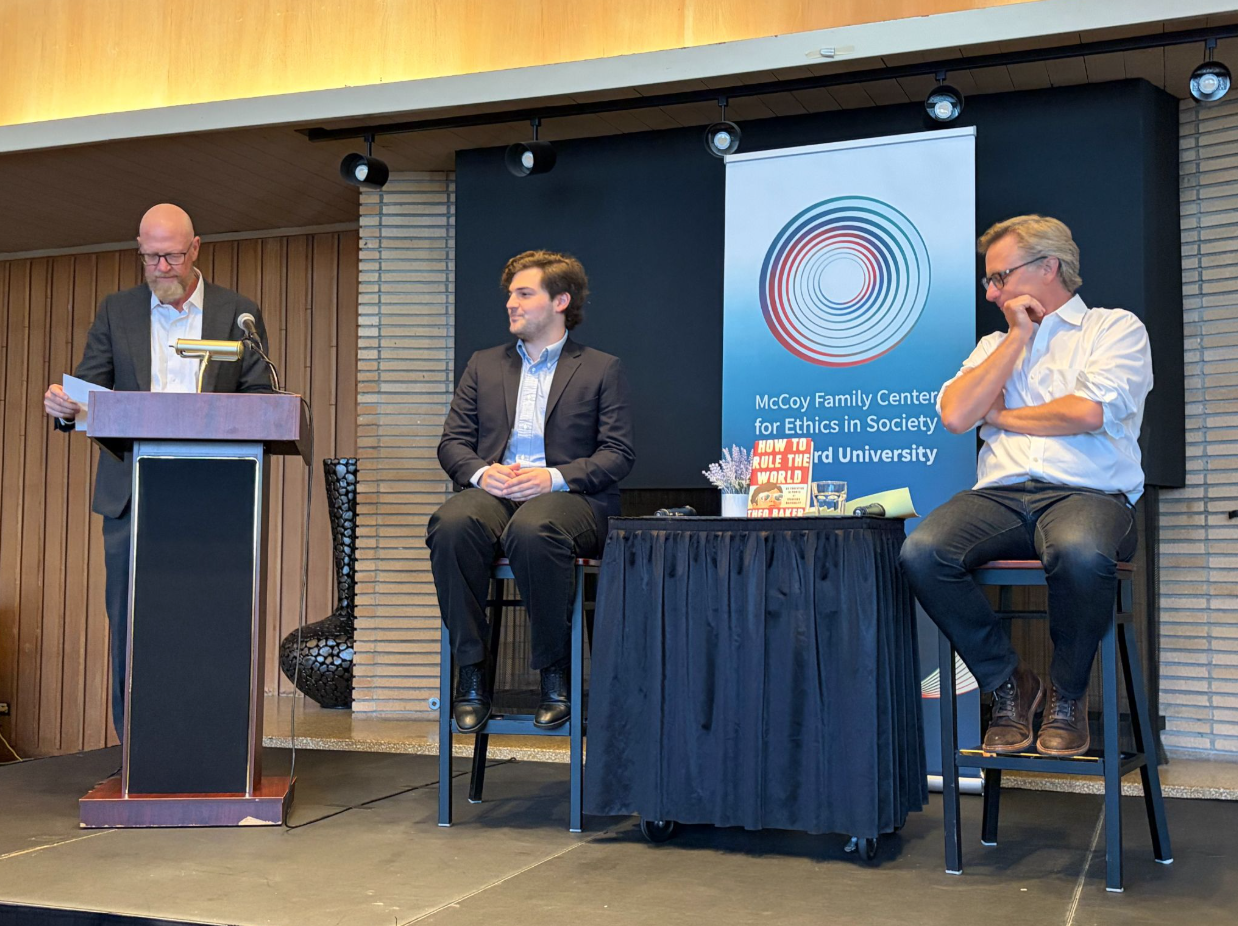
While Stanford is known by many as a postcard-perfect paradise, student journalist Theo Baker ’26’s debut book offers a darker view of the university that he says few people see.
The McCoy Family Center for Ethics in Society hosted Baker for a Wednesday talk featuring the book, titled “How to Rule the World: An Education in Power at Stanford University,” released on May 19.
The event was moderated by Rob Reich — a political science professor, senior fellow at the Stanford Institute for HAI and professor of Social Ethics of Science and Technology — with opening remarks from Leif Wenar, the faculty director of the McCoy Center.
Baker titled his book after an unofficial course called “How to Rule the World,” which Reich described as an “off-the record, uncredited class.” The class only accepts 12 students, and requires references and a rigorous interview process to be accepted, The Daily recently reported.
The book is based on Baker’s experiences during his freshman year, which he likened to “[coming] west searching for gold.” He recalled writing his first Daily article on the so-called ‘War on Fun‘ and his initial plans to be a computer science major. Unlike his parents, who write for The New York Times and The New Yorker, Baker has said he did not intend to become a journalist.
But it was his investigation of former University President Marc Tessier-Lavigne that cemented his reputation as a reporter. During the 2022-23 academic year, Baker published a series of articles that led to Tessier-Lavigne’s resignation and made him the youngest recipient of the George Polk Award.
“I realized very quickly that VCs [venture capitalists] sniff out freshmen,” Baker said, calling this the ‘Coupa Circuit.’
“Their entire job is to sit and identify a teen to invest in… it’s the fetishization of youth.”
In his book, Baker recounts meeting an investor named Ivan, whose office was “a little metal table at the Coupa Café… people troop in to meet him one by one, like a series of patient farm animals waiting for their chance to feed at the trough.”
During the talk, Baker described Stanford as “the most commercialized university in the world,” citing its government and private contracts, corporate partnerships and what he sees as the commodification of its students. Baker added that Stanford has a budget higher than 116 countries, and allows Silicon Valley to pursue a “no guardrails” relationship with students.
In particular, he criticized investors providing students with millions of dollars for undeveloped products and not following up.
“The difference between acceptable and unacceptable [fraud] is if you win,” Baker said. “Reddit made up user data for two years but we don’t talk about it because they won.”
Citing a “culture that doesn’t prize accountability and openness,” Baker said that Stanford had “made a Faustian bargain with Silicon Valley” while maintaining an appearance of perfection reflected by the well-maintained campus grounds.
The book was not meant to “tear down” the entrepreneurial spirit of Stanford, Baker said, but to address a culture of fraud, which he said risks creating the next Sam Bankman-Fried or Elizabeth Holmes. Bankman-Fried was sentenced to 25 years in prison for cryptocurrency scams, while Holmes was sentenced to more than 11 years in prison for misleading and defrauding investors of her health technology startup, Theranos. Holmes had secured investments from prominent Stanford faculty such as chemical engineering professor Channing Robertson.
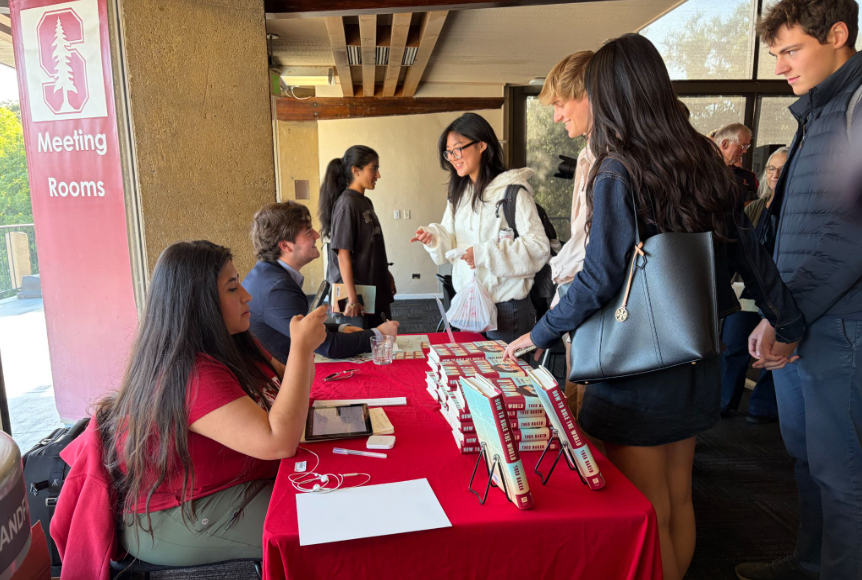
According to Reich, a critique of the book following its publication was that readers “didn’t recognize their own experiences of Stanford” within it. Reich read from a Substack article by Charles Eesley, a professor of the Management Science & Engineering department, who wrote that the book’s story was real, but did not represent the entirety of Stanford.
“The empirical question isn’t whether these things happen,” Eesley wrote. “It’s how many Stanford students actually live this version of Stanford.”
Among the attendees of Baker’s book talk was Elisabeth Bik, a Dutch microbiologist and scientific integrity researcher. According to Bik, she was contacted by Baker to assist with analyzing Tessier-Lavigne’s papers, in which she identified irregularities in his published figures. Tessier-Lavigne later corrected or retracted his papers, which Baker reported in December 2023.
Bik believes fraud among scientists is caused by the “constant pressure” to publish and the expectation that their research must always be “novel,” “interesting” or “earth-shattering.”
“Science has become driven by incentives,” Bik told The Daily. “If you think about how science should be done, it should be done slowly. If you push people to push out results, people are going to cut corners, make mistakes or are going to do outright fraud.”
Both Bik and Baker stressed academic integrity and innovation without dishonesty.
“Tech is cool, but fraud is not cool,” Baker said. “We should inculcate education without cultivating fraud.”