
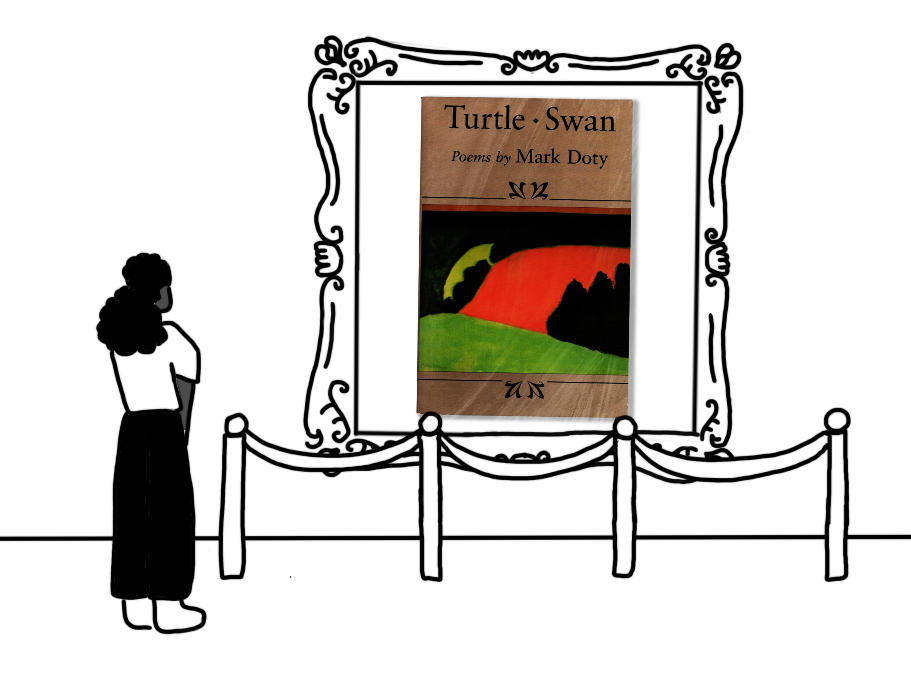
In her column, Ribka introduces a certain piece of media and justifies how and why it has taken up her time and invaded her mind.
To reason with my overbearing infatuations with random media, I use this (il)logic:
I sometimes imagine I was born with an additional limb that was surgically removed just after birth — soon enough that my parents believed I had not grown used to it, rare enough that no one could conceive the loss but myself. I am mourning something and I have lost nothing.
There are two theories I adopt to cope with this inexplicable feeling.
First, that this poem, “Turtle, Swan” by Mark Doty, was the piece of me that was detached and came into my life again like a long-lost limb.
Or, that I will never regain what I have lost, but poetry is the closest way to fill this hole I cannot find.
***
The summer after my junior year of high school, I attended the University of Virginia’s Young Writers Workshop, which was like a summer camp for high school poets, authors, songwriters and dreamers.
Truthfully, I remember very little of those days. It was my first time sleeping away from home since fifth grade, so I recall excitement and scorching heat. UVA was my dream school at the time, but it was still out of reach. The workshop was held for two weeks on Sweet Briar College’s campus. We were offered different poetry salons on certain weekday nights, and I sifted carefully through the bios for something that would intrigue me. I was most attracted by one uniquely titled “I DO NOT WANT YOU TO EVER DIE.”
I recall very little of the workshop itself. The one part I do remember — and will always remember — was our reading aloud of “Turtle, Swan” by Mark Doty, the ending of which was the title of the salon. We each took a stanza for ourselves. I kept all of it.
I am an envious, bitter writer. I’ll read gorgeous lines and, before complimenting the poet, kick myself for not conjuring up the lines first. “Turtle, Swan” has left me bright green for years because of how the poem makes such creative use of reality and observations. Doty turns the real, unreal. Since discovering his work, I have pledged to turn unpoetic life experiences into worthwhile poetry.
Doty uses the mundane to cement his relationship as “normal” during the poem’s 1987 publication, a time of rampant homophobia and apathy to the ongoing AIDS pandemic. The poem takes ordinary instances — such as the narrator losing sight of his significant other in a movie theater — to reveal incredibly personal insight with unique language. He wants the reader, perhaps, to value his partner just as he does. “Turtle, Swan” takes an unexpected, gutwrenching turn with the narrator’s concluding insecurity over the fact that his partner will die to this disease. The poem does not offer this last bit directly, but the workshop leader informed us of the context.
At the end of the workshop, the leader informed us that Doty’s partner had passed from this disease a few years after the poem’s publication.
I will never forget the chill that took over everyone’s bones. How I’ve never felt I could read a room until that day. How everyone must have felt the room grow much bigger than it actually was, and how small it feels to forecast the future when you can’t do a thing to change it.
***
You never know there is space leftover in your heart to obsess over something new until you come across it. You’re endlessly loyal to your favorite movie until it’s not your favorite movie anymore.
I didn’t think “Turtle, Swan” could ever be dethroned, and then it was. It’s not my favorite poem anymore, but it still means so much to me. Even now, I use much of Doty’s approach to anecdotes and the psychology in his writing. I make something out of everything. The way my father maximizes his surface area on couches, or the proximity between elbows while sharing a table with someone you’ve never spoken to.