
I should be writing a paper on Strawson’s “Freedom and Resentment,” but my mind meanders into the Stanford arboretum.
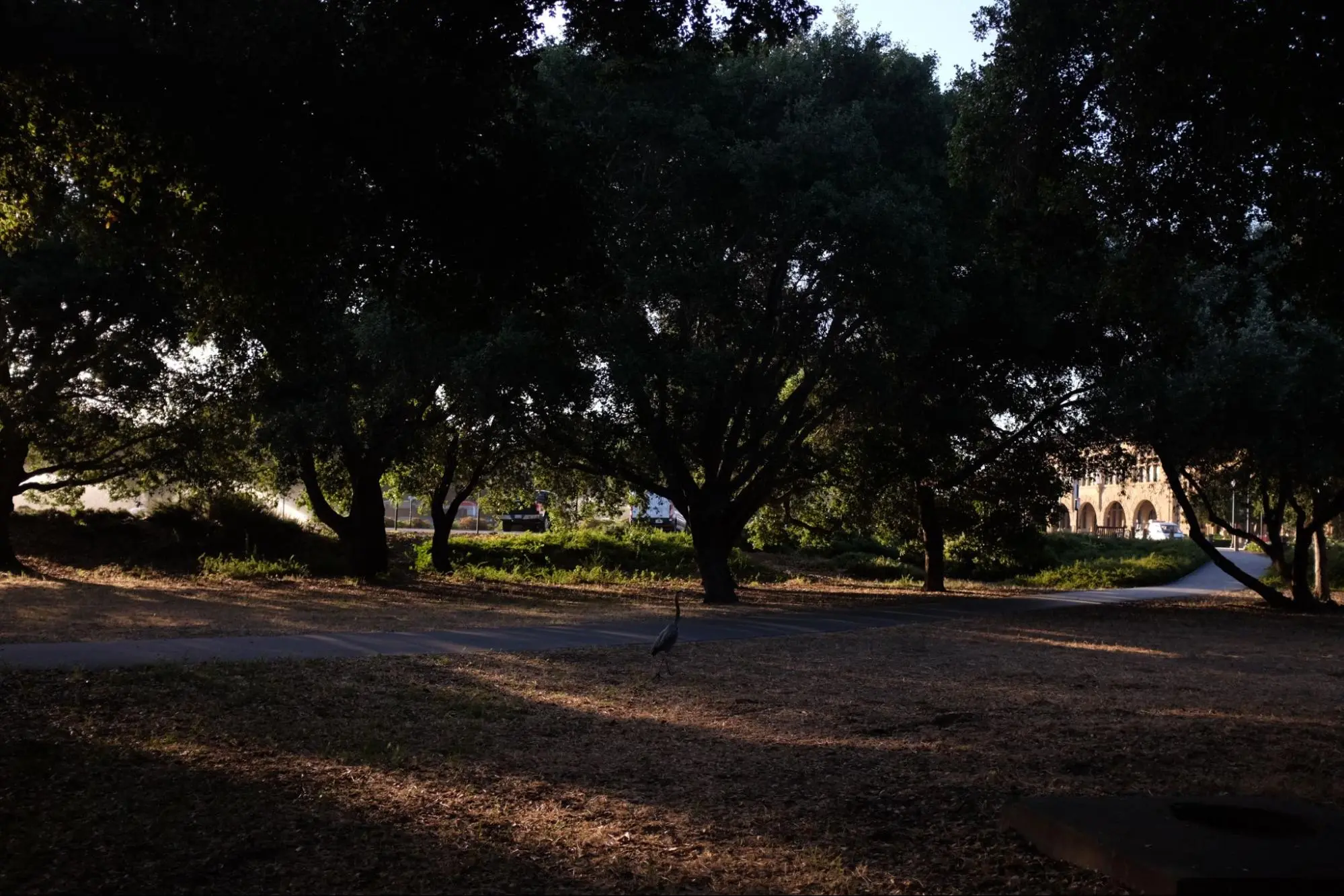
Soaking in the first light of 7:03 a.m., golden rays seeping into the swimming ember-laden light, I met another. I was positioned next to the soft trunk of a towering redwood, angling the camera upwards towards the treetops, when I heard a voice in the near distance.
“Look over there!”
I snapped my head backwards only to see a custodian pointing towards a bird roughly 10 yards away. The bird was standing in the light peeking in through the redwoods, as if it were posing for a portrait. I was stunned. Somewhere in between the shock and gratitude, I gathered the courage to respond, “Oh my god, thank you!”
And slowly, like predator to prey, I darted towards the bird; the leaves crunching beneath my feet should have betrayed my presence far earlier than it did. For around fifteen full seconds, the bird stood there in a discerning, somewhat solemn elegance. I wonder if it felt a crippling solitude or a calm liberation. I snapped one shot before it flew away.
The aperture wasn’t quite right, the shutter speed was completely off — it was brutally unfaithful to the ephemeral quality of the moment. But I don’t think I was meant to capture any more than what I did; the bird knew this, too. Torturing and tantalizing, still.
I was a witness to the beauty of earth’s creatures and the simple kindness of strangers. The custodian asked for nothing in return, and walked away before I could thank him properly — before I could ask for his name. He had every reason to marvel at the bird himself; instead, he shifted my lens towards the object of his own.
It was then, as I watched the bird fly away, as I pondered the custodian’s name, when it came back to me.
This isn’t the first time.
On the last day of spring quarter last year, I was walking around Lake Lagunita when I stopped to admire a bird sitting in the dappled light of (what I now know to be) an oak tree. It was pure white, stunning, still.
“Do you know what this one’s called?” an elderly woman asked as she walked by.
“No, I don’t,” I smiled in response. I would have been happy to have shared this wondering together.
Instead, she offered something better and responded, “It’s an egret!”
She hardly even stopped. All I remember for certain is that she said nothing more, merely continuing onwards, arms linked with her husband, trotting away. No hello. No goodbye. Just wisdom untouched.
I can almost hear Mary Oliver in moments like these. Oliver reminds us in “Wild Geese,” “Whoever you are, no matter how lonely, the world offers itself to your imagination, calls to you like the wild geese, harsh and exciting — over and over announcing your place in the family of things.” Maybe this is me finding my place in the family of things.
I’m reaching for its fullness — I’ll never capture it all. In an interview with The New York Times, Taylor Swift said, “Your twenties are spent grasping, but never quite holding.” I couldn’t agree more. It’s fleeting and fragmented; darting and daring me to just try.
These two moments have since lingered with me. I remember the elderly woman’s face whenever I see an egret. I’ll now remember the custodian’s face, too. I’m astonished at the cosmic force that brought this all together. And how lucky I am to bear witness to it, maybe even participate in the casual chain of it all: the bird brought the custodian to me, who brought me to the bird, who brought me to the elderly woman last year. The universe works in infinitely forgiving ways.
I recently learned that mereology, a denomination of philosophy, concerns itself with the parts, the ‘parthood’ which are constitutive of the ‘whole’. I wonder which parts of our lives will one day compose the complete structure of our whole. Mereology reminds us that sometimes a part can be constitutive of a part; that a part is not always meant to be of a whole. And certainly, some parts will be discarded, laden with remorse, but certainly others will be wedded to our ring finger, teaching us to listen, love, linger.
Attention can be stubbornly stochastic. In fleeting moments of vulnerability, revealing, relishing, it’s easy to forget. These memories, however momentary, remind me to temper this taunting. And may we live a life so full of tethering, that we are most certainly left with(out) (r)egrets.