
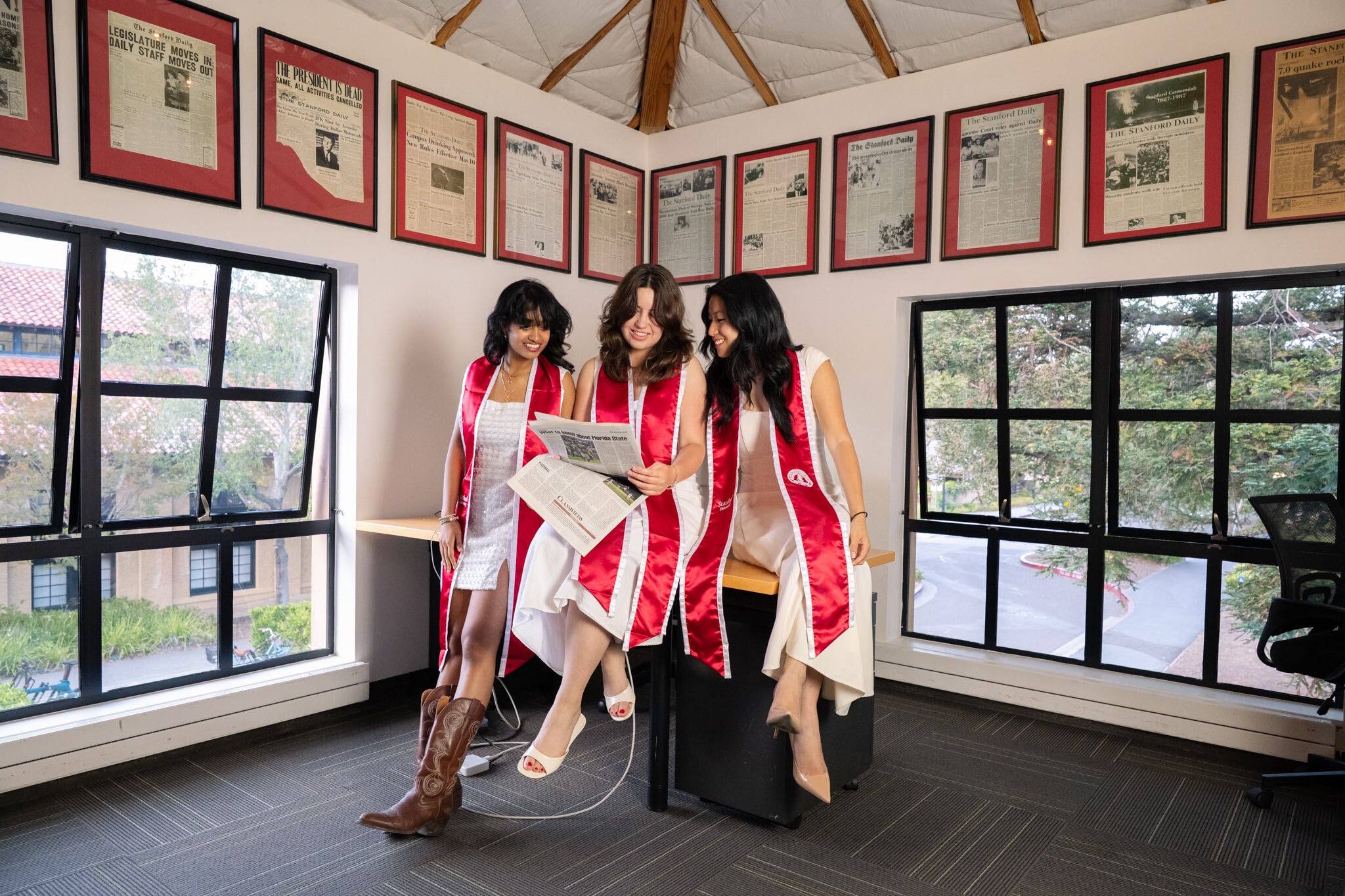
Fountain hopping. Big Game (and all its associated hullabaloo). Dunch. Bay to Breakers.
The list is endless, but these are the obvious answers.
Let me introduce to you some of the less obvious, Daily-specific traditions.
The Ink Bowl, where every year before Stanford fights Cal for The Axe, The Daily plays The Daily Californian in a game of flag football for The Knife (this year, we snatched victory from the jaws of defeat with an awe-inspiring play in overtime).
Buca di Banquet, a formal celebration of each volume’s incredibly hard work with awards, party hats and Palo Alto’s finest Italian food and drinks.
Senior columns, a longstanding tradition for Daily seniors to reflect and write one final piece, of which you are currently reading mine.
I never thought my participation in The Daily would extend to my senior year. Despite my active involvement as a freshman, I found myself leaving The Daily in my sophomore year, chasing other opportunities. I was fully prepared to never return, even deleting Slack from my phone.
Joining and leaving The Daily is not an uncommon act. To work for The Daily means sacrificing your spare time, energy and sleep to writing extra papers after (sometimes instead of) finishing your class assignments. It’s being told no over and over again from sources declining to be interviewed, while the rest of campus accuses you of being biased or unethical or intentionally making mistakes.
For most, besides one line on your resume, there are no real incentives to dedicate this disproportionate, herculean effort to a club. The overwhelming majority of Daily staffers do not go into the field of journalism, meaning there are countless other activities one could participate in if the goal was to optimize for a career. All of the work is done for free, and being a Daily staffer (shockingly) does not offer additional social clout.
So why would anyone do it at all?
The Daily opened my eyes to Stanford’s greatest tradition.
I saw it in Luc, who gave his free time over summer break to The Daily’s Summer Journalism Institute, where he recruited me to write for the science and technology desk and later convinced me to follow in his Daily footsteps.
I met Brad, who started the Games section simply because he loves word games, which has now expanded to even an in-person crossword competition that drew the most number of people I’ve ever seen in The Daily’s house at any one time (he even gave out his personal phone number to everyone who attended, which is an unprecedented level of dedication).
Beyond Hayden (incredible writer, even better editor), or Isaac (fastest responder to Slack messages), or Cayden (broke a finger for The Daily), or all of the people (I could name names forever) who spend their spare hours learning an industry they will not go into after graduation, The Daily also showed me the same phenomenon happening all across campus.
In an article on Stanford Escape, I learned that a group of computer science, electrical engineering and math majors came together to create a free escape room. After editing the article, I was motivated to attend, and I can attest that it was not just any old escape room, but the most technologically-advanced, professional one I have ever been in (and I am an avid escape room enthusiast).
The piece I read on On Call Cafe introduced me to the students committing their free time and effort to build a social hub for their peers’ benefit. They mastered an entirely new craft for this, learning how to make unique coffee combinations and late-night snacks for their constantly evolving menu.
Everywhere you look, there are students engulfed in doing incredible things, at the highest level — not for money or power or fame, but out of pure passion.
This isn’t to say that Stanford’s student body is completely unscrupulous. I was recently asked why go to Stanford, and as in any student body, there will always be members who answer “to become a billionaire” or “to get ahead in the world” or any variation of these answers that betray an underlying lack of ethics or morality.
But much like the proportion of Daily staffers who go into journalism, this is an incredibly small minority. Going to Stanford means being surrounded by computer science majors who stay up until 3 a.m. practicing the piano to perfect a piece for their personal satisfaction and economics majors who memorize lines for their starring role in a theater production while walking to class.
It means upholding this tradition of excellence over incentive.
I ended up rejoining The Daily after running into Greta while walking to class, who convinced me to come back as an executive editor (a personal tradition of mine is very aptly using “Greta” and “Great” as synonyms). For a while, I thought it was a stroke of luck that I ended up back at The Daily at all.
Now, I know that it wasn’t luck, but inevitable. Even if I had not randomly run into Greta on a winter day, I would have always ended up rejoining The Daily — to personally partake in Stanford’s greatest tradition.