
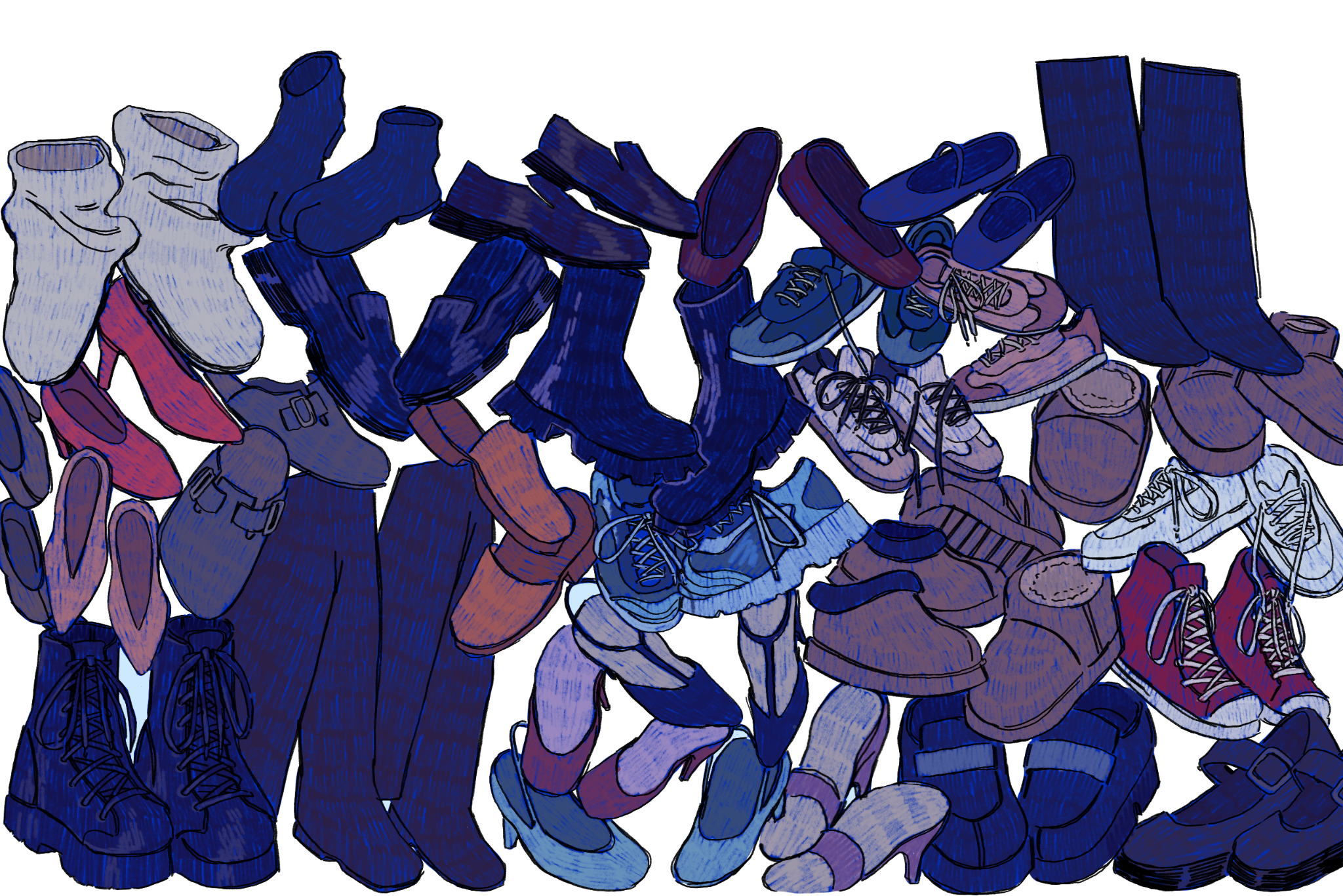
I hate a lot of things. Some would deem me an expert in matters of hate. I take on such a title gleefully.
I hate the sun. I’ll walk to class, and it just so happens that my armpits start sweating the second I sit down, as if they couldn’t have begun sometime during the 15 minute walk there to give me a heads up. I hate continuously correcting people about my pronouns. I wish I could turn microscopic, climb into people’s brains, and turn off their “mispronouning” button. I hate that oranges can be presidents now but the line is drawn at queer presidents. I hate that I can’t think of other things I hate right now because my memory is so terrible — I hate that too.
At the very tippity-top of my mental hatred list — in bold gigantic letters and underlined — is societal expectations. Specifically, the social expectations that have crawled their way into fashion.
I have always loved fashion. At first, I simply dressed the way my mom taught me — though even then, I was a bit over the top. My staple attire included different braid variations and ponytails, both always adorned with a bow. I finally began finding my own style in middle school, and I became gradually allergic to color. From there, I quickly evolved into more alternative and gothic styles: black skirts, four-inch platforms, purple hair with raccoon tails, white base makeup — if anyone has seen me around campus not wearing said attire, please ignore me: I am likely in a depressive rut.
I love fashion. I hate what some people have let it become. Let this be my somewhat gentle, somewhat crude, verbal way of grabbing people by the shoulders and snapping them out of it.
I have two main issues with fashion nowadays: the lack of identity and the overconsumption of fast fashion.
The first delves into the very definition of fashion. I have always viewed fashion as a means of self-expression. Most people hold a similar definition, and even if they don’t, anything you choose to wear inevitably says something about you. Meaning fashion expresses who you are whether you like it or not.
Fashion is meant to be individual — though it can have ties to one’s various communities — but the rise of social media and technology in the contemporary era has turned it into a communal activity. It has quickly been forced to transform from a showcase of individuality to a staple of conformity.
I don’t think there’s anything wrong with liking trends. If every once in a while a trend introduces you to a statement piece you like, by all means feel free to purchase it. Trends become an issue when they become reminiscent of addiction; leaving one teetering, waiting for the next viral sensation. This eradicates the meaning of fashion.
If one is going to just love whichever item is trending next, then do they truly love anything at all? In such a case, the consumer becomes society’s doll: lifeless and eager to be dressed in whatever society deems fit. There truly is no self being expressed here, given that the person is so ready to change every time society finds a new presentation more agreeable.
This is not to say that style should be rigid — sticking to only one color scheme, only one aesthetic. I encourage people to explore with their style. However, if that experimentation is confined only to the shackles of what the general population accepts, then one is not truly exploring anything.
Individuality in fashion is important, but I recognize it’s hard to accomplish. To be truthful, years ago, I used to view fashion as a tool for self-distortion. Every part of fashion is communicative — fabrics, colors, silhouettes — they all form preconceived notions about a person in our heads. As a teenager, I wanted to manipulate those biases to become the person I wanted to be, distorting both others’ views and my own understanding of who I was.
That style isn’t any different from how I dress now — it is only that back then I viewed everything I was negatively. As an adult, I know so many people that struggle with being themselves, especially in a world where identity is so digitized and visible. I don’t have an inspiring anecdote for why you should be yourself, other than that trying to be someone else is too boring and too much of a hassle.
Truthfully, I don’t get the idea of hating someone else’s fashion. Though it may seem as if I’m criticizing trendy fashion, what I’m truly against is the practices that come with it and the reasons people may have behind pursuing it.
I assume many people are scared of expressing themselves for fear of being bad-mouthed. I assume they are afraid of being insulted for who they are, and thus hide behind the security of mass opinion. But I think that someone who truly appreciates art and creative style would not spend time hating on any fashion. One is then left to wonder what type of person would critique another’s self-expression.
Regardless of the answer, I don’t think anyone who finds criticizing another satisfying or necessary is a person whose opinion I would want to take into consideration, and I implore you to think similarly. In fact, the idea of my harmless white base and dramatic lacy skirts making someone exert the effort to walk over to me simply to tell me they hate my style makes me want to wear it even more.
Therefore, despite general consensus, I generally think hatred tends to be an indicator that your style is unique and mesmerizing. I have been asked before, “Aren’t you scared of people saying anything?” I’m not. The type of people I want to surround myself with would never go out of their way to make someone feel bad on the basis of what they’re wearing.
This brings us to our second issue: fast fashion. Wider-spread trends have created a market need for more companies to fulfill the wants of the consumers, resulting in a multitude of brands that mass-produce ill-made products and sell them cheaply.
In addition to the virality of certain pieces of clothing, TikTokers have begun engaging with the communal aspect of fashion trends in three distinct ways. First, creators are attempting to predict future fashion trends. Second, creators are proposing items that should trend next. While typically light-hearted, these videos reaffirm that someone is only allowed to wear something if others are wearing it. Finally, creators are hating on current trends. This aids consumers in moving to the next trend, guiding the masses to change their opinion on previously beloved clothing.
I know supporting ethical fashion costs more money — oftentimes because one is paying someone appropriately for their work — but at a school like Stanford, I struggle to believe most people here can’t afford that.
I am lower middle class, and I can afford to shop ethically. A lot of my clothes are pieces I’ve had for several years. My recent purchases have come from small businesses and resale sites like Depop, Etsy and ThredUp. I know pieces on these sites may seem overcharged — which they sometimes are — but this is mostly because our market is so oversaturated with ludicrously low prices for human labor. I find that spending a bit more money on a piece of clothing while aiding someone’s small business feels more fulfilling than supporting some likely evil corporation.
Achieving your dream wardrobe is something that is meant to take some time, not something that you do every few months with a new grandiose SHEIN haul. Enjoy the process of slowly curating; it allows you time to figure out what you like and what you don’t.
All this to say, I lied. I don’t actually hate your fashion. I hate your fashion if it’s not yours. I hate it if it’s the work of the world convincing you to dress a certain way. I hate it if you have decided societal acceptance via conformity validates your use of unethical fast fashion. Otherwise, I don’t hate it, and even if anyone does … who cares?