
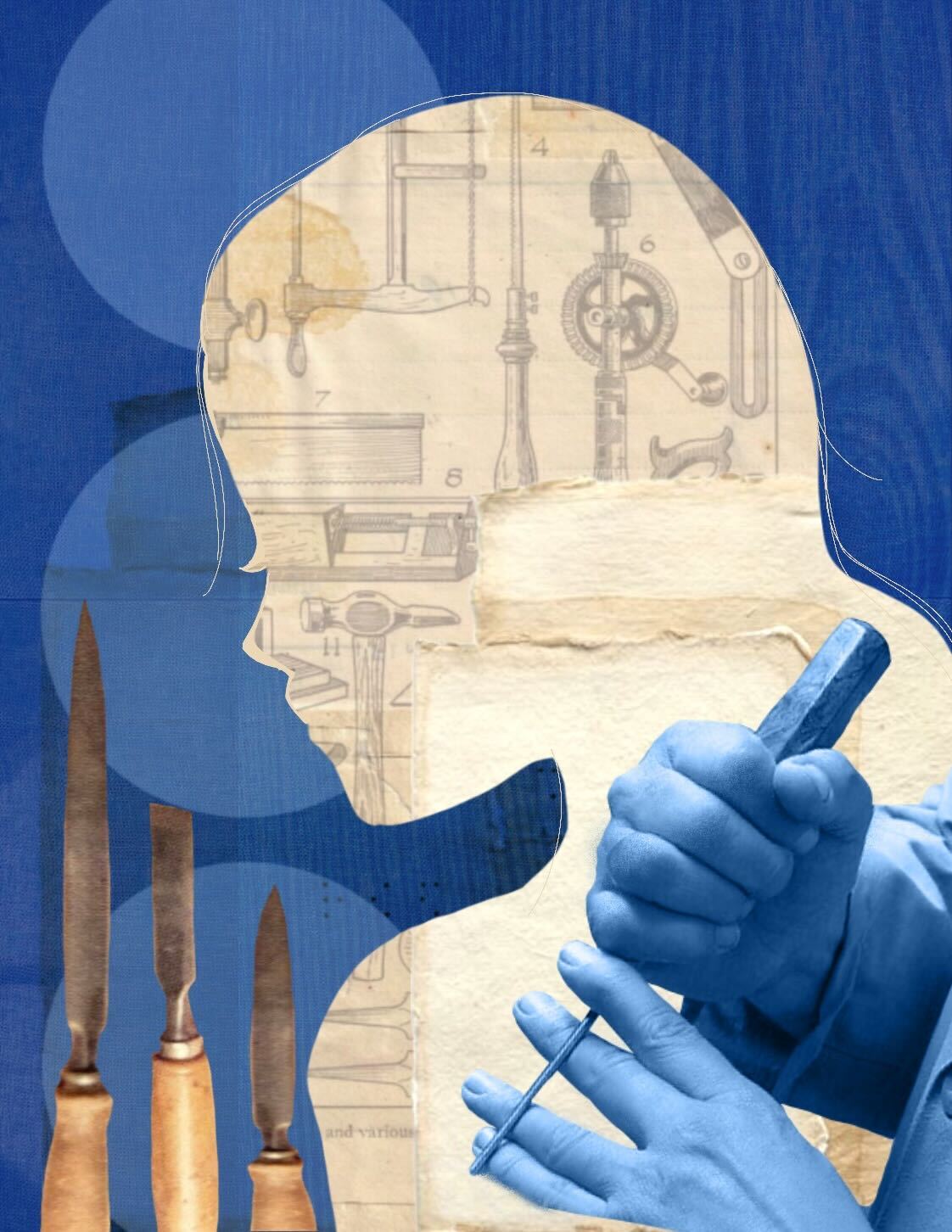
The soft humming of the lathe, the sharp blade cutting through construction planks and the omniscient campfire scent of chiseling wood leave the rest of the world in a luxurious waiting. My gaze is pinned precisely on the angle of my arm pressed tightly against the lathe. Rotating on the lathe is a scrap piece of Australian Walnut, and I’m entranced by its ceaseless spinning. It’s rotating perfectly, disrupted only by the friction forced upon it by a tool of my choice. I’m intimately aware that any slight shifting of posture can completely undermine its final form. However, the posture that typically typifies my perfectionistic hesitation is relinquished. In this moment, I am carefully careless. I carve away. I craft away.
If you ask me what I am most proud of recently, it would be this: a roughly 3” by 2” vase, barely discernible in form and function. As I hold the vase, I am reminded of what makes me feel human.
Tucked tightly between the corner of Santa Teresa and Duena, the Product Realization Lab (PRL) is a second home to mechanical engineering students, but an enigma to almost all other majors, including myself. In the dead center of winter, I found myself here: burnt out in the manufactured, consumer culture way. This is a consumer culture which promises the satisfaction of a product, at the expense of ceaseless production. Woodworking introduced me to its antithesis: the indelible meaning which lies within crafting. I marvel at the simple magnificence of smoothening a coarsely textured scrap of wood into its silky final form.
It is more important than ever that we commit ourselves to a craft. Not necessarily woodcraft, but any craft of your choice — ideally, the one that calls to you. A craft that is tangible and felt intimately through the tips of your fingers and sparks a spirit that has always resided within you. This insatiable craving to create with our hands is an entirely human endeavor. After all, I’d hardly be the first to say we are creative creatures. Yet we often forget this amidst a culture which claims otherwise; this mindless consumption takes many forms: shopping, scrolling and the sorts. We are consumed by the act of consumption itself.
This is the culture I sought to escape from in the PRL. In the midst of my burnout, this craft was akin to medicine. I learned that I had intrinsic value beyond the metrics by which we are evaluated within our institutions. I was invited into another world in which the qualities that make me human — fallible, creative, questioning — were unable to be communicated through a screen. Rarely are we creating something with our own two hands. Rarely, are we committing every fiber of our function to chiseling away at a form that will hold little instrumental or utilitarian value.
The only contender to defeating the value of the craft is sharing it. A master woodcrafter, Senching, taught me how to use the lathe. It was her enthusiastic generosity that brought me to the PRL for the first time, and it was her continued support that allowed me to craft (not complete) my first piece. When I first saw a collection of her work — dozens of the most intricately and delicately designed wooden vases — I marveled at the time and mastery it must have demanded to create each one. This is the wonderful art of the craft: its value is, in some ways, transferrable. We are moved to create not only with, but because of others.
My appreciation for the lopsided wooden vase has nothing to do with its material worth. In fact, I’d go as far to say it has no material worth at all. I instinctually grimace at its imperfection only to remember that it memorializes three hours of time well spent: a tireless labor of continued error and refinement to bring its existence into this world. As Nietzsche says, I spent those three hours being “human, all too human.”