
In high school, I had one goal: get into a top college. Beyond those next four years, I had very few concrete plans for my future, if any. My high-achieving peers, many of us coming from first- or second-generation immigrant families, shared this mentality; regardless of what our professional futures might hold, the path of higher education was the necessary and obvious choice.
When I got to Stanford in September of 2024, I met founders listed in Forbes 30 under 30 with plans for their next enterprise. My roommate, bound for law school, interns with the Santa Clara Public Defenders. Another friend has just started studying for the MCAT to become a neurosurgeon.
I see my peers pursuing countless diverging goals, most of which yield end results I could never imagine for myself. When I came to college, one thing became immediately clear: there was no longer one “right path” along which I could trace my trajectory, no “top college” equivalent. I was overwhelmed by the freedom of choice this institution afforded me, and with potential job connections in every industry imaginable, I still fail to answer the question: “What do you want to do with your life?”
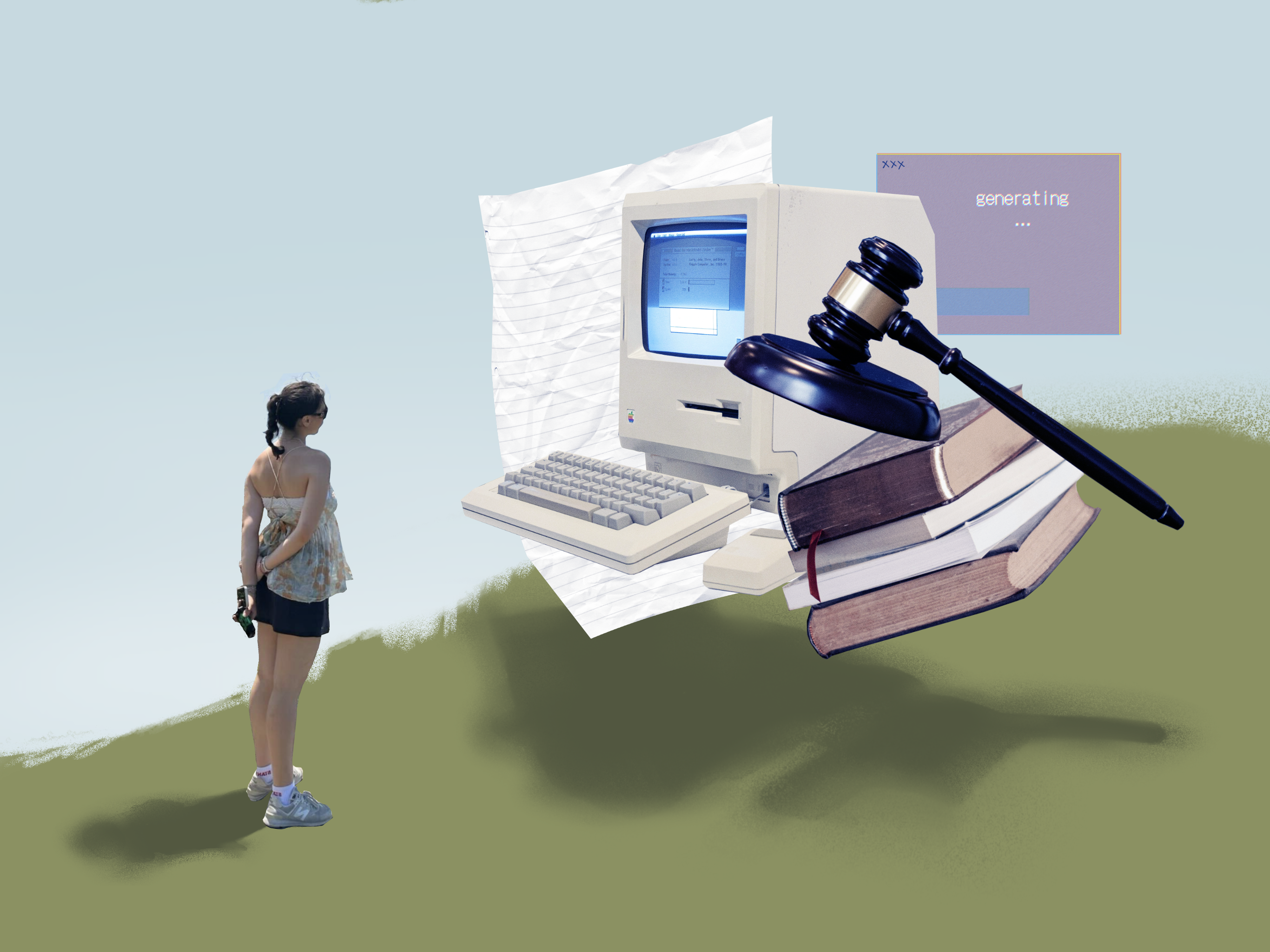
I arrived at Stanford two years after the rise of ChatGPT. I never knew college, job recruitment or essay writing without the prevalence of generative AI models. As former Daily reporter and newly published author Theo Baker ’26 wrote in The New York Times, AI has “permanently changed how we think and behave” — not just intellectually, but regarding our future. Entry-level computer science jobs do not require human employees. For every successful dropout story to come out of Stanford and onto our news feeds, approximately 75% of venture-backed startups fail, according to the Harvard Law School Forum on Corporate Governance. Stanford degrees are no longer a guarantee of employment or success.
I study Comparative Literature. I didn’t have any secure job prospects for AI to disrupt in the first place. There is no recruiter who visits my general survey class of the novel or my seminar on literature of rage. Unlike jobs in STEM fields, the humanities do not provide pipelines or simple transitions to the workforce — the skills I am gaining are not tangible or applicable on a one-to-one task basis.
How do you quantify the ability to sit in ambiguity? The experience of facilitating discussion on a 19th-century novel? The experience of searching digital research libraries like JSTOR for hours and failing to find what you needed? More broadly, what is the tangible value of the slow, uncomfortable, ego-destroying effort it takes to create something inevitably flawed?
That last question is what I ask myself every day, particularly this week as I struggle to condense my notebooks into a digestible final paper or presentation. The essays I will turn in this finals week are by no means the best scholarship in their fields. They are certainly not my best work. They are, however, mine.
As I finish out my second year at Stanford, I have increasingly noticed a campus full of people paying enormous sums of money to avoid the un-fun, strenuous experience of producing something that is just ok.
Such reliance on LLMs, of course, relies on the assumption that they outpace, outwork and outdo people. Perhaps I’m naive, but I don’t think these tools have surpassed human ability in writing just yet. However, they undoubtedly make the process easier. Instead of agonizing over my word choice or rethinking a thesis statement, my mistakes are confirmed by a sycophantic chatbot telling me exactly how to fix it. Instead of emailing my TA and waiting for a response to help organize my thoughts, I can send a message and receive a reply within seconds.
Although the jump from ideation to a solid result has never been simpler with the rise of AI, it cleanly divorces success from the collaboration between humans that makes college such a singular experience. When else are we forced to live in such close proximity with so many people who have made a shared commitment to learning? When else do we have unlimited access to millions of books, scholarly articles and the researchers who wrote them? Stanford, even without a job guarantee post-graduation, is life-changing if we let it be. I worry that students are letting that opportunity slip through their fingers, too wrapped up in their academic and professional reputation to care about growth.
The Daily recently surveyed the class of 2029 on their attitudes toward Stanford and higher education. 31.27% of 323 respondents said the purpose of college for them was to “become a better thinker.” 24.15%, the next largest chunk, hope to “become a more useful member in service of society.” Perhaps these numbers will change in three years. Perhaps respondents have already shifted their priorities. But taking the numbers at face value, using AI robs us of the chance to do either of those things.
Life asks us to confront the messy problems of the world head-on, through negotiating, collaborating, learning and growing. A simple solution is almost never the right one. And if we really do hope to become more useful members of society, we cannot simply opt out of thinking anytime it challenges us or takes more than five minutes.
We seem to be allergic to mediocrity, so paralyzingly afraid of not passing with flying colors that we offload any messy work to avoid feeling bad about our own intellectual abilities. AI is easy, yes, and it lets us avoid the risk of doing something wrong. But it also keeps us stagnant. It allows us to coast, protecting our sense of academic authority or capacity at the expense of what makes us students, not finished products: our ability to learn.
I could have finished this piece a week ago if I’d used an LLM to come up with a witty concluding line, but then why bother writing it at all? As someone who’s never been behind the wheel, I’m all for self-driving cars. When my fan in Roble doesn’t cut it, I’m eternally grateful for the smart thermostats at Green. But these are not creative tasks. These are not opportunities for us, as humans, to grow into ourselves. There may not be a right path to live life to the fullest. But the wrong path is certainly the one that won’t even let us try.