
“What Makes Us Human?” is a biweekly column in which Emi Sakamoto ’28 investigates the interdisciplinary criteria whereby we might better respond to this metaphysically contested question. Amid our rapidly evolving technological landscape, it is incumbent upon us to do so.
“I almost became permanently paralyzed,” Richie said. “As one surgeon put it, seconds away.”
As I walked up the ledge lining Jane Stanford Way, I ran into Richie. Richie Kim, a lecturer in philosophy and my former COLLEGE 101 instructor, taught me about the walk. “Be where your feet are,” he would remind his students.
But I hadn’t seen him in over a year until then. And the last time I saw him, he was walking on his own two feet. As soon as I saw the cane, I became focally concerned with one question. I had to know what was wrong.
“Richie,” I shouted. “How are you?”
“The doctors don’t know,” he responded, likely noticing that my gaze was fixed on his cane. “The neurologists have done dozens of exams. It’s a mystery.”
And then I remember his smile. It was the most disingenuously genuine smile I had ever seen. Disingenuous because he had clearly been enduring months of prolonged pain and uncertainty, genuine because it was strictly for my sake, to inspire courage, to assure me that he would be okay. How a person could be so selfless in a moment where they ought to be entirely otherwise will live with me forever: beyond anything I could learn in a world-class seminar.
He quickly brushed past his medical condition — which was slowly sapping away his mobility, paralyzing him from the bottom up — before asking me about myself. I could hardly form a coherent string of sentences, much less any sensible articulation of my year. In any case, it seemed incorrigbly insignificant.
We concluded our conversation by agreeing to meet again, a few weeks later. The weekend before our meeting, he sent me a message prolonging it: “I just got MRI results back today and I’m getting emergency surgery on Tuesday. So I’ll still be in recovery on Friday. Let’s have our chat a little bit down the line, yeah? Do me a favor and crush it on your finals!”
I never understood that metaphor, the trite one about hearts sinking, until that day. Because as I read that message, it felt anything but trite: it was terribly, brutally visceral. My mind was swimming in the uncertainty he had become well acquainted with. “Would we meet again?” I thought to myself.
Everything else, the clutter of everyday madness and senseless ruminations we too often become ensnared within, dissipated. I remember wishing I believed in God.
For the next 12 days, I waited for a response. When he finally responded, “Recovery is going really well! The difference is incredible. Thank you so much for all of the good will. I feel it from here,” I thanked whatever higher power I prayed to for 12 nights.
But I haven’t even introduced him to you yet.
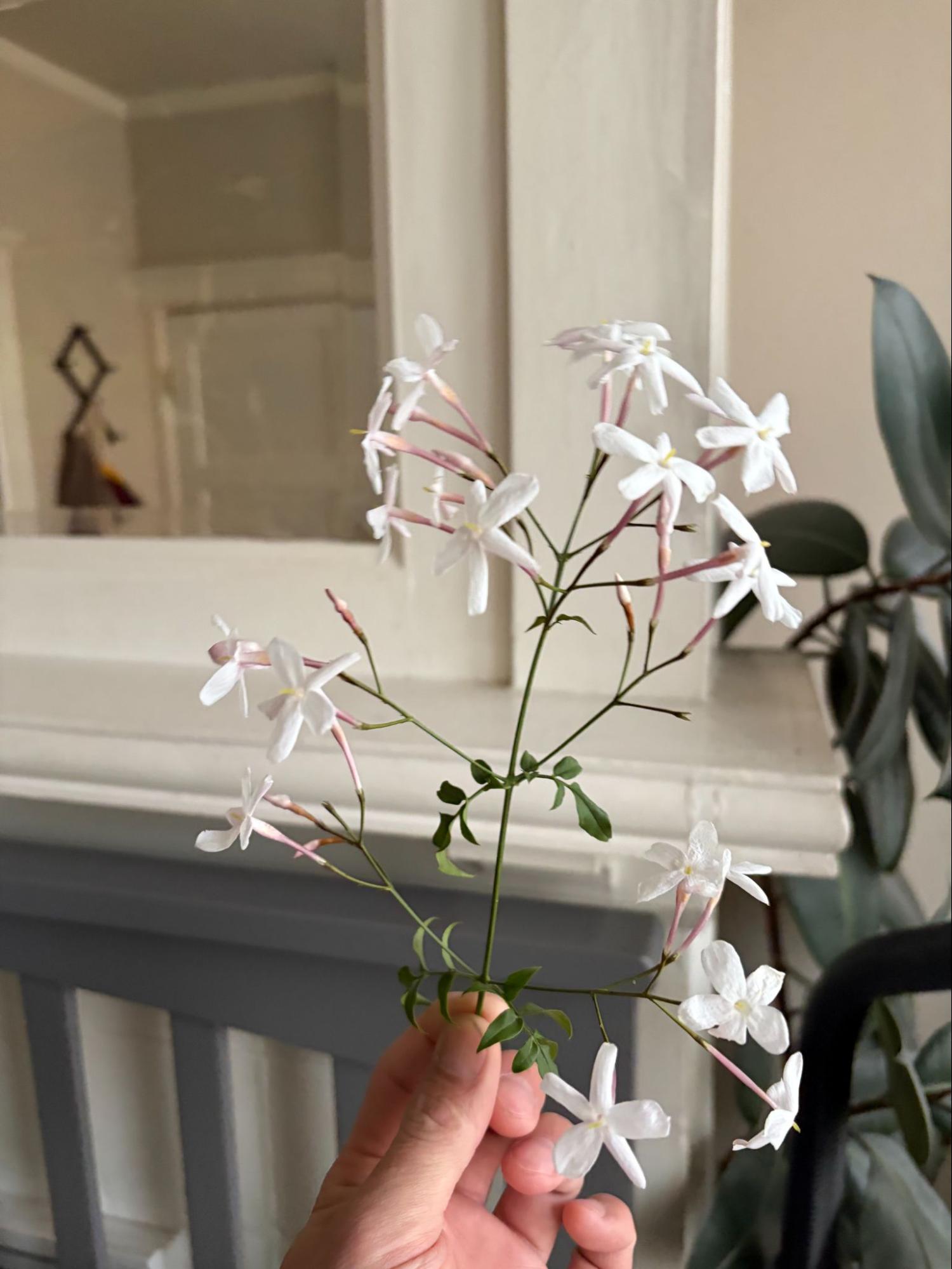
Richie once told me a story that I have since shared with several of my interviewees in order to explain the first question of each interview: “Can you tell me about your walk of life?” This story involves his colleague and friend Taylor Bell. As their conversation continued, she abruptly stood up to smell the jasmine bush a few feet away.
“And I found myself walking, too,” Richie said.
This story is imprinted in my soul. It’s kind of thing only a human would say.
So, when we met again, I asked him to tell me about his walk of life.
“I have endless stories of watching my mom cry and just count dollar bills, doing the math, and it’s not adding up,” Richie began. “A lot of my life was about survival.” Richie’s mother owned a sandwich shop, and his father was a janitor. Richie began his story this way — tracing the lines of our country’s sharp division labor. It was a fragmenting force in his life, and the division of language only compounded upon it.
“I grew up in a household where my parents believed strongly that their children needed to be raised as Americans, so they never taught us the Korean language,” Richie recalled. “No one believed me when I would say I couldn’t speak Korean, especially when they encountered my parents who spoke broken English.”
Despite this, Richie explained that he communicated with his mother through a deep, unspoken understanding which transcended linguistic capabilities. This linguistic divide was nothing in comparison to the sense of displacement he encountered in the world of academia. And his journey there was the cosmic construction of a causal chain unlike any other.
On the morning of the deadline to submit UC applications, Richie’s friend paged him and asked if he wanted to cut class and apply to college. Richie chuckled during his recollection of the story, “I was like, ‘let’s do it’ because I just wanted a new area to play my saxophone.”
A few years into his time at UCLA, he considered transferring to a music school in Boston. Just hours before he was offered an apartment, his mom called. She asked him to graduate from UCLA before going to music school. “I said okay because she never asked me for anything,” Richie explained. “If she didn’t go down the stairs to get milk in the middle of the night, I don’t know, I might be playing my saxophone outside the BTS concert, asking for money.”
Following his mom’s request, Richie began to explore various disciplines. As soon as he found philosophy, he was hooked. “I finally had a chance to really just learn. And I was obsessed,” Richie recalled. “No one thought I was going to go to college. As a poor kid, you think this is exactly where you don’t belong.”
Over and over again, Richie remarked on how the bend and arc of his path was marked by countless critical junctures for which he would not be here without.
Richie was about to leave after his second year in the Ph.D. program. He described the deep sense of displacement he often felt as someone who came from poverty in a room of Ph.D. students who often came from worlds unlike his own. “Debra Satz and really took me in,” Richie remarked. His walks around campus with Debra Satz, then-assistant professor and current Dean of the School of Humanities and Sciences, was the only time he truly felt understood. At the time, there were no tenured women in the department, and she shared his sentiments. Being seen by just one person was enough to inspire Richie to keep courage — to carry on, despite.
When his mom’s financial struggles escalated, Richie nearly quit the Ph.D. program to pick up a job and support his mom. Satz convinced him that the best thing he could do for his mom was to stay in the program. “As Debra put it, my succeeding in life was a way to honor my mom, and to make her life better,” Richie said. “That just blew my mind. As a poor kid, I did think that way. Debra helped me learn about what it is to view the world without giving me explicit instructions.”
Each causal event led to another, until the causal chain which mattered most: the one with his life on the line. In a follow-up email, Richie clarified that it was Taylor Bell, the same friend who stopped to smell the jasmine, who saved his life. In their conversation, Bell said with tears in her eyes, “Whatever it is that you have, there’s a treatment for it. And every day that goes by is a day you’re not getting that treatment.” Bell insisted that Richie ask for MRIs on his brain and spine. She told Richie that the doctors would push back, but that he shouldn’t take ‘no’ for an answer. Because of Bell, Richie wrote multiple messages to his neurologist that day, and got approval for another MRI the following day. That was the MRI which led to the emergency surgery, just in time to prevent the onset of what would have otherwise been permanent paralysis.
I asked him if his studies in philosophy had, in any way, altered his perspectives on his condition. “To lose your basic abilities, little by little, was like bleeding out very slowly … The more it happened, the more I found out what part of my existence I care about the most,” Richie said. “When you’re actually concretely dealing with loss, you kind of find out how you really valence things. In the end, I actually got to a place where I thought, as long as I can keep my mind, I’ll be okay. I often thought about the life of Stephen Hawking. Ever since I was a young kid. Like, how did he do it? But I think I sort of get it now…The mind is a wonderful place.”
And part of what makes it so wonderful is that we get to share its magic with one another. We weave in the stories of those who walk before us and engage in the capacious, co-creative possibilities alongside those who walk with us.
I hadn’t fully appreciated the depth of this co-creation until Richie said, “David Hilbert couldn’t see, so Albert Einstein told the story of the universe. Einstein had the ideas, the genius to conceive of the theory of general relativity, but his math was hardly good enough. Hilbert was able to prove Einstein’s theory with the math, so other people could understand the story.” I was shocked: we often celebrate Einstein as a brilliant physicist and mathematician, the grandfather of brute intelligence. And yet, without Hilbert, we would not know his name.
While the mathematical proof — and most certainly the companion to prove it with — is certainly important, Richie emphasized: this is not always the case. Sometimes, the story can stand on its own, without the mathematical proof. “We’re always inescapably telling stories, right? A lot of people that have interesting stories don’t have anyone to understand them,” Richie said. “In so many other areas in our lives or existence, it’s not about whether there is the math to prove it. Sometimes it’s whether there’s a storyteller out there who can tell the story better than you’re seeing it yourself.”
I thought about what a gift it was to tell his.
In the last five minutes, I asked the final question, “What makes us human?” So much of our conversation had been inadvertently entangled with this question, but I wanted to hear his philosophy directly.
After a careful, quietly effusive contemplation, Richie responded, “Humans expand way beyond doing human things. One of the things I found so audacious with philosophers like Aristotle and Nietzsche, is this idea that we have some feature of our nature that extends, and well beyond, humanness understood as this earthly animal. Every once in a while, there’s a human doing really non-human things…We can do remarkable things that go way beyond merely maintaining the system. And every once in a while you find a person, a human, doing something that is just utterly remarkable.”
Richie’s walk of life is a testament to what is fundamentally remarkable about the human condition. In facing a slow death with that kind of curiosity and courage, Richie showcased a mastery of mind as sharpened by the test of time and a heart that heals the souls of others because of it. It’s the kind so deep and true, that the mere loss of bodily function could never flatten it. I believe his recovery was the universe giving back to him for once; it was a reminder that he has yet to walk this earth for long enough to meet all who desperately need to walk alongside him. The jasmines are waiting.
And as I write, I realize with more clarity than ever: I am one of the lucky ones. Not just because I wouldn’t be writing this article if it weren’t for Richie. Not just because I wouldn’t have survived the frantic frenzy of freshman fall, or the first winter away from home, without his empathically clairvoyant guidance. Instead, it’s because Richie has taught me far more than I could have ever hoped for in a fellow human being: he taught me, far before I set off on this investigation, what it means to be human. In the spirit of the unspoken language he had mastered throughout his upbringing, he taught me more about the human condition simply by being as he was.
Two years ago, Richie taught me to dig deeper into the human condition. Today, I find myself called to do just that. This is the life I choose to walk where I might’ve otherwise been sprinting towards the very end. I witness the beautiful unfolding of this walk I call life, and think about all that I would’ve missed otherwise, without his teachings. I am certainly unalone in this feeling. Richie has walked the walk in a way that continues to inspire the paths of far more than my own. And he will continue to.
This is the walk. This is the life.