
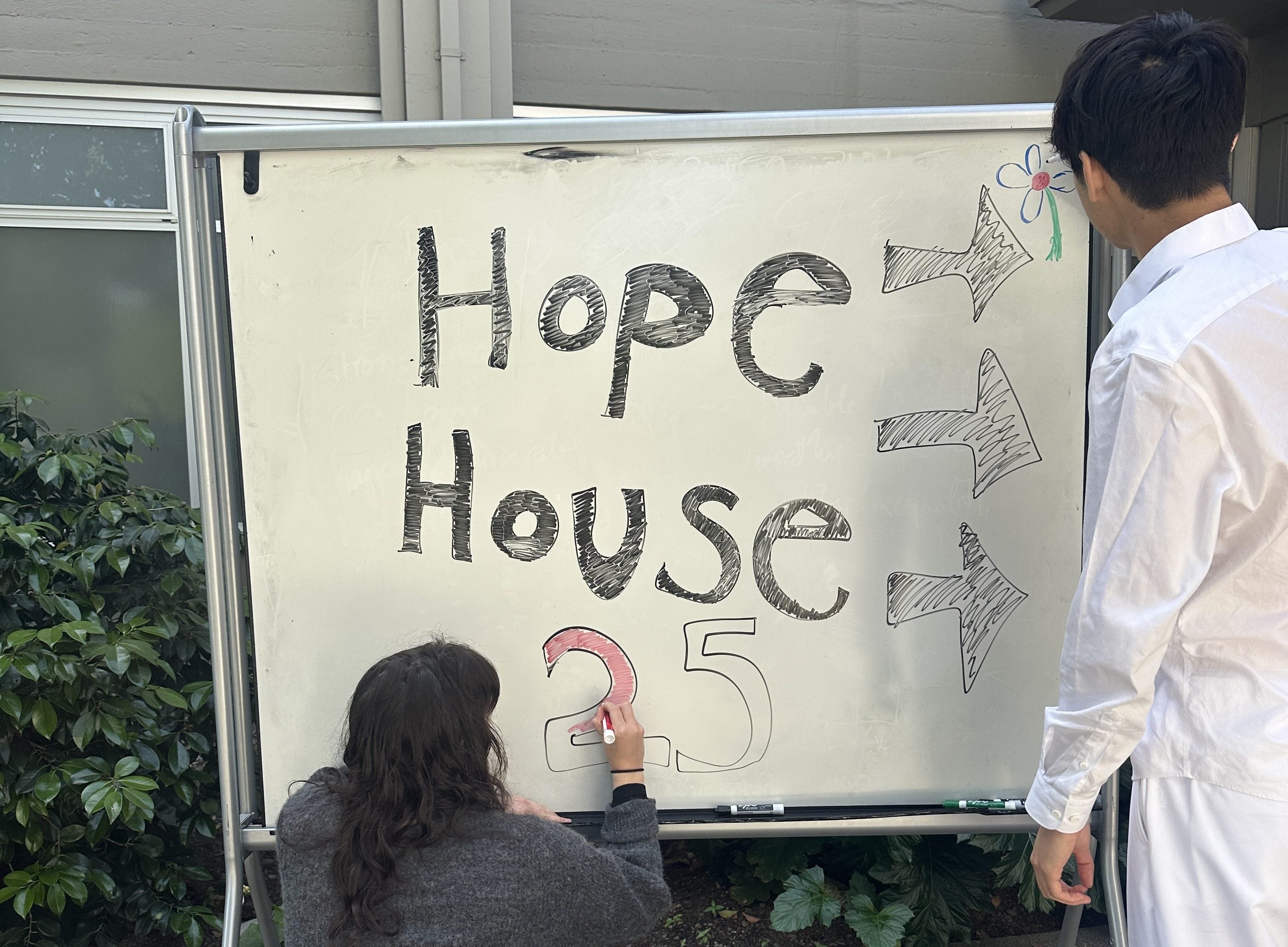
The Hope House classroom is unlike any other at Stanford. The classes follow the same 10-week schedule, grapple with the same humanities texts and are taught by professors, post-docs, graduate students and undergraduate Teaching Assistants (TAs).
The classroom is filled with residents of Hope House, the residential Substance Use Disorder (SUD) Treatment Program where the class takes place twice a week.
This year, the Hope House Scholars Program, a collaboration between the McCoy Family Center for Ethics in Society at Stanford and Hope House, is celebrating its 25-year anniversary.
The house aids up to 16 individuals in substance abuse recovery, targeting women and those who are pregnant or with young children. In the program, Stanford classes are mandatory and fit into a day packed with additional programming to support treatment. Classes include the recurring “Flourishing as a Feminist” taught by program co-coordinator Michaela Hulstyn Ph.D. ’16 and “All About Love,” taught this spring by Sarah Coduto, a third-year English Ph.D. student.
“We, the faculty, learn at least as much as what the women at the Hope House learn,” said program co-founder and political science professor Rob Reich M.A. ’98 Ph.D. ’98. “And what’s been remarkable for us, at least in the number of times that I’ve taught, is how the same texts that I would teach at Stanford University are grappled with in both similar and dissimilar ways amongst the women at Hope House.”
Reich and School of Humanities and Sciences Dean Debra Satz created the Hope House Scholars program to expand the reach of a liberal arts education, guided by the belief that it is something all should have access to.
“[Instructors] are in a space where women are also dealing with really pressing issues, like trying to become better parents, trying to get off drugs and alcohol, and your class is one of many offerings during the day,” Hulstyn said. “You need to speak in a way that people can understand and also motivate why would [the women] want to know about feminism, or why would [they] want to know about different theories of love or science fiction.”
Students at Hope House have access to education from their instructors for 90 minutes per week. They also meet with Stanford student tutors weekly.
“The following is clichéd but true: I have learned more from the women of Hope House than they from me,” wrote Kevin Lai ’28, one of the tutors at the program. Lai recalled numerous moments in which the women exemplified persistence, kindness and strength.
Reich said the inclusion of student tutors in the program helps the classes closely mirror the education one would receive on campus.
“We didn’t design the program explicitly to be a kind of reinforcement of [residents] recovery,” Reich said. “If the women made connections to that as a result of the conversations we were having, we didn’t push those away, but we didn’t develop lesson plans that invited people to begin from this particular circumstance they found themselves in.”
Educating Hope House residents presents a unique set of challenges and benefits. Instructors acknowledge the positive impact on the classroom environment of a pre-established group dynamic — residents live together in close quarters for the duration of their treatment, while typical Stanford students meet each other for the first time in class.
However, teachers can’t give members of the Hope House lengthy readings to grapple with in between sessions: all the learning has to happen during the allotted 90 minute instructional windows. Women come to the classrooms from a wide range of academic backgrounds. Professors also can’t count on seeing the same residents each week, as their treatment schedules may not be aligned with the 10-week academic calendar.
“Whether [a student has] been to the previous nine [classes] or not, it has to be able to stand alone and be a compelling class,” Hulstyn said.
Instructors note that learning goes both ways in the program. Here, the unique classroom environment gives them the chance to become even better teachers, and student tutors often grapple with texts for the first time alongside residents.
“I learned to meet resistance or opposition in the classroom with joy because it actually gives you a lot to work with,” Hulstyn said.
Upon graduating the class, the women are given a certificate for a free Continuing Studies class to provide an opportunity for them to continue pursuing a liberal education. Hulstyn added that the Hope House Scholars Program has the potential to provide participants with a renewed sense of motivation and confidence in their academic abilities.
“As for the future, I continue to believe in the value of this program,” Satz wrote to The Daily. “One challenge we have now is that the stay of the women at Hope House is shorter than in the past because of changes to funding — my hope is that we are able to find ways to continue to engage the women after they leave the facility.”