
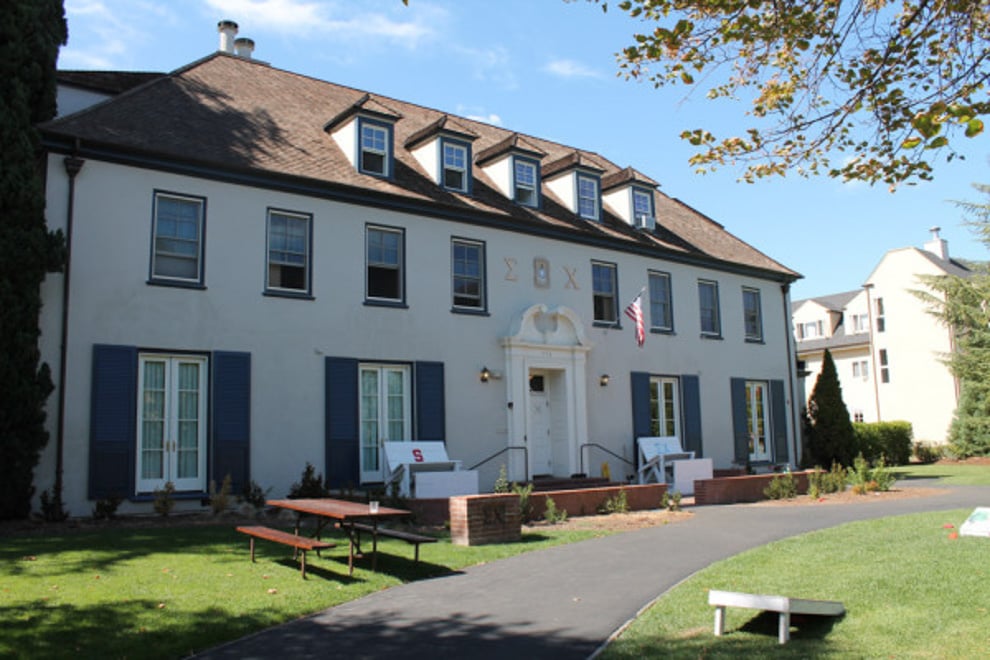
In April, the Alpha Omega House Corporation (AOHC), former owners of Stanford’s Historic Sigma Chi House, announced that the residence had qualified for inclusion in the National Register of Historic Places for its role in the 1960s Civil Rights movement. That’s big news. But as a community, we should be concerned by the University’s documented refusal to allow public recognition of that National Register status, and the removal of pre-existing recognition previously placed there by Sigma Chi students and alumni. Administrators should reverse course.
Stanford History Professor David M. Kennedy, at the Stanford Historical Society’s 50 year anniversary celebration in October 2025, quoted historian David McCullough on why we study history: “Everything we have . . . is because someone went before us and did the hard work.”
The historic importance of this residence starts in 1965 when Stanford’s Sigma Chi Chapter (Alpha Omega) did the hard work by pledging a Black student, Kenny Washington. It was the first time in the history of Sigma Chi that any of its Chapters had pledged a Black student. The Chapter was suspended by its National less than two weeks later. In response, the Stanford students launched a campaign to end discrimination in student associations nationwide. That campaign was the basis of the successful application for National Register status.
The California Historic Resources Board, in its nomination of the federal government wrote:
“The ‘Stanford situation’ . . . fueled the national debate on racial exclusion in [colleges] . . . , [a] debate that played out in newspapers, in Congress, and on university campuses across the country.” Universities, the statement noted, “were confronted with the understanding that they must end discrimination . . . or lose federal funding.”
This residence is only the second structure in the entire State of California recognized by the National Register for its role in the Civil Rights movement. It joins other famous educational buildings that have qualified, including the Kansas elementary schools that led to the 1954 Supreme Court decision of Brown v. Board of Education.
The process of federal historic recognition starts with the California Resources Board. When the AOHC applied to the board, Stanford’s former leadership filed an opposition. The State Board voted to advance the nomination to the U.S. Park Service over Stanford’s objection. Stanford then hired a powerful and connected Washington D.C. law firm, Perkins Coie, to oppose the nomination for federal recognition.
Stanford’s opposition, at both the state and federal level, was based on its claim that the Sigma Chis did nothing significant in pledging a Black student, since other fraternities did the same. But the National Register application clearly focused on the undisputably successful national campaign Stanford students waged to end discrimination in all student groups nationwide.
Stanford’s opposition failed. The federal government found the property to be qualified for National Register status. This month, the senior historian at the national register confirmed that the University has “blocked” public recognition, including a federal plaque.
Those students in 1965 built a broad coalition of support. The New York Times reported on May 1, 1965, that Stanford President Wallace Sterling had authorized a letter to the president of every higher educational institution in the country that hosted a Sigma Chi Chapter, advising them of the discriminatory policies of the national student organization.
The students also recruited Montana Senator Lee Metcalf ’36 (an alum of Stanford’s Sigma Chi Chapter) to further their cause at the federal level. In June of 1965, the Los Angeles Times reported that the United States Education Commissioner, Francis Keppel, had warned American universities and colleges that they could lose Title VI funding if they hosted discriminatory student associations. The article reported that the “Stanford situation” was seen by Commissioner Keppel as the first major test case of de facto discrimination in a student organization since passage of the 1964 Civil Rights Act.
The current owner of a National Register-qualified property can refuse to allow public recognition. To date, the University has refused to authorize placement of the National Register plaque. It has also resisted public inclusion in the National Register itself. Stanford’s opposition was unsupported by the record and rejected by the decision-makers. They need to accept their loss and share this history.
There are six structures on campus that have qualified for the National Register. They are all publicly recognized, except one. Stanford’s Historic Sigma Chi House is the only qualified property not publicly recognized. None of the others were qualified for a history of social justice.
Stanford assumed ownership of this residence on September 1, 2023 when the AOHC ground lease, which began in 1936, was not renewed. The University then also removed existing historical recognition. This included a plaque in the front façade commemorating the historic 1965 campaign. They removed the lettering above the front door of the residence that shared with visitors the history that had been made there. University employees even removed a plaque from the living room wall honoring Stanford’s John Arrillaga family who oversaw the 2006 historic preservation of the residence. All these acts suggest a conscious intent to conceal this history. Why?
The timing of Stanford’s actions in 2023 is suspect. Their objection was rejected by the the State of California on August 4, 2023. Within days, administrators issued a press release announcing its decision not to renew the alumni ground lease on which the residence was constructed. This gives the impression that administration feared the historic status might assist the alumni who were then lobbying Trustees to maintain their ground lease. If that was the real explanation for administrators fighting to conceal this history, it does not warrant doing the same thing now, nearly three years later.
Stanford’s current leadership must right this wrong. All historic recognition removed from this structure in 2023 should be restored, to also include recognition of the Arrillaga family’s role in the historic preservation. The University should promptly advise the National Register that they are withdrawing their objection to public recognition in the National Register and placement of the federal plaque.
Stanford should be sharing this proud moment in its history, not fighting to hide it. Ignoring and concealing federal historic recognition tells the Stanford community that administrators do not care about vulnerable groups. It obscures a legacy of unselfish activism that might motivate current students to speak for those who cannot effectively speak for themselves.