
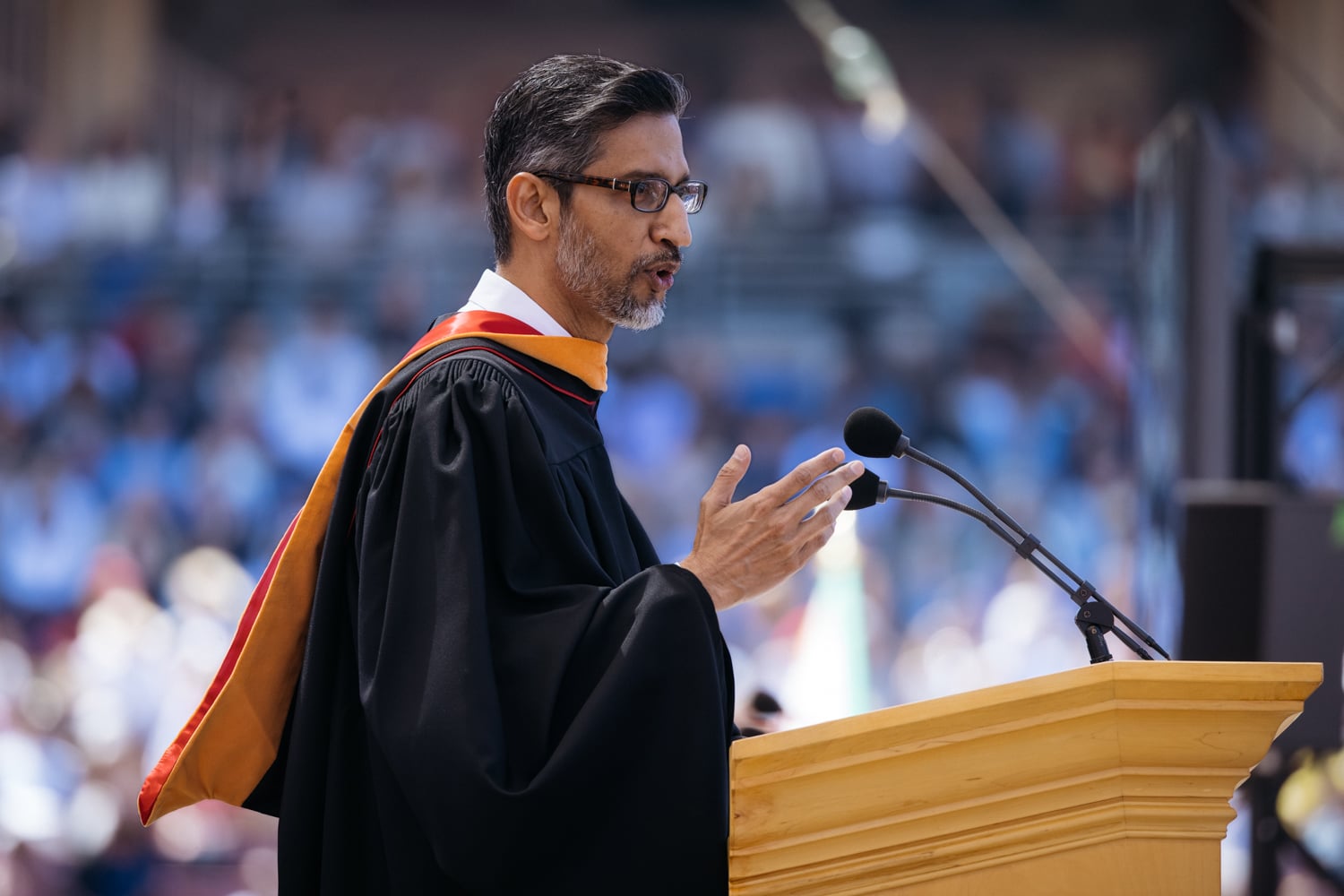
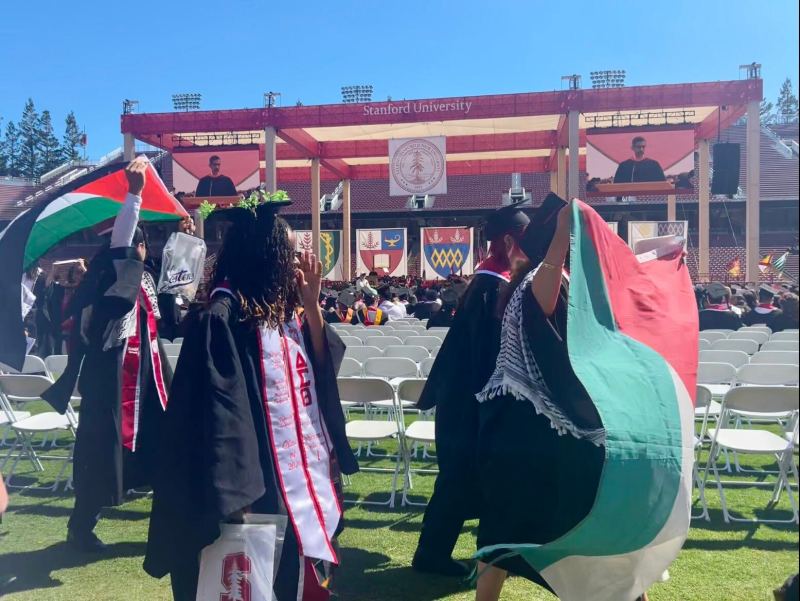
Google CEO Sundar Pichai M.S. ’95 advised students to choose optimism, do hard things and pursue their passions during his address at Stanford’s 135th commencement ceremony Sunday. Around 100 to 200 students — out of 6,000 total graduates — walked out of Stanford Stadium during the speech to protest Google’s involvement with the Israeli government and U.S. Immigration and Customs Enforcement (ICE).
Protesters held their own commencement ceremony in the Arboretum, just outside the stadium. This year marked the third Stanford commencement in a row where students walked out.
In an interview with The Daily, Pichai responded to protesters’ criticism. “As a company [that] provides technology at scale, there are standard tools [that] we have, which [are] available to everyone to use,” he said.
Meanwhile, at the ceremony, Pichai’s message to graduates focused on life lessons he learned at Stanford and beyond.
School and extracurriculars are not the only important parts of a holistic education, he said. He related this to an experience with a former classmate, who encouraged him to skip class for the first time on an impromptu trip to Las Vegas.
“No one seemed to notice that we had missed class. For the first time, I realized the world [wouldn’t] end if I relaxed a little,” he said. Pichai said he hoped that Stanford graduates would recognize the importance of fun in addition to hard work as they exited an environment of high-achieving academics.
Another lesson was to frame life’s setbacks optimistically. Pichai said he learned this on his first visit to California. Having been sold on beautiful beaches and lush forestry, the state wasn’t quite what he expected. The greens he was looking for were mostly browns, and the ocean was absolutely frigid.
He later came to appreciate the scenery for what it was — to “see that particular brown hill as golden” — and to recognize that a year-round summertime climate made up for the cold water temperature. In a similar way, he hoped graduates could see the best in their environment even if it fell short of their expectations, he said.
Pichai also reassured the class of ‘26 that uncertainty is normal post-graduation. “Even a decade [after Stanford], I felt like I wasn’t on the right path, and it took me a while to find my footing.” However, it only took one big break — his final interview at Google — for Pichai’s career to take off, he said. Pichai advised graduates to remain tenacious in the face of difficulties.
Lastly, Pichai said graduates should seek out what most excited them. Having grown up without much technology, some of his personal inspiration comes from the rapid development of the internet in the 1990s and the readily accessible technological resources he had while on campus.
Returning to Stanford as a commencement speaker marked a full-circle moment for Pichai, who initially attended Stanford as a Ph.D. candidate in 1994 before pivoting to a master’s in Materials Science and Engineering due to financial constraints. Since then, Pichai has overseen the development of flagship Google programs like Chrome, Maps, Drive and Gmail, but some things never change.
“Every time I drive down Palm Drive, I still get the same chills I got when I came here 30 years ago,” he told The Daily.
For Pichai, Stanford was an opportunity to “reframe the world in a more optimistic way.” Meeting students and faculty trying to change the world for the better left a lasting impression, he added.
Boos have broken out at some ceremonies this graduation season when speakers promoted artificial intelligence (AI). Pichai notably did not address the subject in his speech.
Speaking to The Daily, however, he described new graduates’ prospects in the age of artificial intelligence with characteristic positivity. “I think these tools are empowering people to do more meaningful work,” he said. “Some of them are removing some of the more repetitive parts in [workers’] day-to-day tasks, which allows them to spend their time in a better way.”
Sunday’s ceremony was the first that Pichai’s parents have been a part of. They were sitting in the stands as he addressed the crowd. Some of his old school friends also returned to watch him speak. “It’s a mini reunion of sorts,” Pichai said.
But not everyone was there to hear his words. As Pichai addressed the graduating class, some students headed to the Arboretum to attend what they called the People’s Commencement.

Pro-Palestinian activist Mahmoud Khalil, known for his protest organizing at Columbia University and his 2025 detention by ICE, delivered an address at the event.
“Over a year ago, while my classmates walked across the stage, I sat behind bars,” he said, referring to the detention. “My crime was literally speaking out against Israeli genocide in Gaza. My crime was refusing to stay silent.”
He went on to commend student activism. “When the moment comes to choose between comfort and conscience, choose conscience,” he said.
The demonstration also featured poetry readings, musical performances and student speeches. From a small stage decorated with flowers, newspaper clippings and flags, speakers expressed solidarity with the people of Palestine and opposition to authoritarianism.
Organizers and attendees say Pichai and his company have enabled human rights violations. They cite Project Nimbus, a $1.2 billion contract by Amazon and Google to provide artificial intelligence and cloud computing services to the Israeli government. Protesters also oppose Google’s provision of cloud services to federal agencies.
“The entire company, under [Pichai’s] direction, is profiting from war and genocide and ICE brutality,” said organizer Amanda Campos ’26. “The millions and millions he’s making are blood money, and to put him on a stage and normalize all of this is quite literally washing over human rights violations.”
The event was inspired by a desire for students to “have the ceremony that we deserve,” Campos said.
The walkout was co-organized by No Tech for Apartheid (NOTA), a group of current and former Google and Amazon workers who oppose Project Nimbus. Attending the alternate ceremony was Nur Iren, a former employee at Google and NOTA member. “It’s very disrespectful to the students who have spent their last four years working here… to have to sit and listen to this war profiteer,” Iren told The Daily.
Iren is one of the hundreds of current and former Google employees who have spoken out against the company’s associations with ICE and Project Nimbus. While Iren says she quit last August, Google recently fired 28 employees who participated in a sit-in protest against the project.
The Daily reached out to Google for comment.
Pichai told The Daily that he valued the protesters’ ability to make a statement about their beliefs. “I appreciate where people are allowed to speak out and express their opinions,” he said. “I’m glad students were able to express their concerns in a peaceful way. That’s part of what makes this a great place.”