
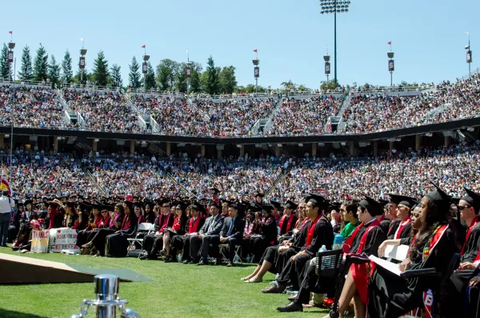
Before the Class of 2026 graduated on June 14, graduating seniors shared reflections on their time at Stanford and plans for the future.
71 members of the Class of 2026 responded to a Daily survey on the class’s demographics, their experience at Stanford and plans after graduation. Despite the small sample size, the data showed a trend among graduates of plans to stay in the Bay Area and pursue advanced degrees.

Thirty-five seniors, approximately half of the respondents, planned to attend graduate or professional school, including coterminal programs. Another 19 will begin working full-time. Nine said they will begin fellowships or research, two will take time off, one will work on a company they founded and two were unclear on future plans.
The plurality of graduates planned to stay in Silicon Valley and the San Francisco metropolitan area. The plurality of students are also from California, reflecting Stanford students’ close ties to the state.
The next-biggest post-graduation destination for Stanford grads was New York, while various other cities, including Washington, D.C. and Chicago, had a few each. A few respondents planned to live internationally: two will go to Asia, two to Europe and one to Latin America.
Meanwhile, students had a mean mental health satisfaction of 65.1 on a scale from one to 100 throughout their Stanford experience. The median was 70.
Academics were ranked the most satisfactory part of student life, with a mean of 83, followed by social life. With an average of 62, sleep fell below mental health, which had an average of 60.2.
Averaging mental health satisfaction by post-grad plans revealed several correlations. Students who reported the lowest average satisfaction were those with unclear plans, whereas the one founder reported the best mental health while at Stanford.
Despite being the largest group of post-grads, those going into graduate or professional school ranked third in terms of their mental health satisfaction.
Another grouping of mental health satisfaction, this time by reported income bracket, revealed a nonlinear relationship.
Students coming from households that made under $25,000 annually reported the lowest mental health, averaging 49 out of 100. Households that made over $500,000 reported the highest, with an average of 75. However, between $25,000 and $200,000 in annual household income, students’ mental health stagnated and even minorly decreased.
When asked how best to describe Stanford’s cultural atmosphere, the most common response was “influenced by wealth,” with 47% of respondents. After that was a tie of opposites between “cliquey” and “supportive and collaborative,” with 36% of respondents each.
With 71 respondents out of a graduating class of roughly 1,800, this survey captures a slice rather than the full picture of the Class of 2026. But the patterns that emerge — including the pull of the Bay Area, the mental health gap and the weight of wealth disparities — echo struggles and realities of the Stanford experience.