
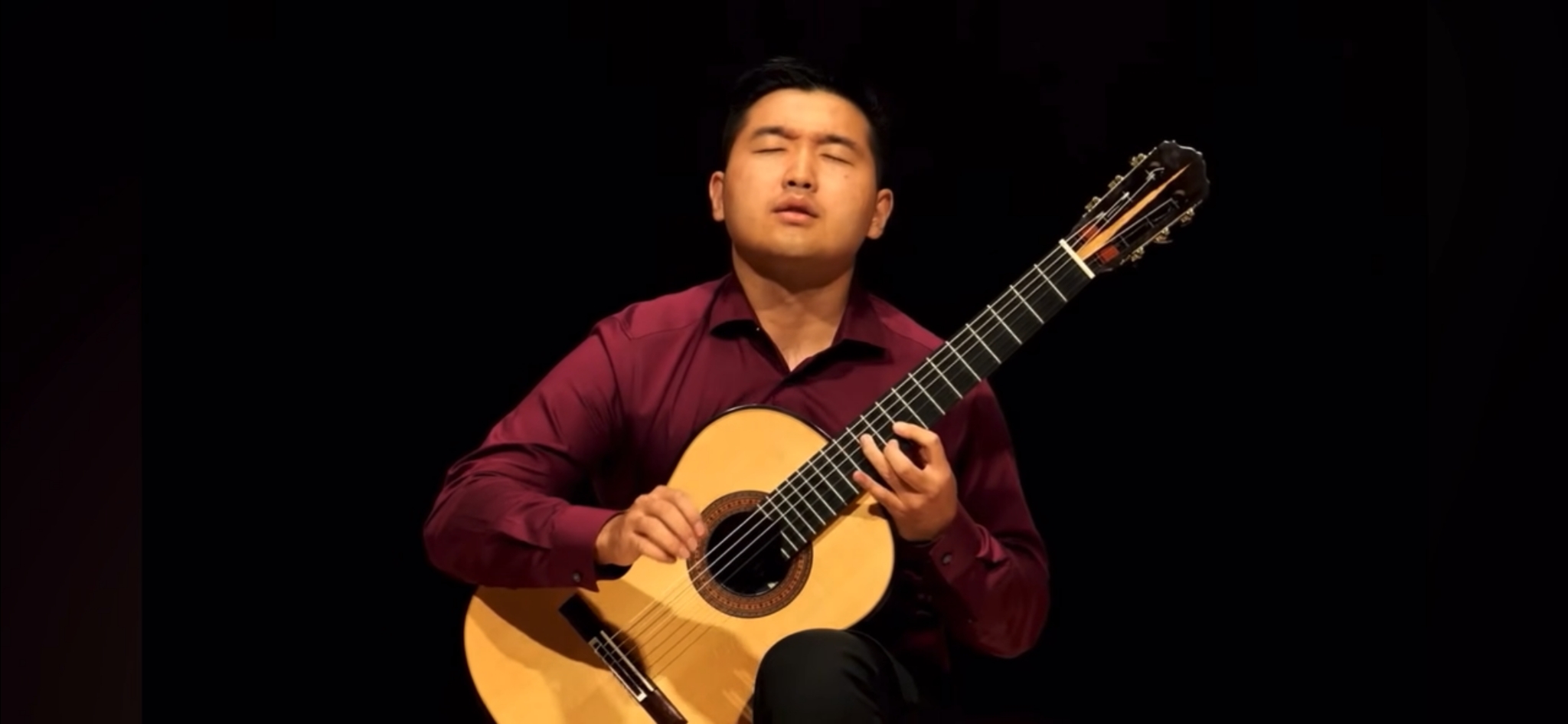
Soon after graduating from Stanford, Eric Wang ’26 flew to Denver as one of 32 contestants in the Guitar Foundation of America’s 2026 International Concert Artist Competition (ICAC).
The ICAC is one of the premier competitions for classical guitar. This June, competitors from countries including the USA, France, Portugal and elsewhere gathered for a week of intense performance. After multiple rounds reviewed by a jury of distinguished guitarists, Wang received the coveted Rose Augustine Grand Prize.
The prize comes with a 50-concert tour in the U.S. and Canada, a recording contract with Naxos — one of the preeminent classical music labels — and a Carnegie Hall debut.
“The profile it gives is potentially career-launching,” interim competition director Helen Sanderson said in an interview with The Daily. “It’s a really golden opportunity for an upcoming young professional.”
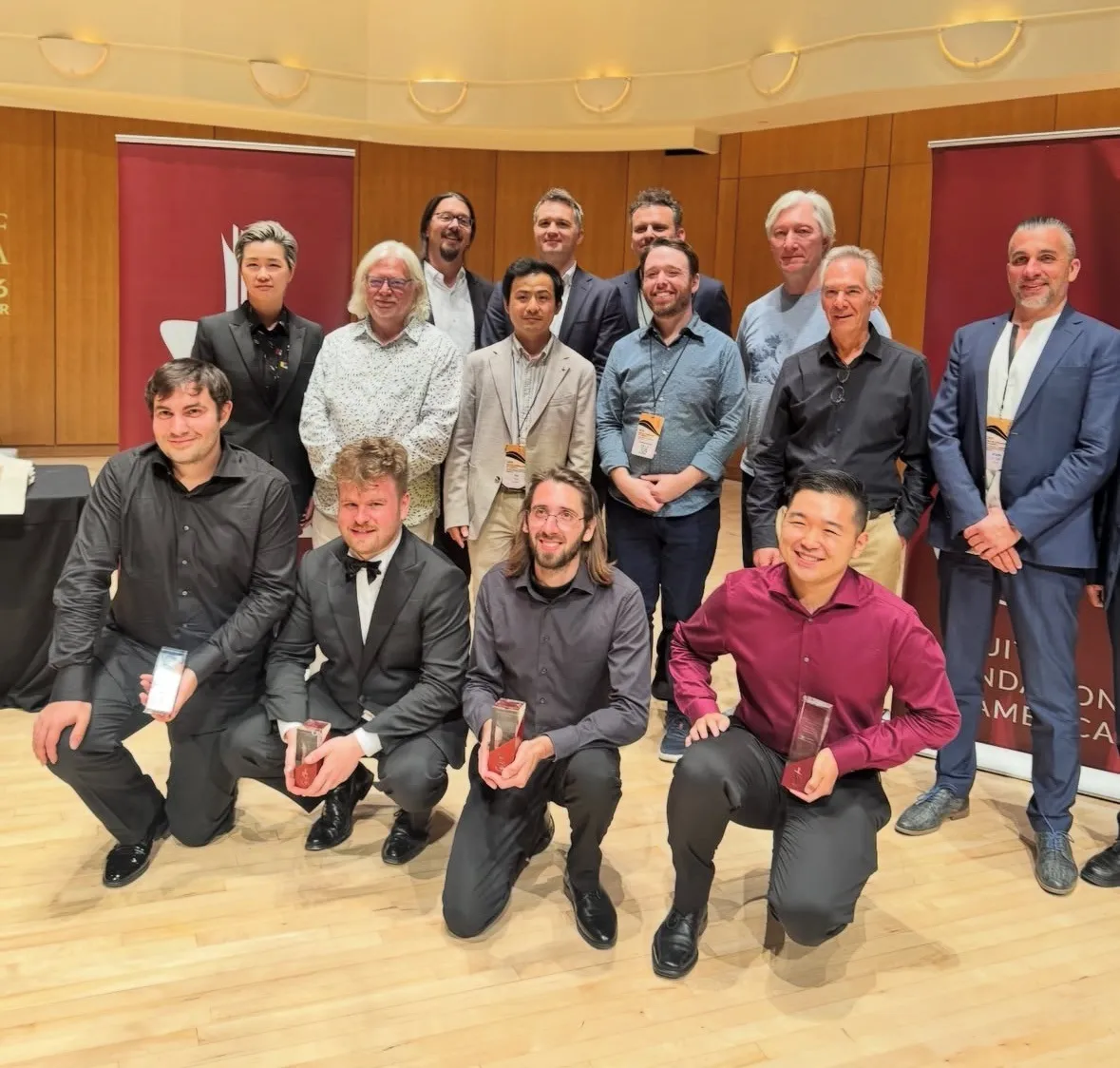
Front row (right to left): Eric Wang (first prize), Guy Hirschberger (second prize), Rémy Patel (fourth prize), Timothée Vinour (third prize). (Photo: Courtesy of Eric Wang)
According to Sanderson, performance at this level demands a combination of virtuosity, stage presence and artistic vision. “It’s absolutely fascinating to see that blend of someone who not only has the technical prowess,” Sanderson said, “but also someone who has a strong musical narrative to share, who’s a real communicator.”
Wang is also the only three-time winner of a Guitar Foundation of America competition, having previously won the junior and senior divisions of the International Youth Competition.
Wang began playing the guitar at the age of four, inspired by his father, an amateur classical guitarist. Growing up, Wang considered music a hobby. “It’s only in college that I’ve started to view it as something I’m doing at a professional level,” he said, “something that I really, really like.”
Wang, who majored in music, attributes important aspects of his musical development to the opportunities he found at Stanford. Though he acknowledged the music program does not have the rigorous structure of a conservatory, its flexibility has allowed him to explore and develop as an artist in ways he could not have found elsewhere. “The most remarkable part of Stanford is your fellow students,” Wang said. “In music, I was very fortunate to have met people who stimulated me intellectually … and I get to study in avenues that are pretty unorthodox.”
One example is his studies with Stephen Prutsman, visiting artist-in-residence at Stanford since 2023. As a pianist, conductor and composer — but not guitarist — Prutsman is an unusual mentor, Wang said.
“It’s so interesting working with him,” Wang said. “As guitarists, often we’re so engrossed in technique that it’s easy to lose sight of the larger musical vision … that’s where Stephen really excelled. It’s helped me play much more effectively in the sense that I want my music to really, really convey this thing rather than get trapped by the nuances of guitars.”
“We would talk purely music,” Prutsman said. He described his and Wang’s artistic process: After they deconstructed and discussed a piece of music, Wang would come to his own interpretive decisions. His relentless focus on the larger musical vision shone through in his performance.
Wang also credits chamber music as an important setting that nurtured his musical development. At Stanford, he composed and arranged for Ensemble Oh?, a student group which showcases original music.
Music was only one side of Wang’s Stanford career. While performing at the highest level in classical guitar, he also majored in physics, receiving both a B.S. in physics and a B.A. in music this June. Balancing musical and academic pursuits was challenging at times. “It’s definitely something you need to make sacrifices for,” he said, “deciding, ‘I need to spend my time here because I really care about this thing.’”
For the next two years, Wang will embark on the extraordinary journey offered by the Grand Prize: recording, touring and working on other musical projects as he builds a name as an artist. After that, he is faced with the decision of continuing a career as a concertizing musician or returning to Stanford, having been accepted as a coterminal master’s student in the electrical engineering program.
“Coming to college, studying these two things, I hoped that by the end, I would have more clarity on one direction or the other,” he said. “And I kind of do. I’ve decided that in this time period, I would be focusing on music.”
But the future is still in the air. “No matter what, I’ll still be doing music, but the question is, in what capacity — whether that will be full-time or I’ll be doing something else as well,” Wang said.
For now, both doors stand wide open.