
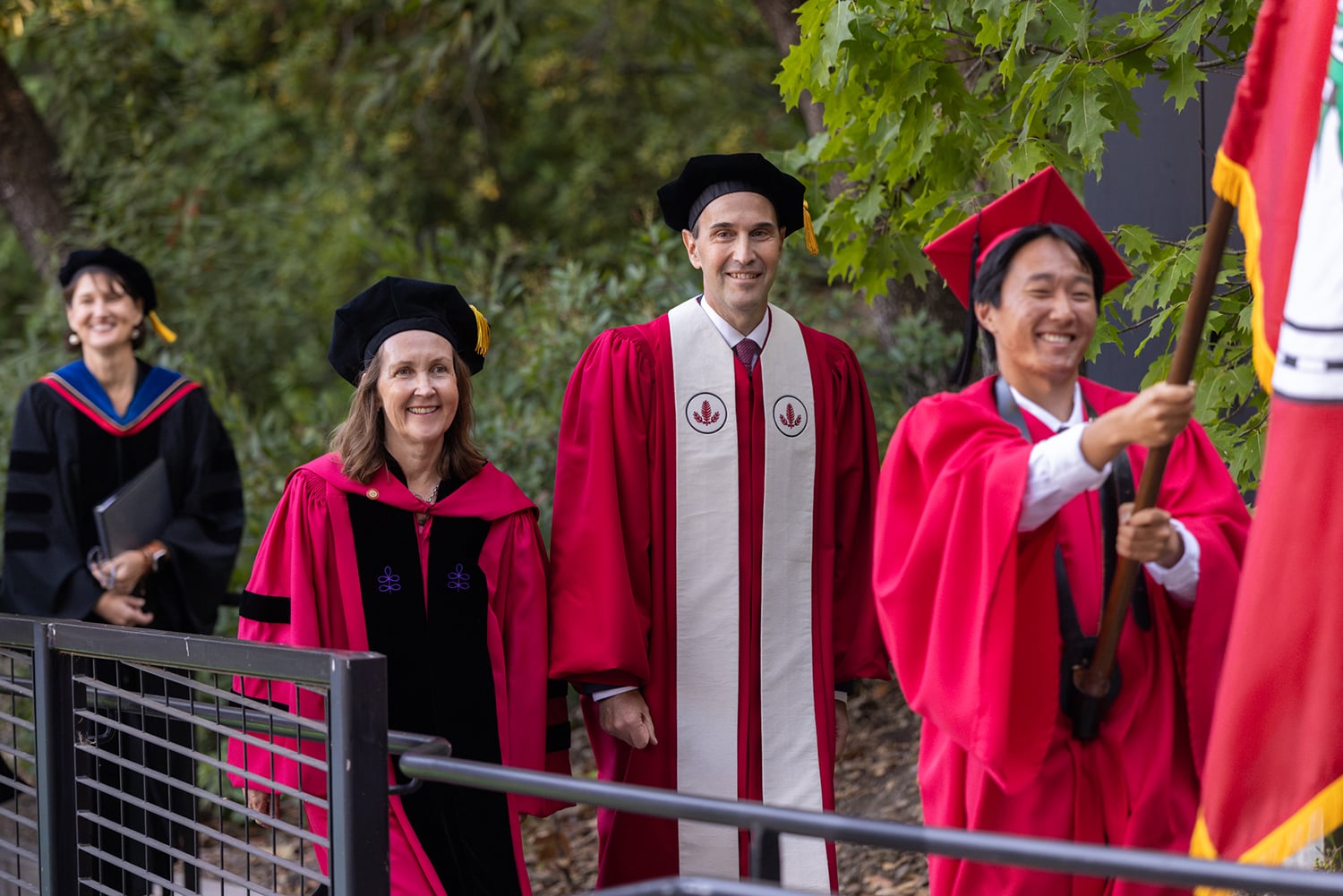
Stanford’s 136th Opening Convocation brought together speakers from all corners of the university to welcome the incoming 2030 freshman class and transfers, kicking off a packed week full of programming for the new arrivals on campus. Notably, this was the second commencement to not feature a land acknowledgement.
The excitement in the air was palpable; as the melodies from the convocation brass quintet drifted from the stage, so did the raucous cheers and chants from the various dorms as a display of pride.
Like his soon-to-be COLLEGE students this coming fall, President Jonathan Levin ’94 made his way through a plethora of readings on education from Plato to Du Bois and raised the question of how a Stanford education would prepare you, the student and learner, for a good life. He proposed three answers – the freedom to explore, the expertise and opportunity for student-faculty relationships provided by a research university and the campus experiences, evidenced by the diversity of the incoming class.
“At the heart of Stanford is a belief in our ability to work together and solve problems – a belief that the future is something you build rather than something that happens to you,” he said.
Levin recalled his own decision to choose Stanford based on this “spirit of exploration,” something exemplified by Jessica Watkins ’10, who changed her major and was able to pursue a plethora of interests from D1 women’s rugby to an internship at NASA Ames. It was this openness to new experiences and the realm of possibility that Stanford could offer that propelled her to a PhD and selection into NASA’s astronaut program, he said.
Both Rev. Dr. Tiffany Steinwert’s invocation and benediction involved her calling upon the new students to absorb the excitement in the air and reflect on how far they’d come, looking back at the families and support structures who had brought them here to this moment. “Friends, look around – I really mean it,” she said.
Richard Shaw, dean of undergraduate admissions and financial aid, put the new frosh and transfer class into perspective: 1950 of them were gathered in the amphitheater’s grassy bowl, 1872 of them first-year students. Of the 78 transfers hailing from 65 colleges, 26 of those were community colleges. All 50 states were represented, along with 72 countries.
Vice Provost of Undergraduate Education Jay Hamilton recalled an alum who described the “ultimate undergraduate experience [as] finding your fellow travelers, those who truly influence your life.” “I see 3.5 possible answers,” he added, listing classmates, faculty, authors, and generative AI as the last half.
Hamilton cautioned against an overreliance on AI, citing a loss in conversations with classmates and professors alike and “working to truly understand an author’s logic and meaning.”
“In short, you’ll miss out on finding your fellow travelers,” he said.
To end on a high note, Hamilton quoted Mary Oliver’s poem “The Summer Day,” and described the next four years as “wild,” “precious,” and “you,” stressing the unique joy and experiences lying in wait.
Bryan Gonzales ‘27, a residential assistant (RA) for Robinson and the selected student speaker, shared how he nurtured his resolve to find lifelong friends and further pursue academic interests on the Farm, just like plants on the farms from his hometown in Southern Illinois.
“It is in these moments of coming together, when we open ourselves up and take the time to be curious of each other, that we begin to build our own community,” he said.
For Saron Amsalu ’30, Stanford “has been a dream since she was 5,” and it was “surreal” to be at Convocation with her new peers. She gushed over Soto’s dorm merch and shared her excitement for Stanford firsts, like picking her classes and having a roommate for the first time.
Eden Amsalu, Saron’s mom, echoed Levin’s remarks with pride: “As the president said, she’ll explore and do new things.”
Saron’s family sent her off with one last photo in Frost Amphitheater after the recessional, along with dozens of other families doing the same.