
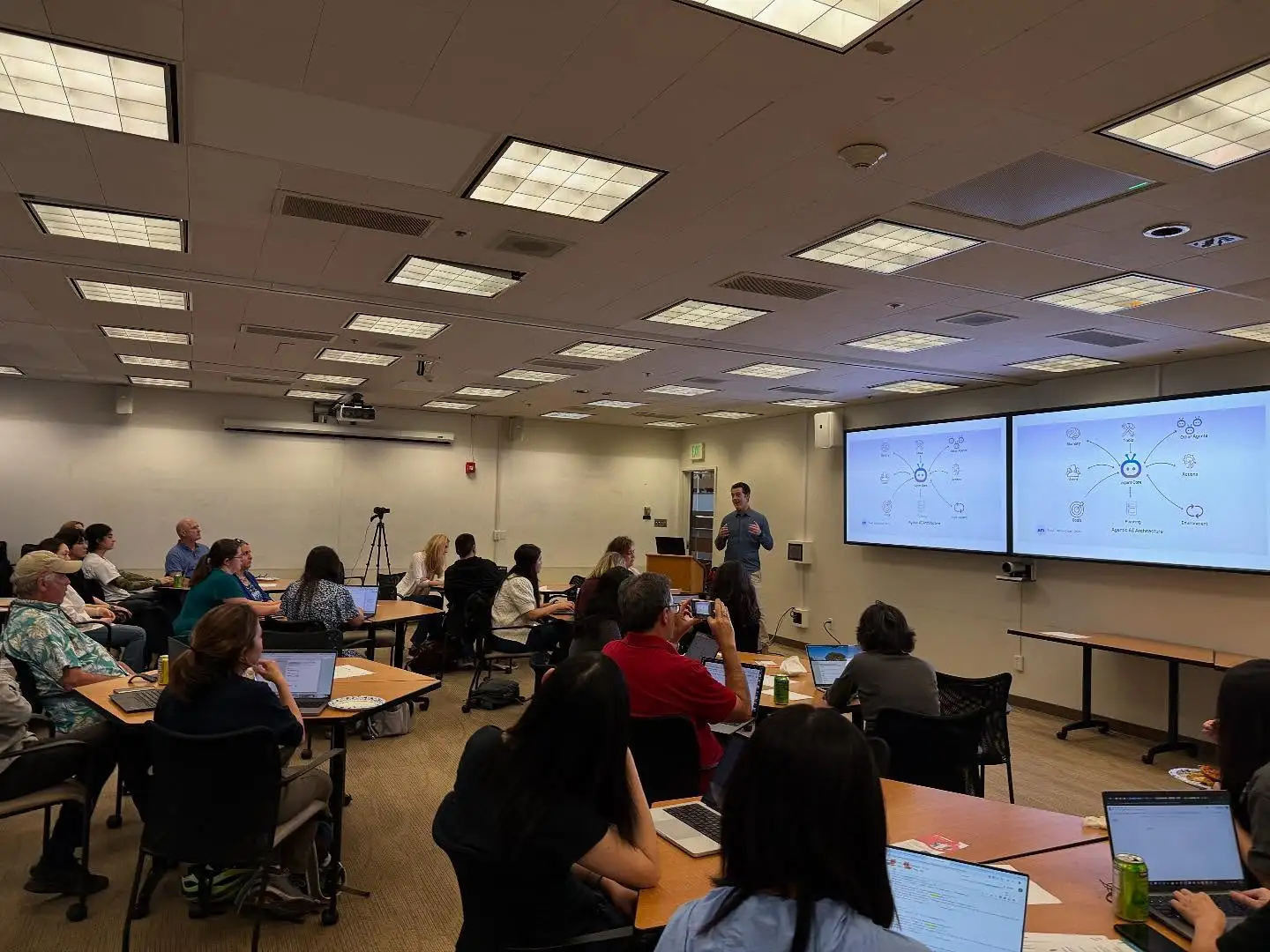
As Silicon Valley develops increasingly capable AI models, Stanford researchers Gregory Wilson and James Zou are examining how the technology can be applied to public policy, scientific research and education.
Wilson and Zou described AI as a tool to expand human capabilities while still requiring human judgement.
At Stanford’s AI Tinkery, Wilson is exploring how AI can affect education. The Tinkery gives students an informal place to experiment with AI, robotics and other emerging technologies as they consider deeper questions about ethical implications in privacy, security, copyright, creativity and cognitive function.
“We’re not necessarily pro-AI or for everyone to use AI,” Wilson said. “But we want to make that space available for people to know what it’s capable of and then maybe decide not to use it.”
Wilson noted that the Tinkery’s approach becomes important especially as students gain access to state-of-the-art AI tools capable of complex tasks such as generating ideas, designing robust solutions to problems and writing text.
For Wilson, AI literacy includes understanding both what the technology can do and the tradeoffs that can come with relying on it. One activity at the Tinkery allows participants to choose between an “AI boost” and a “human boost” while working through stages of a project, Wilson said. Students might use AI to evaluate an idea, or they might speak directly with potential users to understand how to create better products.
A similar distinction appears in scientific research, where Zou said AI can expand what researchers are capable of without replacing the scientists directing the work.
Zou, a leader of Stanford’s AI for Science Lab, studies the extent to which artificial intelligence and machine learning can have an impact on scientific discovery and address problems across fields including biology and healthcare.
“A lot of our work is on both advancing the frontiers of AI systems, and then applying these to tackle important problems across different scientific domains,” Zou said.
In the biomedical field, Zou said AI can help researchers study the mechanisms of aging, develop better molecules and help clinicians make more informed decisions.
Zou pointed to EchoNet, a technology developed by his lab, which is a computer vision system that utilizes ultrasound videos to assess cardiovascular conditions. Zou said EchoNet has received FDA clearance to perform assessments on several different cardiovascular conditions.
While Zou explores how AI can affect scientific research, Wilson is asking a similar question in education: how can AI assist students and teachers without replacing the human relationship at the center of learning?
Instead of focusing on whether or not AI will replace teachers, Wilson said that the most promising direction involves using technology to help teachers build more personal learning experiences for their students.
“We know that in education, a lot of it’s about relationships and that’s what motivates students to learn,” Wilson said. Even as automation emerges, Wilson argued that human interaction remains central to learning.
“There’s a lot of power in learning together,” Wilson said. “I think learning should stay human as much as possible.”
Zou described another area where AI may augment, rather than replace, human research: the social sciences. He noted that AI can assist social science researchers with data analysis and curation. His team has explored using AI to simulate populations, which can help researchers study the effects of policies before moving on to real-world settings.
Furthermore, Zou said AI agents can help scientists gather information, conduct literature searches and suggest potential research questions or experiments.
However, Zou cautioned against becoming overly reliant on AI in scientific research: “I think it’s still really important for the human scientists to think critically, to be able to drive these research projects, and then to really verify and to validate the findings,” he said.
Wilson raises a similar concern in education, where AI’s ability to complete increasingly complex tasks shouldn’t make students reliant on it.
Limitations also remain regarding an AI model’s ability to conduct scientific research on its own. Zou notes that current systems struggle in conducting experiments, understanding the broader context of human issues and verifying results that are difficult to comprehend. One of the biggest challenges for AI in science is how AI can do more open-ended research, he said.
Both Wilson and Zou say that in science, education and the humanities, the era beyond chatbots is not about giving work to these highly capable machines, but rather coexisting and playing to the strengths and weaknesses of humans and AI.