
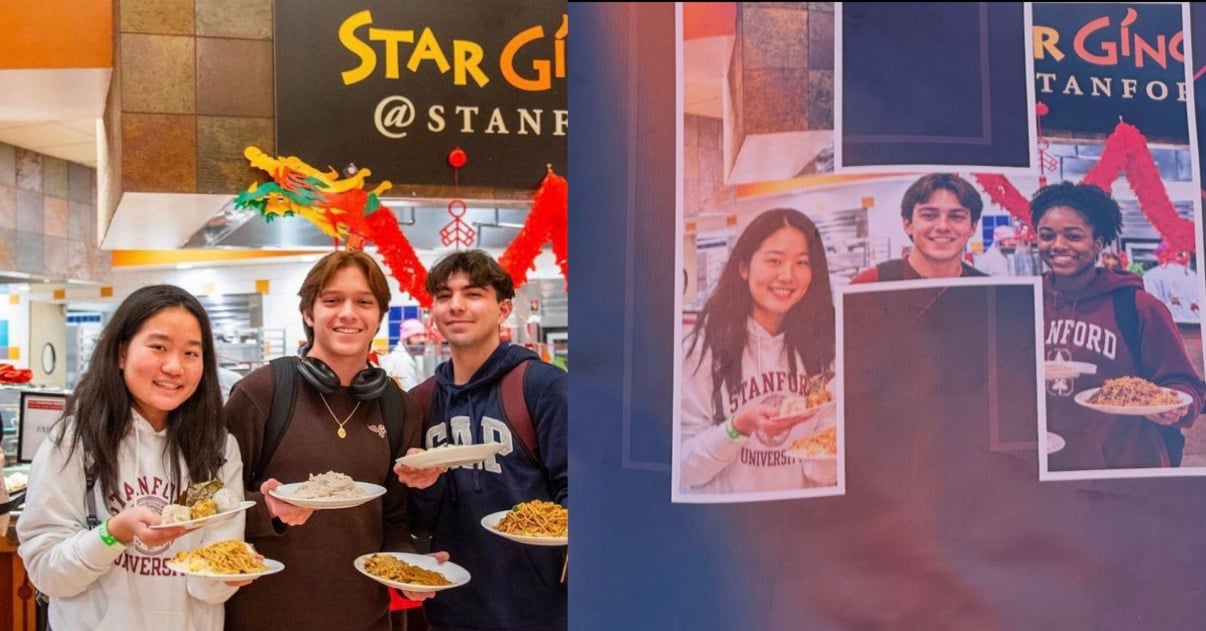
Stanford confirmed that Residential and Dining Enterprises (R&DE) used generative AI to modify the appearance of several students in a promotional image. R&DE changed the students’ clothing into Stanford merchandise, slimmed down two students’ faces and entirely changed one student’s race, gender and appearance.
University public relations director Charlene Gage said that the image was altered with AI in violation of University regulations. “Stanford’s AI policy is clear: The use of AI in producing or altering images of Stanford people, events, research, facilities, or achievements is strictly prohibited,” she wrote to The Daily.
“Both the alteration and lack of disclosure in this case violate that policy. We are working to provide additional training for all staff and ensure proper review of all materials.”
The incident has caused national controversy, stemming from a now-viral Fizz post by Stanford student Billy Ramirez ’27, one of the students in the photo. The Daily confirmed that the photo was used in a custom banner in the Governor’s Corner student housing center, which has since been taken down.
The alteration has since drawn attention from news outlets across the country, including The New York Times and San Francisco Chronicle.
In a statement to The Daily, Ramirez said that a friend initially sent him the edited photo. “I thought that maybe they merged me with the guy in the middle, but I was like ‘Oh, no, they actually replaced me,’” he said. He described the incident as “funny,” but also noted that he was exhausted by the current level of media attention he had received from outlets across the country.
“I’m so tired, I want it to stop,” Ramirez said. “I don’t want my legacy at Stanford to be ‘the AI guy.’”
According to Ramirez, the original image was taken in Stern Dining at the 2024 Lunar New Year Dinner, and that the unaltered photo had been used in previous University promotional material.
Ramirez also told the Stanford Review that while he initially found the decision “hilarious,” he quickly became upset at the University’s willingness to alter his identity and background for official advertising. “Seeing my identity changed and being left out of the picture made me feel, in a way, silenced and erased from a representation that was supposed to include me,” he said.
Many students have taken to Fizz, an anonymous social media app, to criticize the alteration.
“Students should be able to trust that their images are used accurately and respectfully,” Associated Students of Stanford University (ASSU) President Jared Hammerstrom ’27 wrote to the Daily. “We support the students affected and take their concerns seriously. I hope this leads to clearer practices around the use of AI going forward.”
Ramirez called for a public statement from the University regarding the situation. “These news organizations are really quick to say something, but when it comes to the University, [it’s] crickets,” he told the Daily.
Ramirez hopes this incident will be a wake-up call for the University over how it represents the student body. “[This] just shows there needs to be … more Black and Hispanic representation on campus,” he said.
Stanford has seen declining Black and Hispanic enrollment since the Supreme Court’s June 2023 decision to end affirmative action. The undergraduate class of 2029 saw a decrease in Hispanic students from 12.4%, from 15% the year prior, while the class’s Black population declined from 7% to 5.8%.
“Stanford wants to put on this image that, ‘yes, we are diverse.’ But then they actually need to pursue action to make a diverse community, which is not really happening,” Ramirez said.