
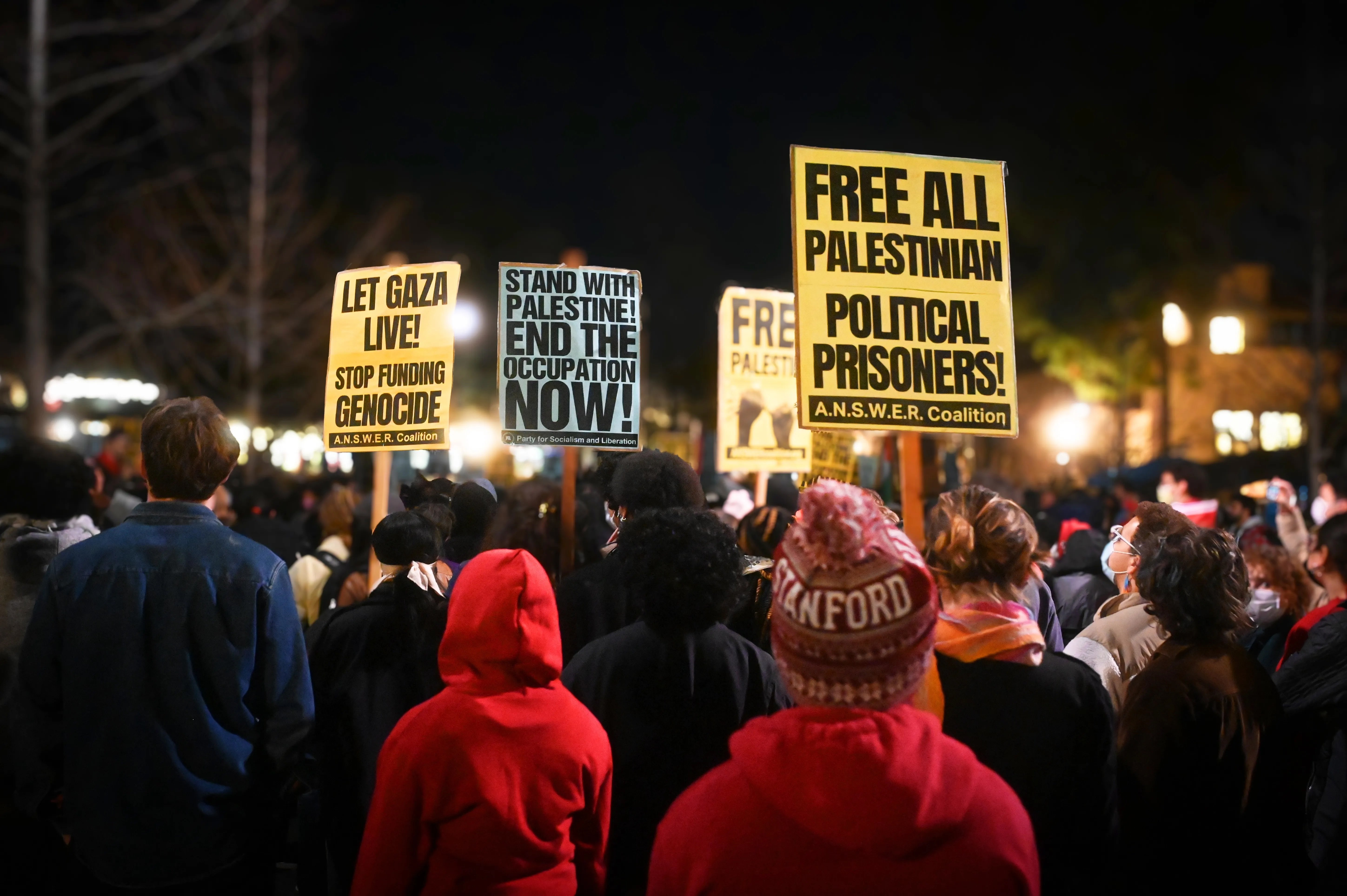
A new report from the American Civil Liberties Union (ACLU) and Amnesty International USA describes “systemic suppression of pro-Palestine and anti-genocide speech on college campuses nationwide,” citing Stanford as an example.
Among other incidents, the report noted an ongoing wrongful termination case filed by former Stanford Medical School Professor Wen Feng. In the complaint, Feng alleged that the University wrongfully terminated her for participating in the “Sick from Genocide” event, which focused on violence against healthcare workers in Gaza.
The 287-page document, which was sent to Stanford before publication, included a Sept. 16 letter from the University pushing back on the characterization. The Daily has separately reached out to the University for comment.
“Stanford is proud to have devoted many resources to ensuring freedom of expression and peaceable assembly on campus over the past several years,” wrote vice provost for institutional equity, access and community Patrick Dunkley in the letter.
He specifically referenced the Foundation for Individual Rights and Expression’s 2027 College Free Speech Rankings, which saw Stanford rise to No. 55 after being ranked No. 207 in 2023. “Our administration and faculty senate place the highest value on freedom of expression,” he wrote.
Dunkley also highlighted several University free speech initiatives, including its Freedom of Expression website and the creation of a Special Advisor to the Provost on University Speech.
“While more work remains to be done, we are confident that we have the will and capacity to protect our community members’ freedom of expression, and this will remain an ongoing priority,” he wrote.
Dunkley disputed claims of faculty censorship but refused to comment on Feng’s specific lawsuit, citing privacy concerns.
Parts of the report detailed instances of “unnecessary and excessive use of force” against student protestors on American campuses.
The organizations further concluded that universities disproportionately targeted their policies toward pro-Palestinian activists by restricting tent usage and banner hanging. Stanford was named as one such school.
More specifically, the report cited the Stanford Muslim, Arab, and Palestinian Communities Committee, which noted that policies against banners and flags in common spaces were “routinely ignored, and then invoked and enforced for the first time in response to pro-Palestine expression.” ACLU and Amnesty described the University’s actions as “selective enforcement…that raises serious concerns.”
The report’s broader survey included 80 schools nationwide, concluding that universities violated “basic free speech, association, and assembly rights” by punishing students for pro-Palestinian speech protected by the First Amendment.
The Trump administration targeted pro-Palestinian individuals on college campuses and “[coerced] universities into accepting broad-ranging agreements to restore federal funding in exchange for making institutional changes,” the report contended. According to the organizations, those actions chilled student speech on campus and hindered the protest movement.
“Campus leadership has suppressed free speech and peaceful protest while enabling the Trump administration to advance its anti-rights agenda and seek ideological control over higher education,” Justin Mazzola, deputy director of research at Amnesty International, said in a press release.
Amnesty International made headlines in Dec. 2024 when it declared Israel’s war in Gaza “an genocide.” It remains one of the most prominent human rights groups to do so.
Mazzola described the Trump administration’s actions as “dangerously reminiscent of McCarthy-era censorship” and “a blatant violation of academic freedom.”
In August, a U.S. District Court sided with The Daily in its free speech lawsuit against the Trump administration. The court ruled that the federal government had unconstitutionally deported legal immigrants on the basis of protected speech, chilling student speech on campuses.