
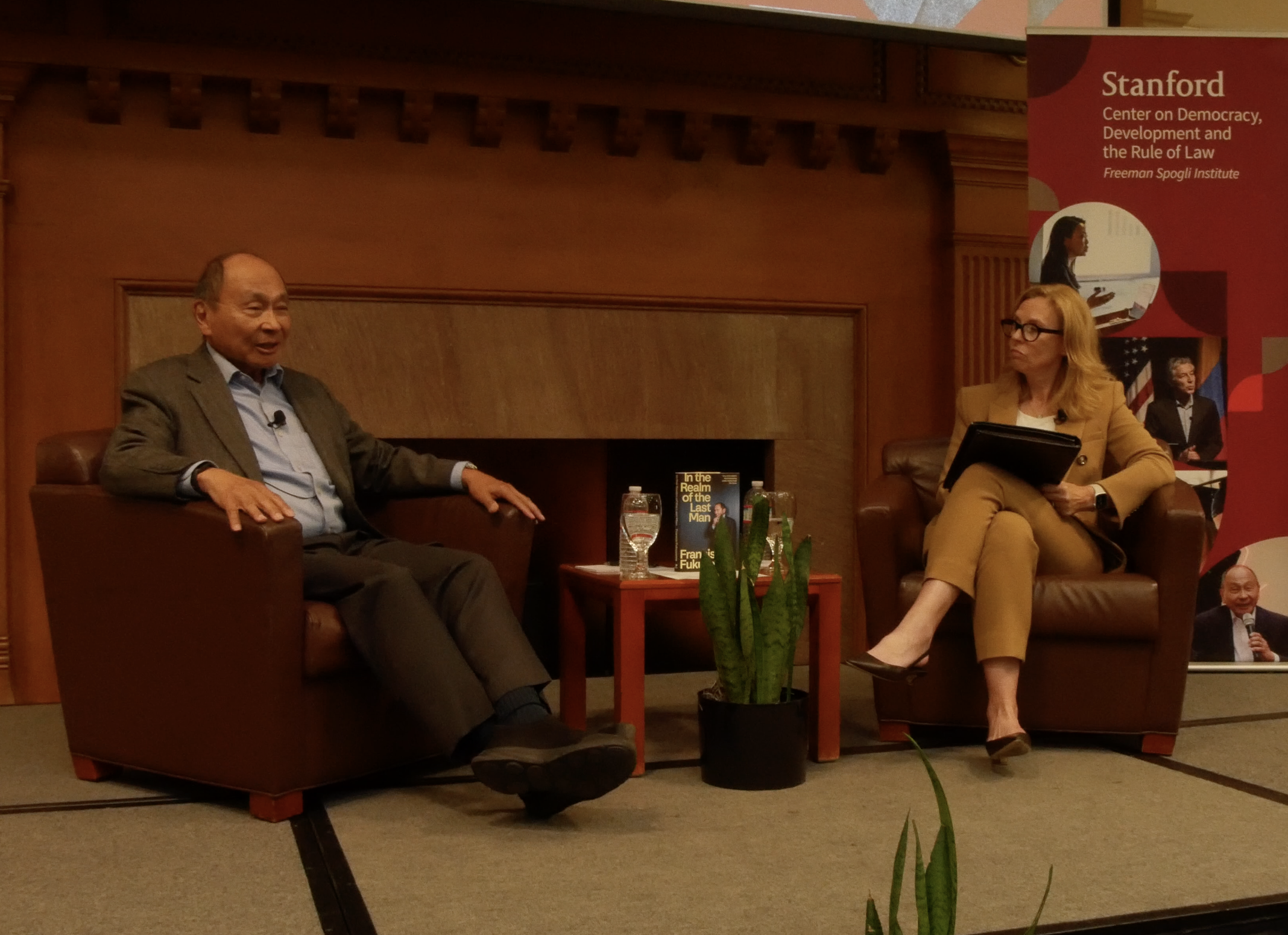
Passionate discussion of the trajectory — and possible end — of history unfolded at Bechtel Hall on Wednesday night as renowned thinker Francis Fukuyama — a senior fellow at Stanford’s Freeman Spogli Institute (FSI) — spoke about his new book, “In the Realm of the Last Man: A Memoir.”
The Wednesday talk tied together the personal and political, tracing Fukuyama’s evolution as a scholar through the personal and world events that shaped him. The Center on Democracy, Development and the Rule of Law (CDDRL) hosted the event, while Kathryn Stoner, a political science professor and Fukuyama’s successor as the Mosbacher Director of CDDRL, moderated the discussion.
“History, as I’ve used it, is not just the unrolling of events,” Fukuyama said during the talk.
A long-time faculty member at CDDRL, Fukuyama first gained global attention for his 1992 debut book “The End of History and the Last Man.” In it, he proposed the “end of history,” which suggested that ideological evolution ended with Western liberal democracy. Referencing Friedrich Nietzsche, he also theorized that this end would produce the “last man,” an individual living in a society that does not require struggle to exist peacefully.
Fukuyama referred back to his best-known work in naming the new memoir. For years since the 1992 book, his ideas from the early 1990s have faced misunderstanding or sharp questions, Fukuyama acknowledged Wednesday. That reception led him to write one final attempt to correct the record.
He specifically referenced the German philosopher Hegel, for whom “the end of history was not the determination of events. It was the goal towards which history seems to be driving.”
Attendees of the event were eager to hear Fukuyama reflect upon his influences.
“‘The End of History and the Last Man’ is seminal in international relations, and studying political science, it’s interesting to get to see someone in person and flesh out their minds,” said Cécile Pomarède, a predoctoral research fellow at the King Center on Global Development.
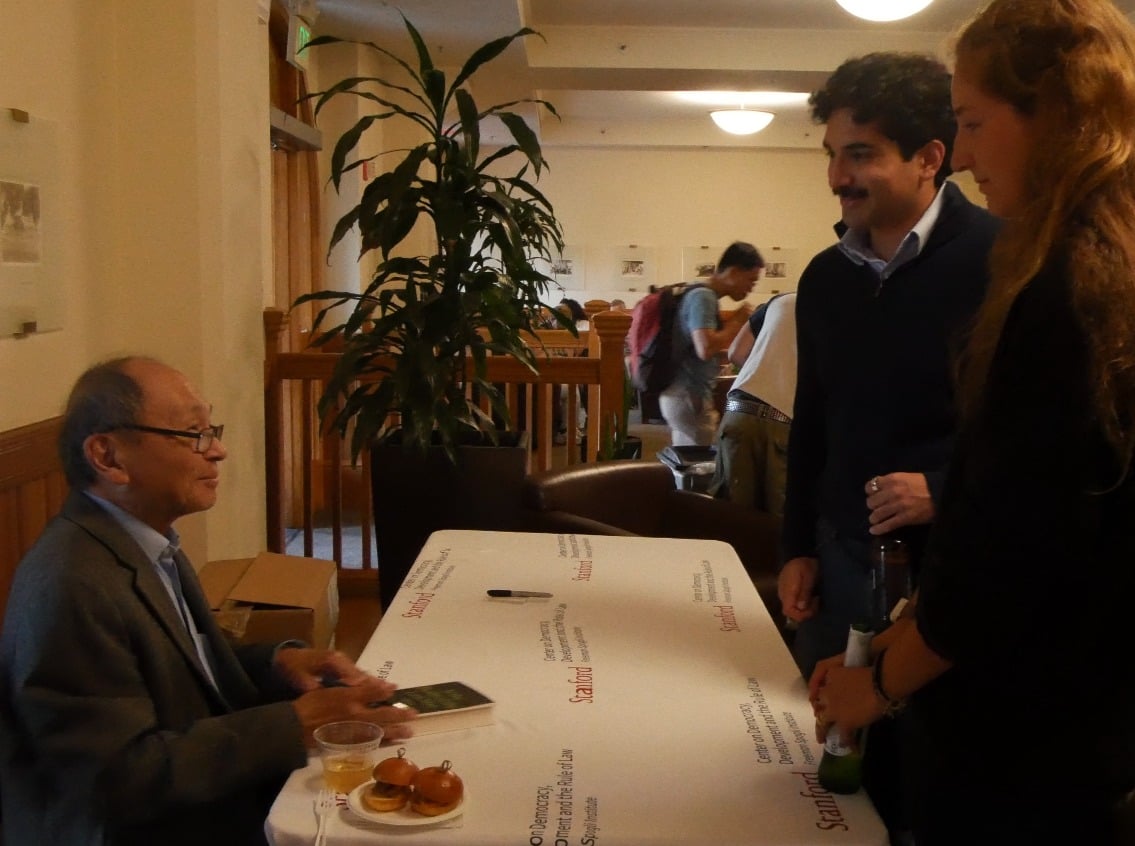
Much of the discussion dwelled on the current crises facing liberalism, which Fukuyama championed even as he acknowledged its “flattening” effect on “human variation.” He described the January 6 insurrection as a “chimera” that stemmed from a deeply rooted human desire to experience struggle, revolting against the past gains of liberalism.
Turning to the Trump administration’s actions, including challenges to the Constitution, Fukuyama said his family history shaped his perspective.
“I take the attempt to overturn birthright citizenship quite personally because my mother was on a student visa when she came to the United States, married my father and had me, so I would not be an American citizen if you didn’t interpret the 14th Amendment,” Fukuyama said.
At another point in the talk, Stoner invited Fukuyama to reflect on his break with the neoconservative movement in the 2000s. He described the Iraq War and the 2008 financial crisis as pivotal to his shift in worldview. Humans’ views, he contended, are often tied to group loyalty rather than pure reason, deterring many from updating their outlook.
Attendee Sian McAllister, a predoctoral research fellow at the King Center on Global Development, felt that an intellectual memoir by such an esteemed scholar offered unique insights.
“You live long enough to see how your personal life intersects with the events of your times and the main ideas of your time,” McAllister said of Fukuyama’s project.
While liberal democracy may be the “end of history” in Fukuyama’s eyes, a liberal arts education marks the beginning of citizenship. Fukuyama specifically expressed support for liberal arts curriculums like Stanford’s Civic, Liberal and Global Education (COLLEGE) program, encouraging students to proactively search for answers about the world.
“What is the best way to live? What is human happiness? What makes for a good, fulfilling life? If you don’t confront ideas on that scale early in your education, you’re really missing something,” Fukuyama said.