
Editor’s Note: This article is purely satirical and fictitious. All attributions in this article are not genuine, and this story should be read in the context of pure entertainment only.
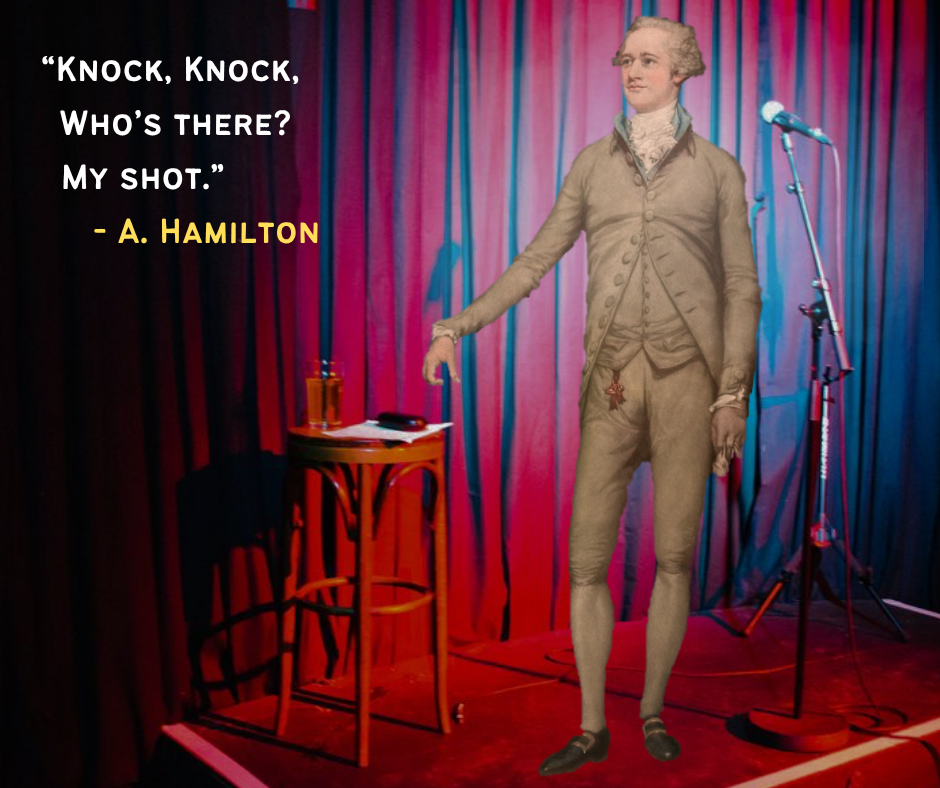
“Knock-knock. Who’s there? My shot.”
Statesman Alexander Hamilton pioneered the throwaway joke, an often dual-meaning, deadpan remark fired off in passing. He taught the technique to Bill Burr, who shot him to eliminate competition for his Netflix specials.
Comedy has always been political. As our reward, politics has never been more comedic, and we’re better off. Let me read to you a headline: “Dan Sullivan endorses Dan Sullivan to beat Dan Sullivan in perplexing Alaska Senate race.”
That’s just the tip of the iceberg. Insider trading has never been so accessible; try betting on yourself and kidnapping a dictator in the Global South. We’re democratizing measles and regulating elections. We relish peace so much that we’ve made several peace deals to end one war. It’s a gas. It’s a government of the people, by the people, for the people, like Lincoln prescribed in Citizens United v. FEC.
In 1985, media philosopher Neil Postman warned that our television centered-culture had created the “Age of Show Business,” a time period whose media environment rewards aesthetic appeal and entertainment value to the point that meaningful political discourse is nigh impossible. The past forty-one years have only reinforced his worry; for all my detractors that call humor a poor vehicle for philosophy and truth, I point them to a culture that sends memes in the comment section of a bot-populated internet about the legitimacy of hate crimes against marginalized communities.
The stakes are lower and higher at the same time.
And the battle at home rages on. Although the Department of Defense has reclaimed its original name, the Department of War, the vice of liberalism still compels the Hoover War Library to hide its birth name and water itself down as the Hoover Institution Library and Archives. Stanford’s Special Collections hasn’t yet surrendered its rare folios to Anthropic for slicing, scanning, and serving up to Claude. We’ve neutered Beyond Sex Ed, but what about Sex Ed itself? For that matter, what about Ed?
We ask not whether we will fight, only how. And I argue that superior to the sit-in and the walk-out as protest strategies is the stand-up.
Humor draws boundaries and humor fosters community, and it draws power from the fact that you never say what you mean, a principle that attracts two types of people. First, cowards. Bullies and tyrants who wrap hatred in comedy, giggling over propaganda slop and bonding through malapropistic dogwhistles. People who joke about other people’s suffering to make it trivial. I wrote the headline ironically, yet comedy is the best form of protest when what you’re protesting is dignity and action. Comedy for the sake of mockery persuades people to remain steadfast in hatred.
So why write humor? Why do I write humor? Why should you?
Because that’s not all comedy is, and that’s not all that comedy can do.
When I teach humor writing to my students in the Daily’s High School Workshops, I explain that if you can never say what you mean when you write humor, you must be precise about what you mean or you can’t be precise with what you say. So humor writing as an art is as close as I get to meditation, rumination, working through my contradictions at the basest and most philosophical level. Those of us attracted to the art of humor love the self-reflection it forces upon us.
Humor can draw boundaries between what we are willing to accept and what we are not; humor can foster community between people struggling to coordinate and organize together. Meaningful levity isn’t reductive mockery; it isn’t defined by humor’s ability to set people apart. Meaningful levity is defined by humor’s equal ability to bring people together intimately with an unsettled perspective. As we grapple with the world’s most comedic politics in human history, we deserve meaningful levity more than ever.
In that world, laughs are the bubbles that rise from the bottom of the boiling stove while mad men water down the melting pot to warn them that hot-headed hatred will blow up in their face.
Beyond its social impact, satire is the only honest way to make a living in the 21st century. It exemplifies the pattern that the most morally rewarding careers are often the most financially rewarding as well. I study Economics, but the only stocks I know are laughingstocks. Meanwhile, the dot-comedy bubble will never burst, except in laughter. For democracy and for the economy, comedy is the best policy.
Besides, wouldn’t you rather hear out a comedian over a politician on the state of the world? We’re not trying to sell ourselves to you. We do what we do because we’re too far left field to play politics. I’m not fit to run a campaign. In fact, I’m not fit. In high school, I could only ever run on a laugh track. That’s alright. Public office is the lowest form of democratic participation, rivaled only by voting, and you and I came to Stanford to learn How to Rule the World.
Well, I found my power. Like Neil Postman said, “In America God favors all those who possess both a talent and a format to amuse.” My barrel of laughs fires louder and farther than the barrel of your shotgun. Call us the Humor Institute. We’re a think tank. A lobbying firm. A social engineering degree. And if you want to fight the good fight, the bad fight or even the ugly fight… we want you. Come to the Daily House at 11am on Sundays and find your power.
Jenny Ballutay ’28, Vol. 270 Humor Managing Editor