
Stanford commencement speeches gradually shifted from a collective to a more personal framing between 2016 and 2026. Speakers now use “I” nearly three times as often as “we.” Ten years ago, “we” led by more than double.
The Daily used speech transcripts from The Stanford Report and natural language processing to analyze each speech, measuring sentiment, readability, pronoun usage and general diction from the past 11 years. The analysis showed shifts in tone, as well as in the attitudes and outlooks of the speakers, especially in relation to their experiences at Stanford.
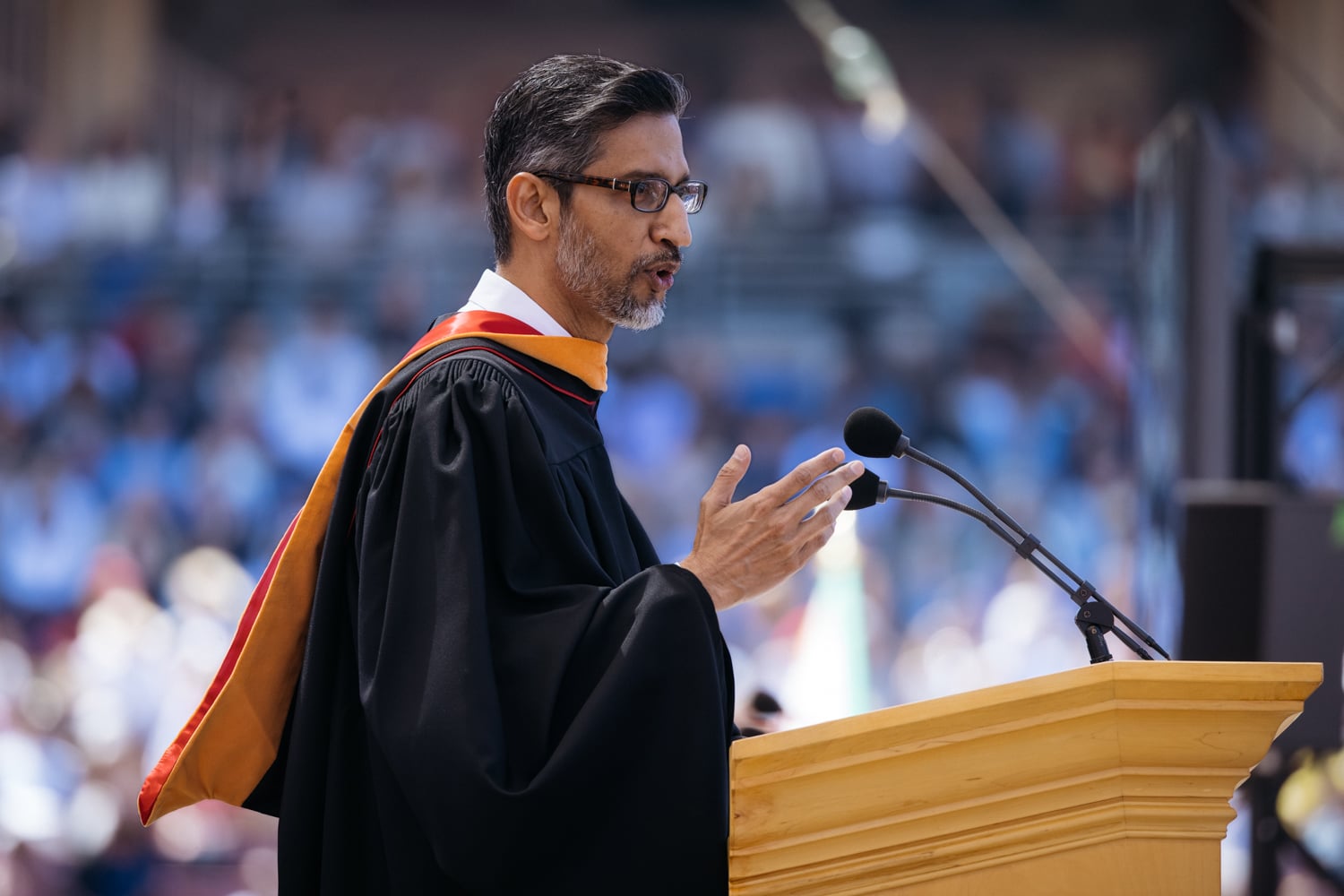
The commencement speakers from 2016-2026, in order, were documentarian Ken Burns, former Justice of the Supreme Court of California Mariano-Florentio Cuellar, actor Sterling K. Brown, former Apple CEO Tim Cook, astrophysicist France Cordova (though this address to the Class of 2020 was delayed until 2022 due to COVID-19), comedian Issa Rae, Netflix co-founder Reed Hastings, former tennis player John McEnroe, philanthropist Melinda French Gates, competitive swimmer Katie Ledecky and Google CEO Sundar Pichai.
Looking at the “I,” “we” and “you” pronoun distribution, “I” has become a larger portion of the language, while “we” has shrunk.
This data suggests a shift in priority from a collective framing to an individual, anecdotal approach over the past 10 years.
Interestingly, the Class of 2022 speech deviates from this trend, with “I” only leading “we” by a 0.13% margin. This could be attributed to a renewed sentiment in shared experience at the first in-person commencement since COVID.
Examining “grade level,” or textual difficulty, of the speeches over time reveals no consistent pattern. The mean is a grade level of 7.4 across the decade.
France Cordova’s speech to the Class of 2020 ranks at the highest grade level, 10.3. In it, she called on graduates to “vectorize into the unknown.” The simplest speech by the Flesh-Kincaid formula was Katie Ledecky’s 2025 address, which sustained the metaphor of life as a race.
The Daily mapped how feelings like anticipation, joy, fear and surprise measured across the corpus of speeches. Surprise consistently ranked among the lowest of these sentiments over the past decade.
When mapped altogether over time, anticipation ranks highest in seven of the 11 past speeches. This includes diction like “hope” and “future.”
The exceptions were Mariano-Florentino Cuellar in 2017, John McEnroe in 2023 and Katie Ledecky in 2025, all of whom carried more sentiments of joy than anticipation, as well as Tim Cook in 2019, with fear ranking highest. Cook’s higher fear sentiment stemmed from his caution to the tech industry, citing data breaches, hate speech and fake news.
Melinda French-Gates’ 2024 speech ranked highest in both joy and anticipation among all the speeches. She ended her remarks by encouraging grads to remain courageous and confident, and to become the “force that shapes the shore.”