
Stanford is hosting its fourth annual meetup for defense contractors this week, called DEFCON. The student-run conference brings together a host of AI, military, and weapons technology companies to promote industry engagement and recruitment at Stanford.
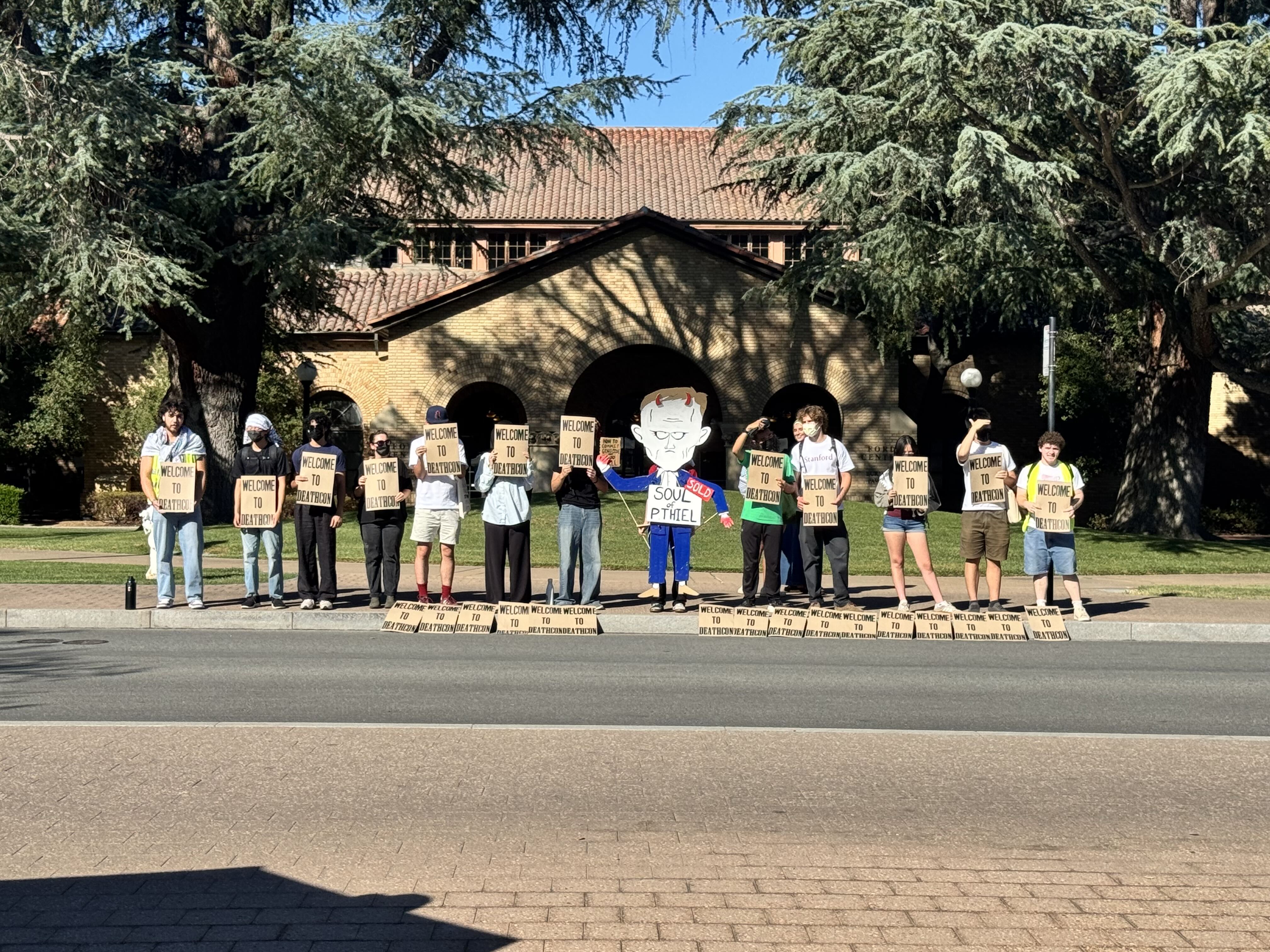
A Tuesday tabling event for the conference was met by students protesting the military tech industry, one of whom carried a large cutout criticizing Palantir CEO Peter Thiel ’89, JD ’92.
DEFCON has historically brought Stanford students and military tech leaders into conversation on campus. Speakers this year will include the founders, CEOs and CTOs of major defense companies, members of the U.S. Office of the Secretary of War and the former Taiwanese president.
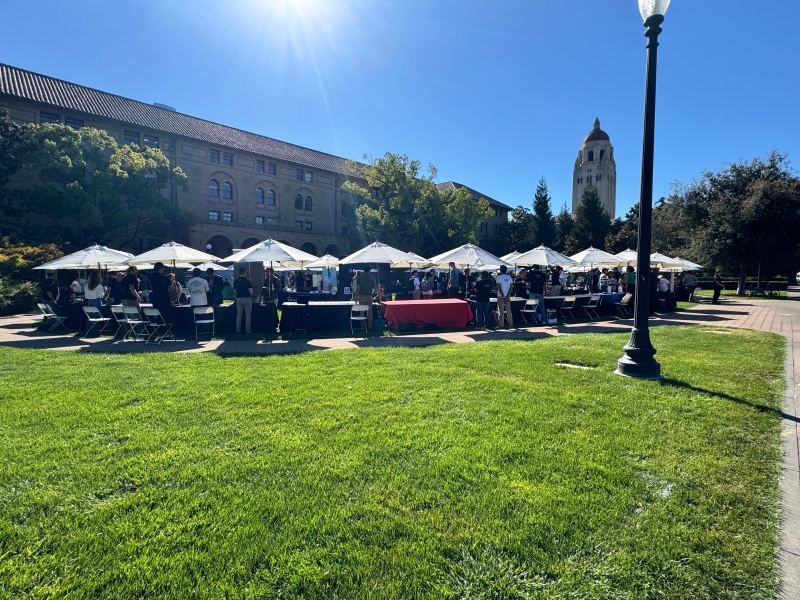
The tabling event outside Encina Commons marked the beginning of the conference and included such companies as Arkenstone, Z1, Umbra, Castlelion and Gallatin, who displayed images of their technologies in action alongside physical drones.
In protest, around fifteen students stood quietly across the road, holding signs and an artistic depiction of Peter Thiel. Eventgoers watched them for some time. Protest organizer Arin Iverson ’27, however, described the event as primarily for the passersby.
“The most important thing was not to change hearts and minds because I think that’s very difficult,” said Iverson. Instead, he said the rally intended to demonstrate that “there is an active opposition to the presence and recruitment of students by defense contractors on campus.”
The protestors’ signs read ‘WELCOME TO DEATHCON,’ while Iverson puppeteered the cutout of Peter Thiel, which sported devil horns, bloodstained hands, a book reading ‘How to commit genocide and go to Hell’ and a sign reading, ‘Soul of P. Thiel: SOLD.’
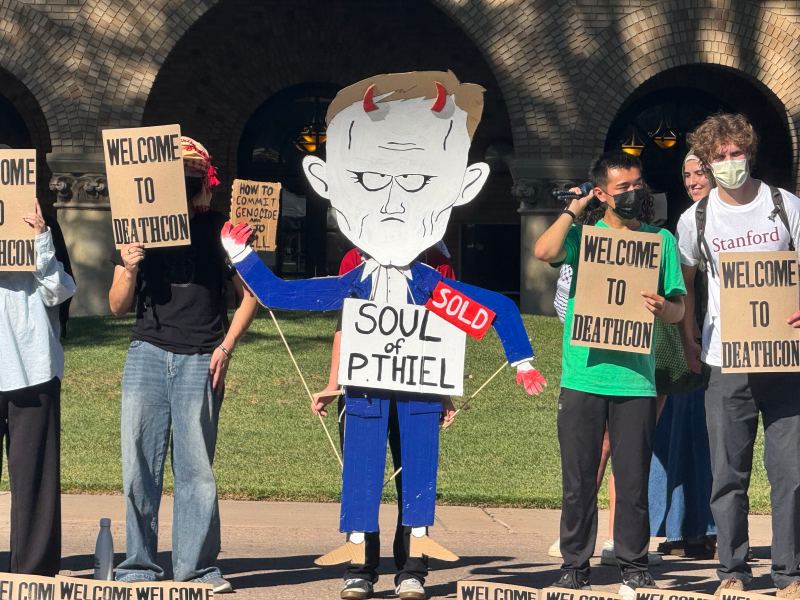
Iverson said that to draw attention to their cause, the group hoped to create “something of a spectacle” using their cutout of Thiel. Palantir itself is one of the biggest sponsors of DEFCON.
Fellow protestor Reid Smith ’28, who serves as co-president of the pro-Palestinian student group Jewish Voice for Peace (JVP), said the protest also intended to criticize the ‘funnel’ of Stanford students into the defense industry. “We’re funneling all of the immense talent at our university to military/AI tech startups … to kill people overseas,” he said.
Another protestor, Andrew Chen ’27, agreed. “I just don’t think we should be killing people in Palestine [or] using our army to suppress people all over the globe…Stanford plays a direct role in funnelling students into that type of career,” said Chen.
His favored first step would be for Stanford to stop “platforming these people who run these huge corporations that do objectively evil things.”
Iverson and Smith said their protest was not widely publicized, and that the group intentionally limited its size, to abide by Time and Place restrictions at Stanford. Iverson told The Daily that, “We weren’t using amplified noise, we weren’t blocking any sidewalk or road,” and that this was an important factor for ensuring a peaceful protest.
Though some students crossed the road to speak with the protestors, the protesters were mostly separated from the event itself.
One DEFCON staffer, Andreas, expressed appreciation for the ability for students to peacefully protest. “I’m really thankful we live in a country where people can protest and disagree. It’s their right and they should protest if they feel strongly,” the staffer told The Daily.