
The Undergraduate Senate (UGS) passed its first bill of the academic year at its Wednesday night meeting. The bill, which creates new communication channels and creates transparency around Senate actions, aims to make UGS more accessible to Stanford undergraduates. Senators also debated Stanford’s proposed long-term campus expansion plan and introduced a resolution supporting three students impacted by the university’s use of images altered by AI.
Authored by Communications Committee Co-Chair Ashton Dolce ’29 and UGS Co-Chair Laila Ali ‘28, the bill laid out a series of measures, including a biweekly newsletter, weekly “Grounds for Change” coffee chats, publicly accessible links for scheduling for senators and a centralized form for students to submit concerns. It also establishes a quarterly “State of the ASSU” report, which will detail the work of the Senate committees. The UGS passed the bill unanimously.
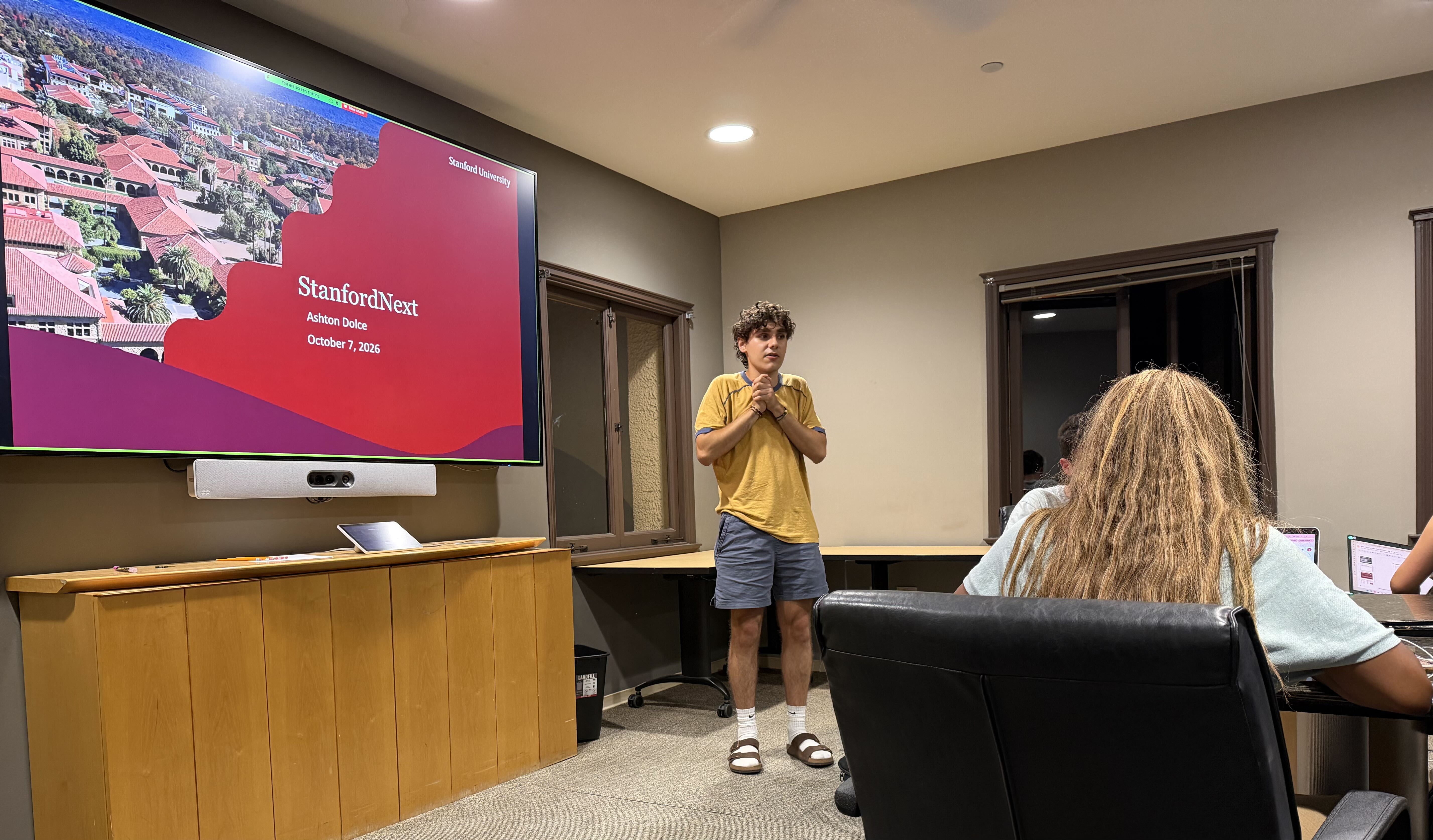
Dolce also expressed concerns about StanfordNext, the University’s proposed expansion for affordable housing.
Stanford submitted the StanfordNext application to Santa Clara County in September, proposing 1.8 million square feet of additional academic space and 2,500 new student beds over the next two decades. The proposal also includes a $100 million community fund focused primarily on regional affordable housing. Stanford’s current General Use Permit, which was approved in 2000, currently limits builds to 2,035,000 net square feet of academic and academic support space. The StanfordNext application is now in a county review with a vote potentially in 2028.
With StanfordNext currently under county review, Dolce advocated for senators to pay attention to the impact of the proposal on the broader community.
“Stanford is a big university. It has a lot of people. That impacts transportation in the area, [and] that impacts access to housing,” he said. “[The county] wants Stanford to actually build the housing instead of just contributing to a fund that will actually build less housing than if Stanford built it themselves.”
Dolce also raised a question about how StanfordNext could affect campus workers, placing emphasis on those facing long commutes.
“All of the workers who work at Stanford, who may not be classified as workers, but might be subcontracted workers, how long are they gonna have to travel to get to campus? All these questions are related to StanfordNext,” he said
The Senate also considered a proposed resolution supporting three Stanford students whose images were modified with AI by Residential and Dining Enterprises (R&DE). The resolution would share support and stand with the students impacted.
Senator Ethan Alfonso ’27 argued in favor of the measure. “These are three Stanford students, who went through their first 3 weeks of fall quarter … being followed by their peers, trying to take pictures with folks that they have no idea who they are,” he said, referring to the widespread media attention the students received. “As the Undergraduate Senate, we wanted to walk alongside them, with any of the messaging that we put through in solidarity with them,” said Alfonso.
UGS Co-Chair Ali noted that students may also sometimes not realize that photographs taken at R&DE events could be used for marketing.
“I know that when I’m at an R&DE event and I pose for a photo, I don’t really assume it’s gonna be used for marketing purposes,” she said. R&DE has indicated that it is willing to make it clearer when photographers are taking photos for marketing purposes.
Dolce urged students to stay involved with the issue. “I think we should all be paying attention to it,” he said.