
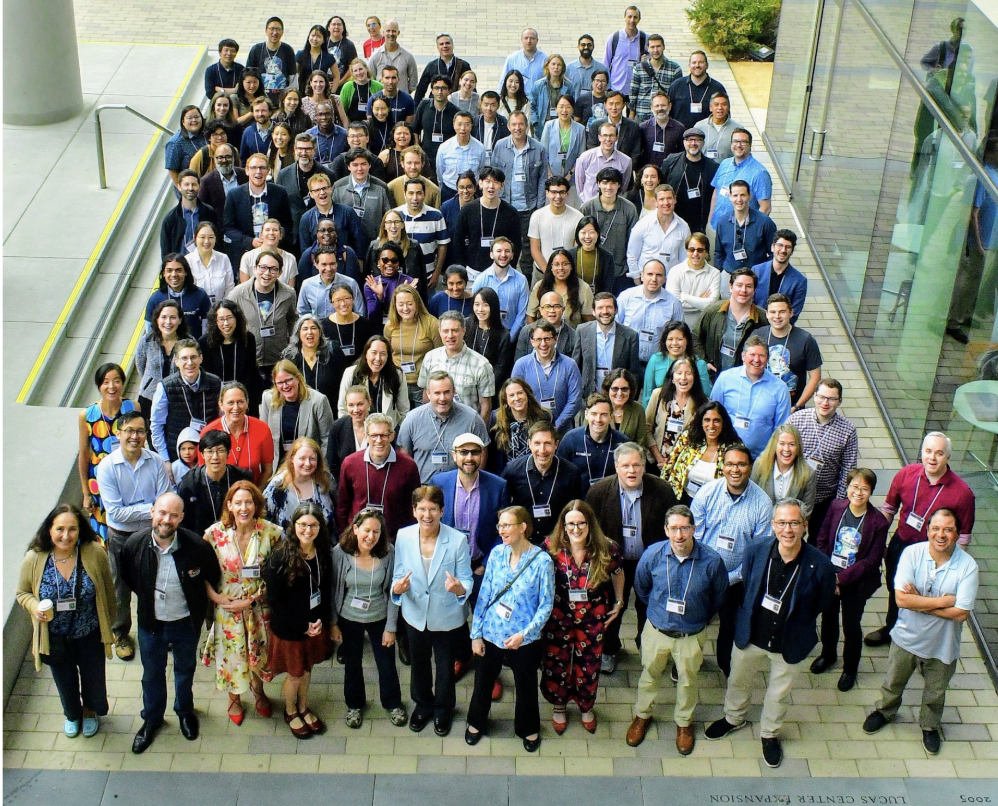
The chemical biology community came together on Oct. 9 to celebrate Nobel Prize-winning chemist and Stanford professor Carolyn Bertozzi’s 60th birthday.
Distinguished scientists, researchers and entrepreneurs who had worked with Bertozzi as students, collaborators or cofounders traveled from around the world to attend the symposium in Li Ka Shing Learning and Knowledge Center. Presentations highlighted research from institutions including Harvard University, University of Texas Southwestern Medical Center and Peking University, as well as biotechnology companies such as Genentech and GlaxoSmithKline.
Bertozzi joined Stanford’s faculty in 2015, but her approach to mentorship began earlier in her career at the University of California, Berkeley, where she earned her Ph.D. in chemistry and served on the faculty for nearly two decades. She currently serves as the Baker Family Director of the Sarafan Chemistry, Engineering and Medicine for Human Health Institute (ChEM-H).
Jennifer Prescher opened the session, reflecting on her time in the Bertozzi lab nearly 20 years ago developing bioorthogonal probes — chemical tools that labeled and tracked biomolecules in living systems. The project’s imaging applications stuck with Prescher throughout her career; she now engineers bioluminescent probes to capture dynamic biological processes in the body.
Bertozzi’s scientific contributions include biological tagging systems, cellular engineering techniques and the conception of bioorthogonal chemistry, a field of chemical synthesis that earned her a share of the 2022 Nobel Prize in Chemistry.
“She has spoken about how the diversity of people in her lab helped make the unconventional thinking behind her Nobel-winning work possible,” said Mikaela Ribi, Bertozzi’s former research associate and a Ph.D. candidate, wrote to The Daily. “Bringing together people who approach the world differently can change the questions we ask, the assumptions we challenge and the discoveries we make.”
The Bertozzi group has developed next-generation antibody-drug conjugates (ADCs), lysosome-targeting chimeras (LYTACs) and more targeted cell therapies. Several of these modalities have become clinical candidates for cancer and autoimmune disease treatments.
“In the Bertozzi spirit, chemistry to the rescue,” said Benjamin Schumann at the symposium. Schumann conducted postdoctoral research in Bertozzi’s Stanford lab before establishing his own research group in Germany.
“[Bertozzi] inspired me to be a daring scientist,” chemist Lara Mahal of University of Alberta said in her talk. Mahal’s research challenges existing assumptions about microRNA, small molecules that help regulate gene expression.
Over the course of her career, Bertozzi’s mentorship fostered almost 300 researchers, 60 of whom now lead independent academic laboratories, and her lab’s discoveries have helped launch at least 12 biotechnology companies. Although her work has contributed to numerous entrepreneurial ventures, Bertozzi continues to engage with the field as a scientific adviser and board member.
“Carolyn brings people into her lab because she believes in them, then gives them the freedom to decide what to focus on. It challenges them, but also allows for creative freedom for young scientists,” Ribi wrote to the Daily. “It’s a community of people who love their work and feel empowered to pursue it creatively and passionately, surrounded by others who want to see them succeed.”
The research sessions concluded with reflections on the lasting influence of Bertozzi’s mentorship. Stavroula Hatzios, an associate professor of molecular, cellular and developmental biology and of chemistry at Yale, said, “These aspects of her inspiring, compassionate mentorship have transformed the lives of so many, and will ultimately be her lasting legacy.”