

A campus talk featuring alumna author Brittany Newell ’16 M.A. ’18 has sparked discourse over her career as a sex worker and some students’ attempts to secretly film the event.
Newell is the author of “Soft Core,” a novel inspired in large part by Newell’s firsthand experience working as a dominatrix in San Francisco. The novel has received attention from major publications.
Her talk was advertised via email to students of the Structured Liberal Education (SLE) program — Stanford’s liberal arts residential-learning program for first-year students — as including “advice to budding writers about a career in the arts.”
The talk drew campus attention after The Stanford Review published an article titled “SLE invites Professional Dominatrix to Advise Students.” The Daily Mail soon followed with its own coverage.
Newell openly addressed the Review article, which had been published the night before, multiple times during the talk. According to attendee Begum Zeynep Yapici ’29, Newell “found it funny” that a Stanford newspaper could attack her credibility as a speaker when she was a Stanford alum.
In a statement to The Daily, Newell wrote, “I don’t mind controversy. It’s good to make people think and feel deeply.”
“I’d rather make money helping men and women feel better about the shame that disfigures their lives than make money designing warfare technologies,” she added. “I am proud to be a novelist who is unafraid of the shadows and my readers are similarly unafraid. I have a marvelous life and I wish that for all people of the world during these painful political times.”
Around 20 SLE students, alumni and faculty attended the event, held as part of SLE’s “Books and Boba” speaker series. According to several attendees, most of the questions from students focused on Newell’s creative process, her time as a writer at Stanford and publishing. According to SLE alum Vivi LaFont ’29, some students asked questions about her background as a dominatrix as it related to her literary work.
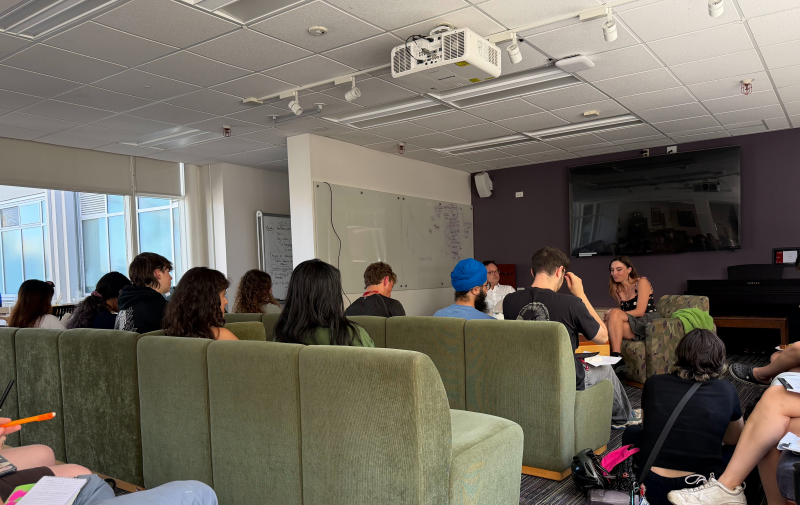
SLE Associate Director Michaela Hulstyn wrote to The Daily that Newell’s remarks spanned “her critically-acclaimed fiction, her literary influences and advice on how to publish short stories, query an agent and navigate the publishing world as a young person.”
SLE student Nic Chesterman ’30 observed that “a lot of the kids were much more interested in the process of being a professional writer than about anything else she did.”
Midway through the event, two students moved from the back to the front row, apparently trying to subtly film with their phones, according to multiple witnesses.
In response to Newell’s reference to the Stanford Review article, the individuals started laughing quietly. According to Yapici, after Newell asked why they were laughing, they explained that they knew the author of the Stanford Review article.
According to Yapici, who was sitting next to the two students, one of the individuals mouthed “should I do this?” and received a confirmation “yeah,” from the other.
Later in the talk, Chesterman sat next to the two students and observed the suspicious angle of one of their phones. Chesterman brought it to Newell’s attention, asking “are you comfortable being filmed? Because I think someone’s filming.”
According to multiple witnesses, after being called out by Chesterman, the students denied that they had been filming. The Daily has reached out to the students for comment.
“They were like, ‘No, we are not [filming].’ And then it was a panic, deleting stuff,” recalled Yapici, demonstrating the frantic phone-swiping motions she witnessed. Although she didn’t see their phone screens, “we all could see what they were doing,” she said.
Hulstyn elaborated on the rationale for SLE’s choice to host Newell.
“Our optional events are meant to introduce students to a range of writers, artists and thinkers whose ideas challenge assumptions or help them engage thoughtfully with a variety of ideas and forms,” wrote Hulstyn.
Students attendees agreed.
“Having more exposure to people in different fields is never really going to be a bad thing, and if people aren’t interested, they just don’t have to go at all,” Chesterman said.
Guests’ books often do not fully align with class material, according to Hulstyn. “However, one obvious overlap between the required curriculum from SLE this quarter and Newell’s visit was the idea that fiction can do things aside from sending messages,” she wrote.
English professor Mark Greif, who moderated the SLE talk, also invited Newell as part of his class, ENGLISH 177: “Contemporary Novel in U.S. Perspective.” Inviting Newell, Greif said, was not necessarily “pushing an agenda other than that of encouraging people to read and also perhaps to become artists,” Greif said.
Greif also stressed the importance of confronting diverse moral worldviews in university settings.
“The university often is the place in which you have that experience of figuring out what your judgement and principle works out to be, in confrontation with guests who aren’t exactly like you. There’s value in a university context to confronting questions of judgement and morals,” he said.
According to Hulstyn, the event and controversy “generated an engaging conversation amongst students about the enduring double standard we see in the reception of women’s writing.”
“As Newell said at the event, when men write about sex today, it’s often received as experimental or avant-garde, but when women do it, it’s often described as indulgent or overly personal, as if the woman writer can only ever be writing her diary,” Hulstyn wrote.
Greif elaborated that “the first rule of literary criticism” requires separation of the “imagined creative work” from the author. Yet her personal experience was relevant in that it gave her firsthand knowledge about the community in which the book is set, he said.
Student attendees offered similar reflections. Many raised the frequent question in SLE of who determines what qualifies as good art.
“You can’t come into spaces like this, imagining what a good novelist or a good writer looks like, and then shoving people out of that space because of arbitrary factors like…their background,” said LaFont.
Others expressed frustration that the controversy surrounding Newell’s background took attention away from her art.
“The incident is not what’s important about [Newell] and about her career,” said Yapici. “I find it a bit saddening that her teachings, and who she is, [are] being overshadowed by all this stuff.”