
Editor’s Note: This article is a review and includes subjective thoughts, opinions and critiques.
To call aespa’s Oct. 6 concert at Oakland Arena a performance is akin to calling Einstein “smart,” or the universe “vast” — descriptions wholly inadequate to encapsulate the sheerness of what went down.
The performance marked the 14th stop of aespa’s “Synk: Complaexity” tour, which centers the K-Pop girl group’s second full-length album, “Lemonade.” The narratives place the band’s four members — Ningning, Winter, Giselle and Karina — into a chaotic, disjointed digital universe of glitches and error that threatens both their group and individual identities. It’s a theme that builds on aespa’s broader fascination with the hyperpop movement, refracting questions of individual identity and authenticity through a metaverse-esque medium.
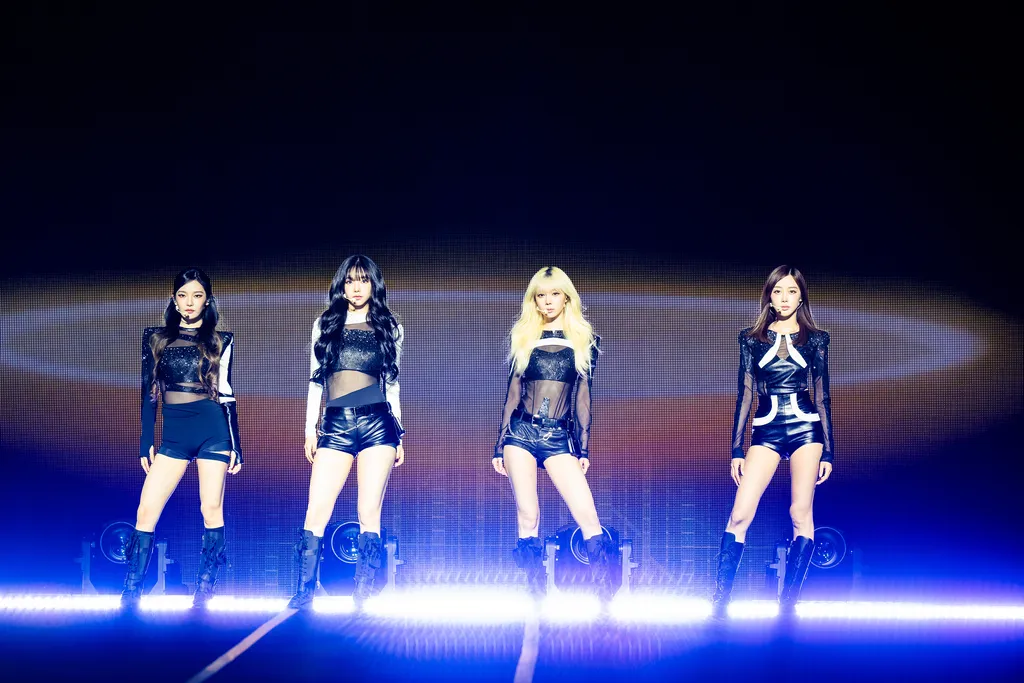
But if the performance was themed with technology in mind, it was aespa’s intensity of human performance that made their show such a sight to behold. This human component was apparent from the start, which saw aespa perform its album’s titular track “Lemonade.” While the performance was choreographed with the typical excellence of most K-Pop bands, it unified the identity of the group — in no small part thanks to a jumbotron that shifted the focal point seamlessly between members. In some moments — particularly in performances of older fan-favorites like “Whiplash” and “Black Mamba” — there was a sense that we were watching the emergence of one organism out of four.
This group identity was one aespa built by highlighting its individual members: whether it was Giselle’s impeccable audience engagement or Ningning’s staccato choreography, each member brought unique color to the stage. aespa furthered this interplay through its use of wardrobe choices: whether donning a wedding-esque white for “Camouflauge,” or a streetwear fit for “Next Level,” costumes were thematically congruent while being distinct at a glance. The jumbotron threaded these components together, consistently highlighting Giselle’s energy and Winter’s elegance, while spotlighting each member equally.
What truly made the night, however, were the set of solo and duo performances that characterized the second half of the concert. These moments, more than anything, highlighted the strength of each member. Winter, decked in a denim blue jacket and cowboy boots, was the perfect conductor of energy in her performance of “Saddle Up,” with minute pauses and powerful riffs that lit up the audience. Giselle’s “BYEB4HELLO” offered a stunningly intimate portrayal of the artist as a solitary individual. Ningning was ethereal in “I Love You But I Gotta Let You Go,” spotlighting a classically theatrical exploration of loss and heartbreak with a voice that cut through the emotional baggage.
Then, there was Karina.
aespa’s leader was the definition of stage presence. With nary a wrong move through the entire two-hour, ten-minute concert, Karina anchored the group as its emotional core. In large part thanks to her array of talent — rapping, dancing and singing with equal flair — she was equal parts force of nature and natural backdrop to any track. Her solo, “16-bit,” was the perfect encapsulation of that presence: despite being surrounded by a mountain of dancers, Karina remained the definitive focal point, with vocals flowing like wine throughout the crowd. There was something otherworldly about her, something hard to put into words about the sheer gravitas Karina provided on stage.
It was not a perfect concert. The strobe lights flanking either side of the catwalk shone directly into the audience, making it difficult to see aespa. There was also an emotional disconnect to the whole experience, with elegant songs like “Count On Me” immediately following explosive, high-energy tracks like “WDA (Whole Different Animal).”
Most curious was the resolution portion of the concert, which sees aespa narratively reclaim its individual and collective identities. The moment is visually depicted through a series of shots on grainy film, capturing the members doing everyday things: we see drives to the beach and moments tucked between the pages of coffeeshop books. It is a sequence that the “Synk: Complaexity” press release dubs the “ultimate victory.” Yet it comes with a strong dose of irony, and one has a hard time reconciling these snapshots with the hyper-curated, uber-regimented world of K-Pop. Instead, they beg the question of how many of these moments aespa’s members sacrificed to get where they are now.
Ninging, Winter, Giselle and Karina did not answer these questions. Instead, aespa did what K-Pop always does: perform. Yet in their performance, we find broader questions about ourselves: questions about collective and individual identity, about spectacle and sacrifice, about what it means to be and to belong. In this way, aespa’s “Synk: Complaexity” is the best sort of art: equal parts entertainment and meditation on the role we play within our own lives.