
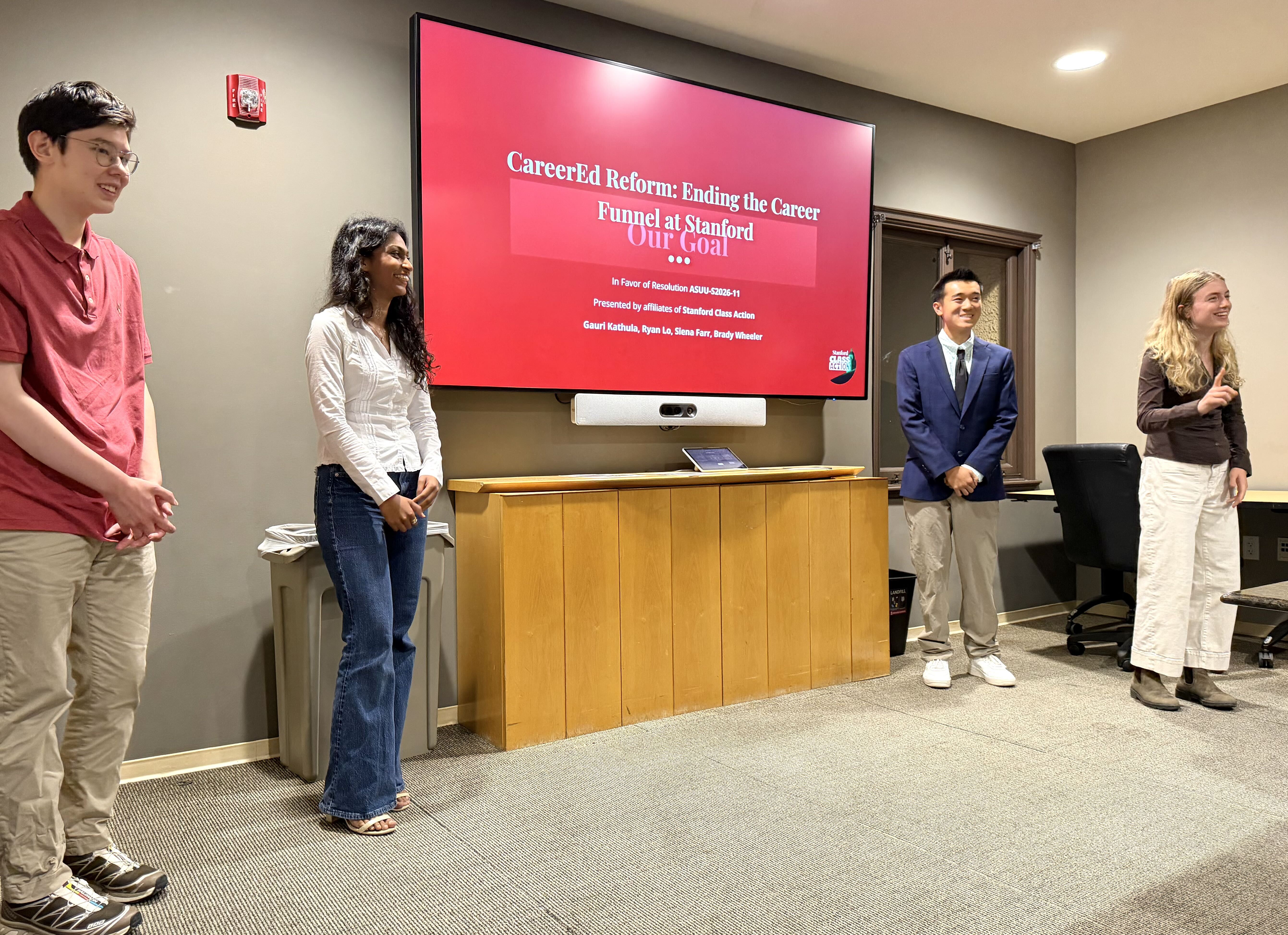
The Undergraduate Senate (UGS) unanimously passed a resolution supporting CareerEd reform and another in solidarity with the students affected by AI misuse to protect student identities at its weekly meeting Wednesday.
Affiliates of Stanford Class Action, Ryan Lo ’30, Gauri Kathula ’29, Siena Farr ’30 and Brady Wheeler ’30, presented a proposal for reforming CareerEd, which was previously moved from being a part of the Office of the Vice Provost for Student Affairs (VPSA) to the Office of the Vice Provost for Undergraduate Education (VPUE). The proposal raised concerns over the influence of corporations on career services and the availability of opportunities outside the technology, consulting and finance industries.
The students argued that CareerEd’s reliance on corporate funds disadvantages organizations that lack financial resources to participate in the University’s recruiting programs. They pointed to CareerEd’s Circles of Influence employer partnership program, which provides corporations with exclusive resume access and priority at CareerEd events. The program has three tiers, with the highest tier, ‘Cardinal,’ costing companies $15,000 annually.
“Who can actually pay for these programs? That would go to the corporations and companies that actually have that money to spare,” Lo said.
Lo described walking through the Stanford Fall career fair and the DEFCON career fair on the same day last week and seeing only one row of nonprofit and service-oriented organizations, as opposed to the many rows of for-profit organizations. He also saw many of the same technology and finance companies at both events.
“Something’s got to change about that, from my own personal experience,” Lo said.
The presenters proposed four changes: increasing stable funding for CareerEd to reduce its dependence on sponsorships coming from corporations, directing a portion of the sponsorship funds towards public-service and other career pathways, creating opportunities for students to advise the office’s priorities and including public-service recruitment already integrated with the University, such as the Haas Center for Public Service and Stanford Impact Labs.
“Students should have a … mechanism over which they can have a say in how CareerEd allocates tuition dollars,” Farr said.
After the presentation, the UGS unanimously passed the resolution supporting the CareerEd reforms.
Senator Ethan Alfonso ’27 and Senator Jan Dwayne Cacnio ’29 also met with the Interim Director of the Office of Community Standards (OCS) Lawrence Marshall and presented on the office’s priorities and procedures.
Approximately eight cases get to a full hearing every year and 70% of the cases involve first-time Honor Code violations, according to the senators’ presentation. Improper AI use on problem sets was the main source of violations identified.
Alfonso and Cacnio explained that OCS has jurisdiction over the sanctions; however, OCS does not dictate students’ grades in classes. The grade is solely up to the professor.
The OCS has also implemented new measures to avoid past free speech issues.
“We have now transitioned to a space where [Marshall] has defended the First Amendment right to free speech,” said Alfonso.
The senators addressed the distinction between protected expression and violations in conduct. Cacnio said Marshall had emphasized that student speech should be protected and could not be the basis for an OCS case by itself.
“Student speech should definitely be protected … and OCS will never file a case in regard to that,” said Cacnio.
The UGS also unanimously passed a joint resolution in solidarity with students affected by AI misuse and to protect student identities. The AI-misuse resolution criticized the production and use of altered images by Stanford’s Residential and Dining Enterprises (R&DE) as “an attempt to manufacture diversity rather than honor the diversity already present at Stanford.”
The resolution calls for a public apology and investigation into the AI misuse, a commitment to not use AI-generated or altered images of students, a removal of the remaining copies of the altered image and student representation on Stanford’s AI Advisory Committee.
A separate joint resolution, the Campus WiFi resolution, was also introduced for further discussion at future meetings. Laila Ali ‘28, UGS co-chair, said the goal for this resolution is to raise the issue to the Faculty Senate and work with the Graduate Student Council (GSC) and university IT so members can make actionable changes.
The UGS also swore in three proxies to represent senators studying abroad during the quarter. The proxies are as follows: Marinelly Rivera ’29 for Kylie Price ’28, Vedanth Venkatesh ’27 for Minji Cho ’28 and Armaan Sharma ’29 for Intisar Alkhatib ’28.