
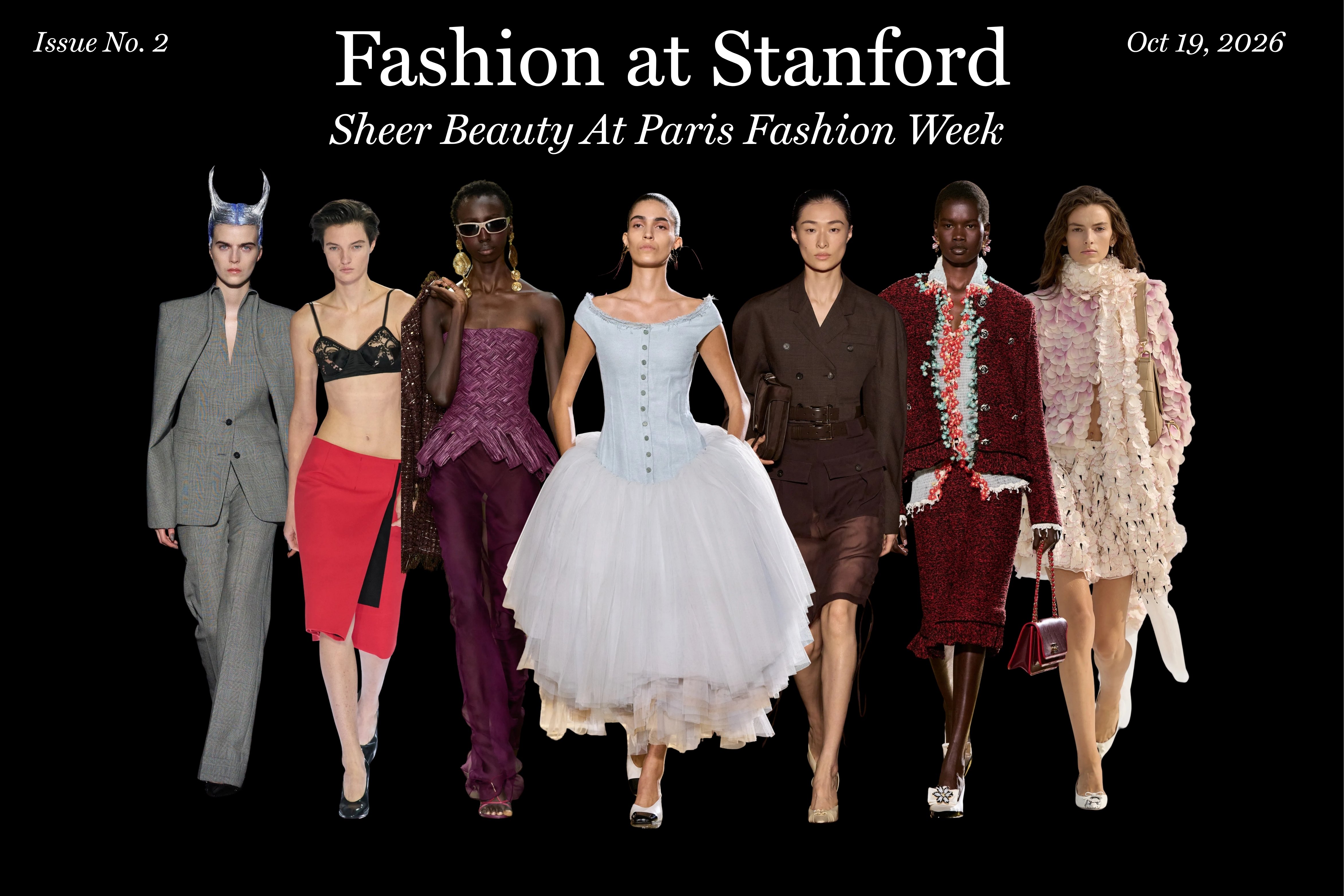
Like the famous quote from “The Devil Wears Prada,” runway collections can give us a glimpse into what trends we will eventually see on the street. But more than just being aesthetic inventions, these trends are often tied to ideas that can be observed across many different runway shows. This week, I sat down with co-writer Nesara Shree ’28 to discuss some of our favorite shows from Paris Fashion Week and the ideas behind them. In Paris earlier this month, about 100 fashion houses presented their Spring/Summer 2027 (SS27) collections, which will be released in stores next spring.
Jacob Tan (JT): Before we dive into our standout shows, let’s start with the basics. When you’re watching a runway, Nesara, what kinds of things are you looking for?
Nesara Shree (NS): I like to approach them from two angles. The first is art: treating fashion the same way I would digest a painting, photograph or work of literature. What is its aesthetic vision or political message? How does the designer express it through construction, fabric and color? What does it make me feel, and what does that reveal to me about myself? The second angle is more personal, as I peruse the looks for style notes that translate. A good show nudges me to see the clothes I already own in a new light. Jacob, what are you looking for?
JT: I’m definitely looking at all those things too! I would add that in addition to the clothing, I like to consider the set design, the music, the order of looks, the model casting, maybe even what the invitation looks like if I can find a photo online! These elements sometimes give clues as to what a collection is about or inspired by. OK, so tell me about your favorite show from this past Fashion Week!
NS: Before anyone sat down in the Jardin des Tuileries, Jonathan Anderson — creative director at Dior — had already told us what Dior SS27 was about by attaching a pair of collectible Chinese Wénwán walnuts to the show invitations. Traditionally, the owner rolls the walnuts in their palms for years, until the shell is darkened and takes on a unique, glassy patina. This simple ritual suggests that the timelessness of Dior depends not on preservation but on the relentless work of reinterpreting and experimenting with house codes to make it one’s own.
JT: That’s a really interesting idea, especially since creative directors at these storied houses like Dior have so much pressure to reference and preserve the house’s archive and codes. But maybe, like with Wénwán, the archive isn’t something to protect but something to handle. How did this idea translate into the clothes themselves?
NS: As Dior’s newly appointed creative inheritor — he was named sole creative director in June 2025 — Anderson seemed to release the weight of tradition through a literal embrace of “lightness.” Most of Dior’s SS27 collection was sheer, animated by movement, wind and light: bralettes surfaced beneath frayed organza jackets, gauzy knit polos were knotted over translucent houndstooth trousers and sheer, patterned blazers were layered throughout. I especially loved the daytime petal boas draped from the models’ hair, accentuating this illusion of weightlessness.
JT: That’s so interesting. That’s actually something I’ve noticed across a lot of runways this season, especially at Chanel. Sheerness has become somewhat of a new house code under creative director Matthieu Blazy, like in his couture collection this January.
NS: I noticed it everywhere too, even in the Issey Miyake show, which I know was a favorite of yours! Can you tell me a little bit more about that show?
JT: Issey Miyake’s collection was titled “Ma,” after the Japanese concept of the importance of negative space in art. This idea became really evident as the collection progressed. The collection started with a series of sprayed resin tops that were molded exactly to the models body, made of a proprietary 3-D resin spray in collaboration with Wacoal Corporation. Some of the cocoon-like tops were even imprinted with the shape of pants and a belt, despite still being a singular piece of resin. As the show continued, the garments moved further and further away from the shape of the model’s body, starting with button up shirts trapped under sheer long sleeves, to bouncy knit dresses where sleeves were improperly used as the neck-hole, to a series of floating bubble dresses that literally appeared to drift across the runway.
To me, this collection was a meditation on how we use clothes to make sense of bodily form and divisions. Miyake, who has always been revolutionary in this area, pushed back against the traditional divisions that we use to cut clothing (waist, torso, arms, legs) by rethinking how clothes shape the body. By the time we arrived at the bubble dresses, the clothes no longer were structured by the shape of the body, and instead became animated by air.
NS: Dior’s historical code is the antithesis of what you’re describing. The iconic 1947 debut molded the female body with cinched waists, padded hips, and luxurious, billowing skirts. This season’s show strays far from any rigidity with its boneless, almost ephemeral re-interpretation of form. Granted, we’ve come a long way since postwar 1947. But the collection was a response to its time, much like these motifs of sheerness and lightness in fashion are a response to ours. Clothes that ask nothing of the body are liberation. Transparency in the age of untruth feels radical. Connecting back to the idea of “Ma,” there’s a shift towards embracing negative space, or an absence of form and structure. And, for Dior, it’s a fresh reimagining for a house so long tethered to its sculptural silhouettes. Now, I don’t think these concepts are reserved for high fashion alone. How do you think runway patterns could be adapted to everyday style? Or how are you personally adapting them?
JT: Judging from Dior and Miyake, we will be seeing lots of sheer, lightweight and flowy styles next spring particularly in garments that might typically be more structured or opaque, like a suit, sweater or dress. I’ve been drawn to this new label, Adrian Cashmere, that makes some really cool sweaters that are semi-sheer, and this other label, Soshiotsuki, is making incredible unstructured suits. What about for you?
NS: On the womenswear side, I noticed so many runways putting bras on full display, layered over tops or worn entirely on their own. The Prada show featured essentially 63 unique permutations of a skirt styled with a bra. For everyday wear, I love the look of a colorful bralette peeking through a thin shirt or a sheer knit.
JT: Speaking of color, I noticed a lot of purple and also gold on the runways this season, which is interesting because those colors are always connotated with royalty to me. I think that these colors, alongside other trends like maximalism, signal a return to opulence and grandiosity in fashion that was looked down upon in the “quiet luxury” era.
This installment, we talked about two runway shows that reconsidered form and structure, through both construction and materiality. But no discussion of form in fashion is complete without talking about “The King of Cling,” originator of the iconic Bandage Dress, Mr. Azzedine Alaia! Join us in our next column for an exclusive interview with Lauren Carmerlengo, the head curator of the Azzedine Alaia retrospective coming to the San Francisco Legion of Honor museum in November!