
Editor’s Note: This article is a review and includes subjective thoughts, opinions and critiques.
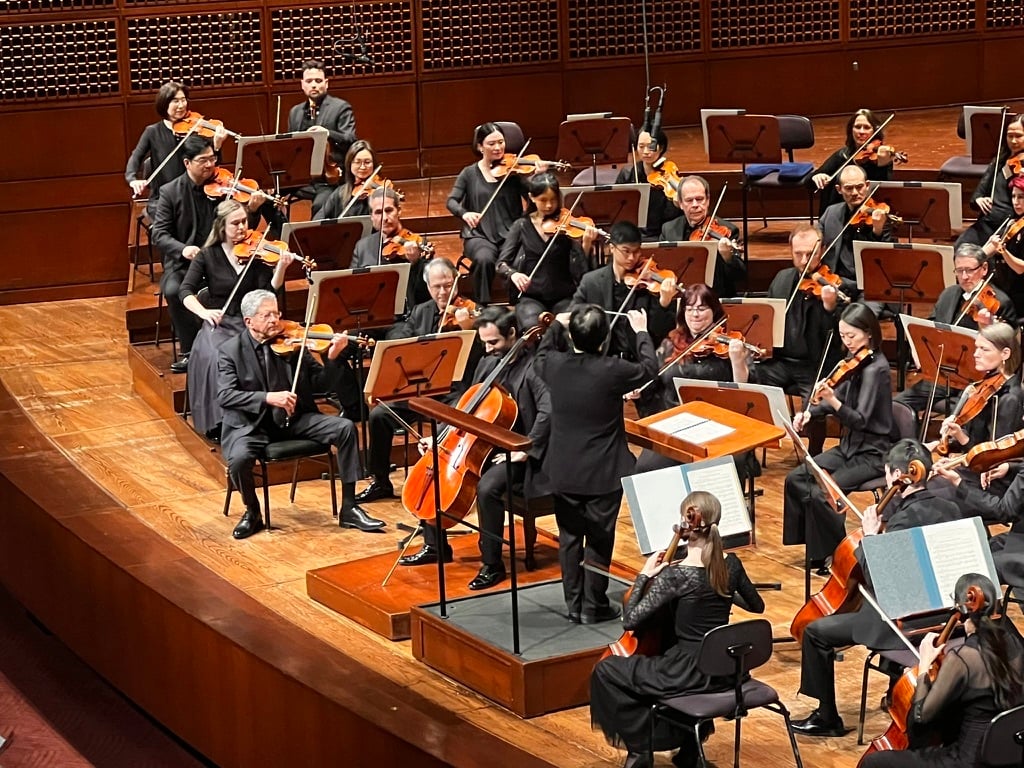
San Francisco’s Davies Symphony Hall brimmed with warm anticipation as audience members took their seats on Saturday night. The chatter faded to a hush as an oboe played the tuning “A” and the winds and strings quietly checked their instruments. Conductor Xian Zhang emerged onto the stage to much applause.
The night began with a rendition of Kodály’s “Dances of Galánta” — an energetic Romani folk-inspired piece that nicely whetted the audience’s appetites for the singing melodies of Tchaikovsky. Whistles and loud cheering greeted cellist Pablo Ferrández as he walked onstage. The orchestra, light and subdued, began Tchaikovsky’s “Rococo Variations.” Once Ferrández started the main theme, I was immediately entranced.
Hailed as a “cello genius,” Ferrández’s tone has been described by Gramophone as “capable of both radiance and richness.” He won a prize at the XV Tchaikovsky Competition, and has collaborated with other internationally renowned artists such as Anne-Sophie Mutter and Manfred Honeck.
It’s an exceptional reputation, and one Ferrández lived up to. Too often have I struggled to properly hear the low frequencies of a solo cello accompanied by a 100-person orchestra; it’s been difficult for me to understand why this instrumentation is compelling. This issue has often encouraged composers to write instead for brighter instruments with higher registers, such as the violin, causing much pain to the cello community (including me!).
Somehow, Ferrández’s elegant, gentle sound managed to cut through the orchestra so easily that it was almost uncharacteristic of the instrument. Coupled with his carefree yet precise command of the higher register, this made the entire experience uniquely enjoyable. I was able to comfortably immerse myself in his sound. Were there more soloists with his qualities throughout history, perhaps the amount of cello repertoire might equal — if not surpass — that of other popular instruments.
The performance was not perfect. Ferrández made many decisions I did not agree with. His legato reflected a modernized cello technique: his bow reacted to the rhythms of his left hand, constantly starting and stopping rather than drawing smoothly over the strings. Many of his interpretative decisions conflicted with how most other cellists approach the Tchaikovsky. While some of them worked (such as his extreme accelerando on the scales in the fourth variation), others felt overly contrarian. I was especially taken aback when he played a traditionally fortissimo passage in the cadenza rather hushed and whispery. However, I have to acknowledge the courage it takes to try these new ideas. It requires true intention as a musician to strive against tradition, especially in such a popular work.
As he started the final, presto variation, Ferrández’s radiant tone never faltered, despite Tchaikovsky’s tongue-twister notes and rhythms. The trade-off runs between Ferrández and principal flautist Yubeen Kim were precisely matched in timing, character and virtuosity.
As the music approached the challenging octaves section, I recalled an unfortunate video in which the laureates of the XVII Tchaikovsky Competition performed the same part with much trouble. Impressively, Ferrández breezed past it with a slight smile on his face, each tone ringing perfectly throughout the hall.
Naturally, a standing ovation was in order. As an encore, Ferrández played the “Sarabande” from Bach’s first cello suite. Here, he transitioned from elegance to a warm, glorious tone that resounded against the beautiful acoustics of the hall. Again, I had some disagreements: his “Sarabande” — a name which literally translates to a steady, triple-metered Spanish dance — was overly expressive in tempo, and more akin to a free-flowing prelude. It still enthralled the audience, who awarded him a second ovation afterwards.
The Tchaikovsky was followed by a performance of Dvořák’s Symphony No. 8. The cello solos in the beginning of the first and last movements were well-played. Conductor Zhang poured a great amount of effort and energy into the performance, and it was a joy to watch her. The standard tempi were logical throughout and easy to follow. The violins did not come in together in a few moment and a few late stragglers stuck out. Otherwise, it was a fine rendition.
Overall, this was an incredibly compelling performance. Despite my disagreement with some of Ferrández’s technical choices, I’m able to retain the utmost respect for his prowess as a musician. His artistic daring and technical abilities impressed me far beyond the subjective realm that so often limits critical listeners. I warmly encourage others to consider this approach — to look beyond one’s personal preferences in favor of seeking inspiration in every performance.