
The Undergraduate Senate (UGS) reviewed proposals for a permanent free-speech policy and a proposal to fund First-Generation and Low-Income Week programming at their Wednesday night meeting.
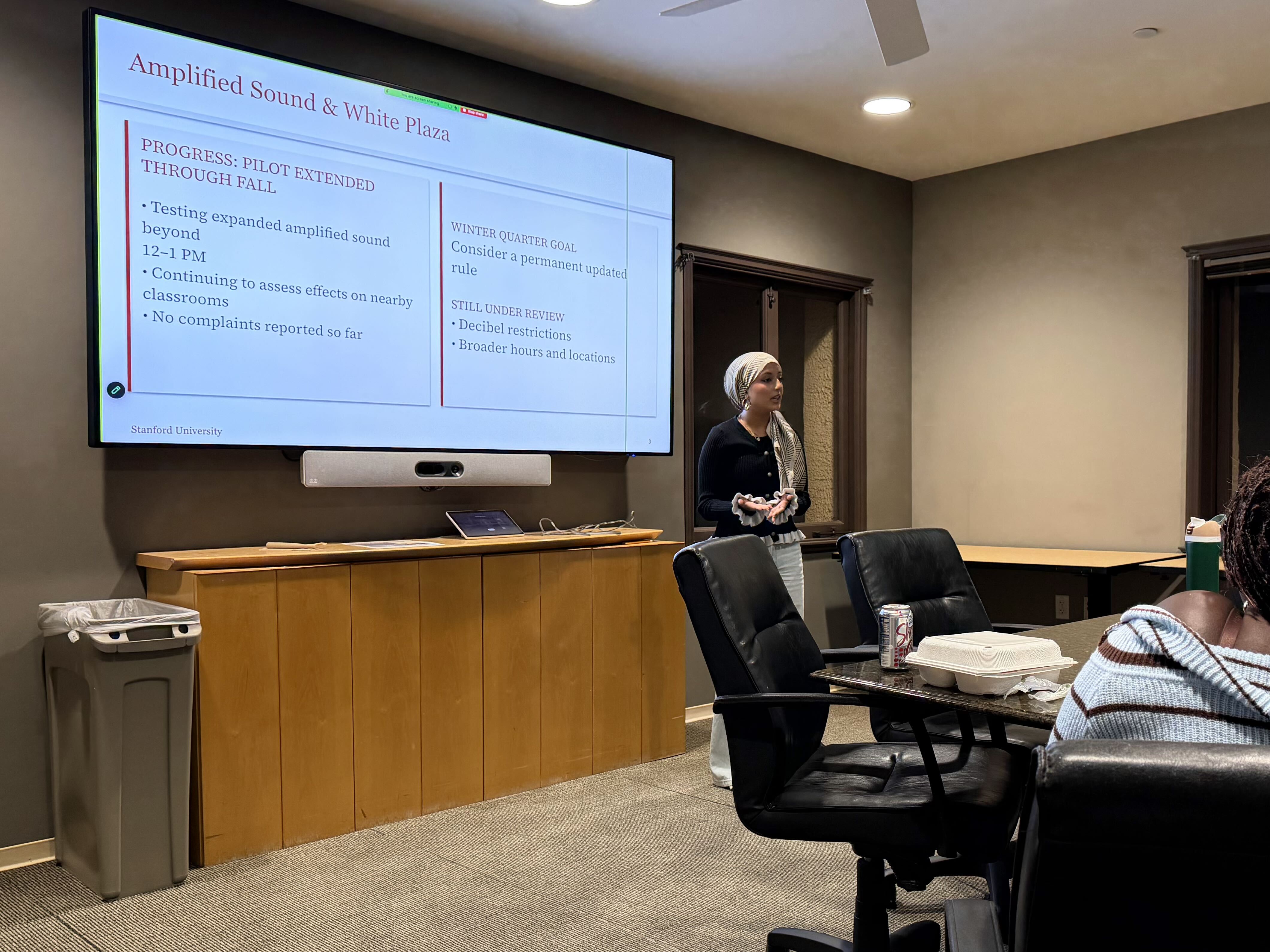
UGS Co-Chair Laila Ali ’28 presented updates from the free-speech working group. The group is continuing a pilot that allows amplified sound in White Plaza from 9 a.m. to 5 p.m. through the fall quarter. They plan to use the pilot to help inform decisions about a permanent policy by the beginning of winter quarter.
Stanford’s current free speech policies — including decibel restrictions and limitations on some campus spaces — have sparked debate since they were rolled out in the fall of 2024.
The pilot initially ran during the final weeks of spring quarter 2026, but the working group decided to extend it through the fall to adequately evaluate the policy. Ali said the group had received few complaints so far about the pilot.
The working group is also addressing difficulty with event registration and approval processes. Proposed changes aim to allow students to track events with greater ease by streamlining the process. The group also reviewed event-space costs to make fees transparent and improve accessibility for Voluntary Student Organizations.
A free-speech guide has also been developed to consolidate the information. Ali described it as containing “all the how-tos and things to know about free speech at Stanford,” including “how to organize and where to find resources.”
The policy is still in the works, and the pilot program’s 9 a.m. to 5 p.m. hours could be altered in future iterations.
Senator Ethan Alfonso ’27 introduced a bill to allocate UGS funds for programming during First-Generation and Low-Income Week, currently scheduled for Nov. 2-8. The bill’s vote is slated for an upcoming meeting.
The week aimed to “serve the undergraduate, graduate, first-generational, [low] income communities, as well as the intersecting identities, like transfer students, our guardian scholars, which are our former and current foster youth,” said Alfonso.
Under the bill, funding would go to the First-Generation and Low-Income Partnership, a student organization that helps coordinate the programming. The funds would be allocated entirely to First-Generation and Low-Income Week activities.
Senator Anjali Verma ’29 also outlined a proposal to address hand sanitizer availability in dining halls, saying that “frosh flu is going around.”
Senators raised concerns that current dispensers are empty and difficult to find. Their proposal aims to improve access to hand sanitizer in dining halls, and the UGS will vote on the proposal in a future meeting.
Associated Students of Stanford University (ASSU) President Jared Hammerstrom ’27 also presented a bill to UGS on the appointment of Sonia Dholakia ’29 and Matthew Coughlin, a second-year Mechanical Engineering PhD student, as members of the five-student Constitutional Council.
Hammerstrom said more than 50 students submitted applications for the two vacant spots, and that they hope to introduce the nominees “to the broader Stanford community” in a later public meeting.