
Eliya Cohen barely spoke English when Hamas took him into Gaza on Oct. 7, 2023. He learned it in the tunnels, reading “Shadow and Bone,” a novel gifted to him by a fellow hostage, over a dozen times.
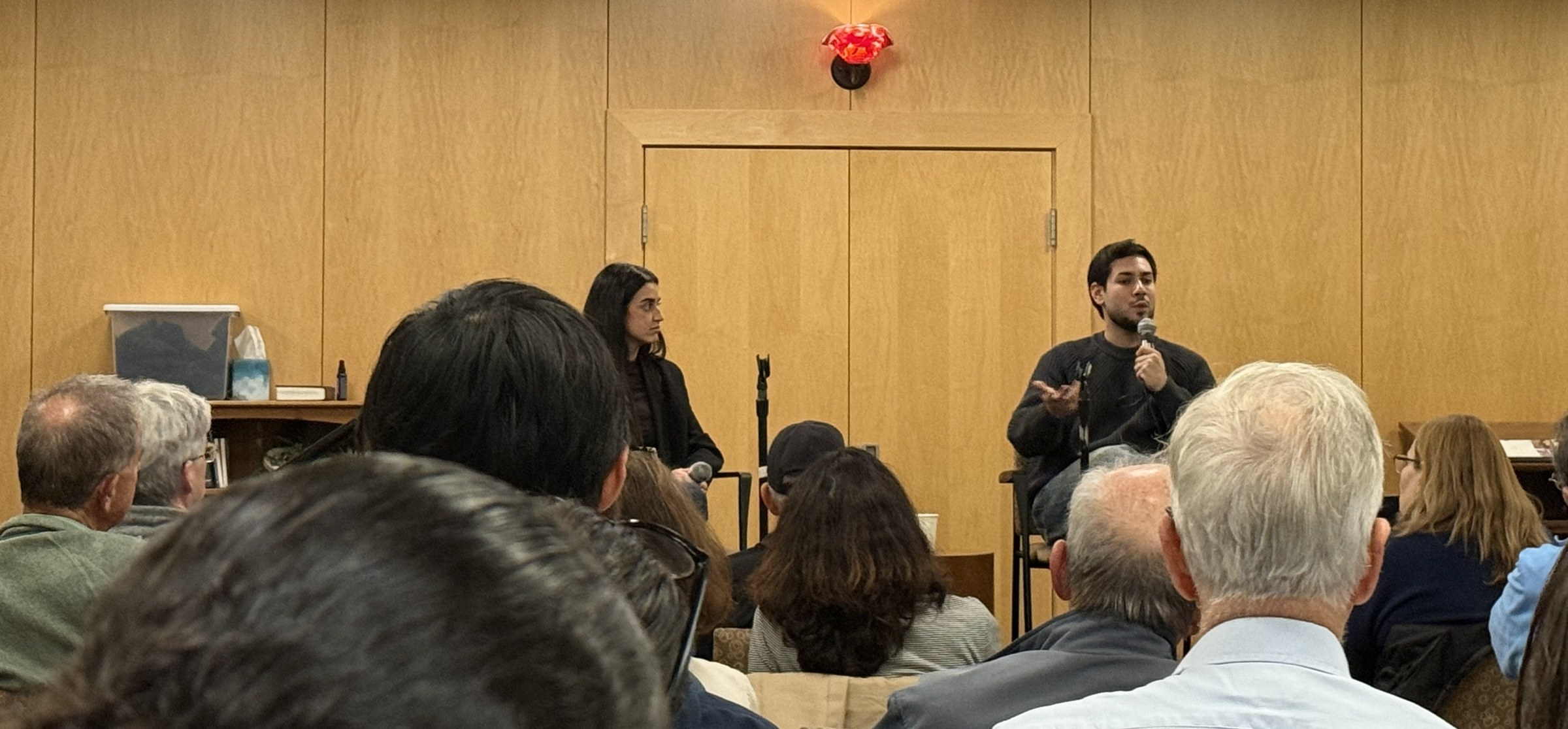
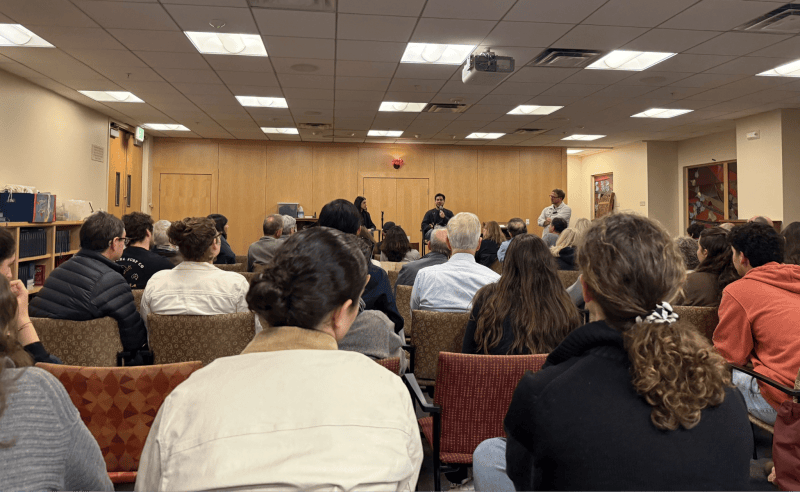
He recounted this story among others on Thursday at Stanford Hillel, using his newly learned English to tell a room of students and community members about surviving as a captive of Hamas. He left them with a simple but powerful message:
“Don’t ask G-d what you want, ask him for what you need,” he said. Many Jews write G-d rather than God, out of reverence for the divine name.
Cohen spoke alongside his wife, Ziv Abud, who survived the same terrorist attack ot the Nova Music Festival on Oct. 7. For over 505 days, neither knew whether the other was alive.
In their conversation, Abud and Cohen chronicled their experience on Oct. 7. Abud said they noticed initial signs of the attack at 6:29 a.m. Eventually, the couple took refuge in a bomb shelter near Kibbutz Re’im. Although it was meant to hold 10 people at most, 29 people crowded in — including Abud’s nephew and his girlfriend — as Abud noted.
According to the couple, Hamas quickly broke into the shelter and began throwing grenades inside. After killing Aner Shapira, an off-duty Israeli soldier who lobbed the grenades back, Hamas fired into the shelter killing Abud’s nephew and his girlfriend. While Cohen was able to hide Abud under a pile of dead bodies, he was dragged out of the shelter at gunpoint with a bullet in his leg.
As Cohen was driven into Gaza, people beat and spat on him, he said. In Gaza, his captors disguised him as a Muslim woman, and brought him to a large house before performing surgery on his leg without anesthetic. After being moved through tunnels beneath a mosque, he licked the tunnel walls for drops of water and bargained for food. He lost about 60 pounds in captivity.
For Cohen, faith kept him going. He credited his survival to “choosing life,” despite having a “1% chance” of surviving. He also noted that hostages caught pieces of the outside world. For instance, Cohen said he learned that Donald Trump had won the presidential election and had promised to bring the hostages home after overhearing the TV. Once, after asking God for a sign, he heard an Israeli radio broadcast.
Cohen also spoke about meeting other hostages, including Hersh Goldberg-Polin, an East Bay native who gave him the book after being told by Hamas that he was going home (Goldberg-Polin was later killed by Hamas in August 2024). Hamas also told Cohen that he and other hostages would be killed if the Israel Defense Forces (IDF) attempted to rescue them.
In an email to The Daily, Rabbi Jessica Kirschner, executive director of Hillel at Stanford, said the couple has “something precious and life-affirming” to teach the community.
“Eliya and Ziv provide pretty remarkable examples of resilience and growth in the face of adversity,” Kirschner wrote.
Cohen’s captivity ended on Feb. 22, 2025, when Hamas released him as part of a hostage deal, upon which he met with Omer Shem Tov. On the stage Hamas set up in Gaza, Cohen smiled and flashed a victory sign.
He had survived, and to him, that meant he had won.
Abud described her campaign to free Cohen, traveling the world to press for his release and tell their story. In March 2024, she stood in Tel Aviv’s Hostages Square in a yellow dress, the color for hostage liberation, instead of a wedding gown. On Valentine’s Day, she wore a red dress and set up a date for two, with only a photo of Cohen in his seat.
Each week, she watched freed hostages come home. “They looked like Holocaust survivors,” she said.
Freedom brought its own weight. Cohen said he felt guilty even eating or drinking until the remaining living hostages came home, about eight months after his release. When he campaigned in Washington D.C., people told him his story was propaganda. But the couple said that telling their story helped them remember details they had forgotten. According to the couple, they do not expect to change the minds of people who hate them, but they try.
They have since told their story at a San Francisco synagogue and spoke at the United Nations on Oct. 6 this year.
Both came back home changed. At first, they didn’t know whether they were still a match, so they started over and dated again from zero. Cohen proposed on Oct. 23, 2025, after the last living hostages returned home. They married on Aug. 19, 2026, before more than 1,000 guests at Ronit Farm in Israel, under a wedding canopy made from Ben Avida’s prayer shawl.
During the question-and-answer session, an audience member asked whether any captor ever showed him compassion. Cohen said he wished one had. It never happened, he noted. He described everyone he encountered in Gaza, children and women included, as having evil in their eyes.
Ultimately, Cohen and Abud said that they carry not post-traumatic stress, but post-traumatic growth.