
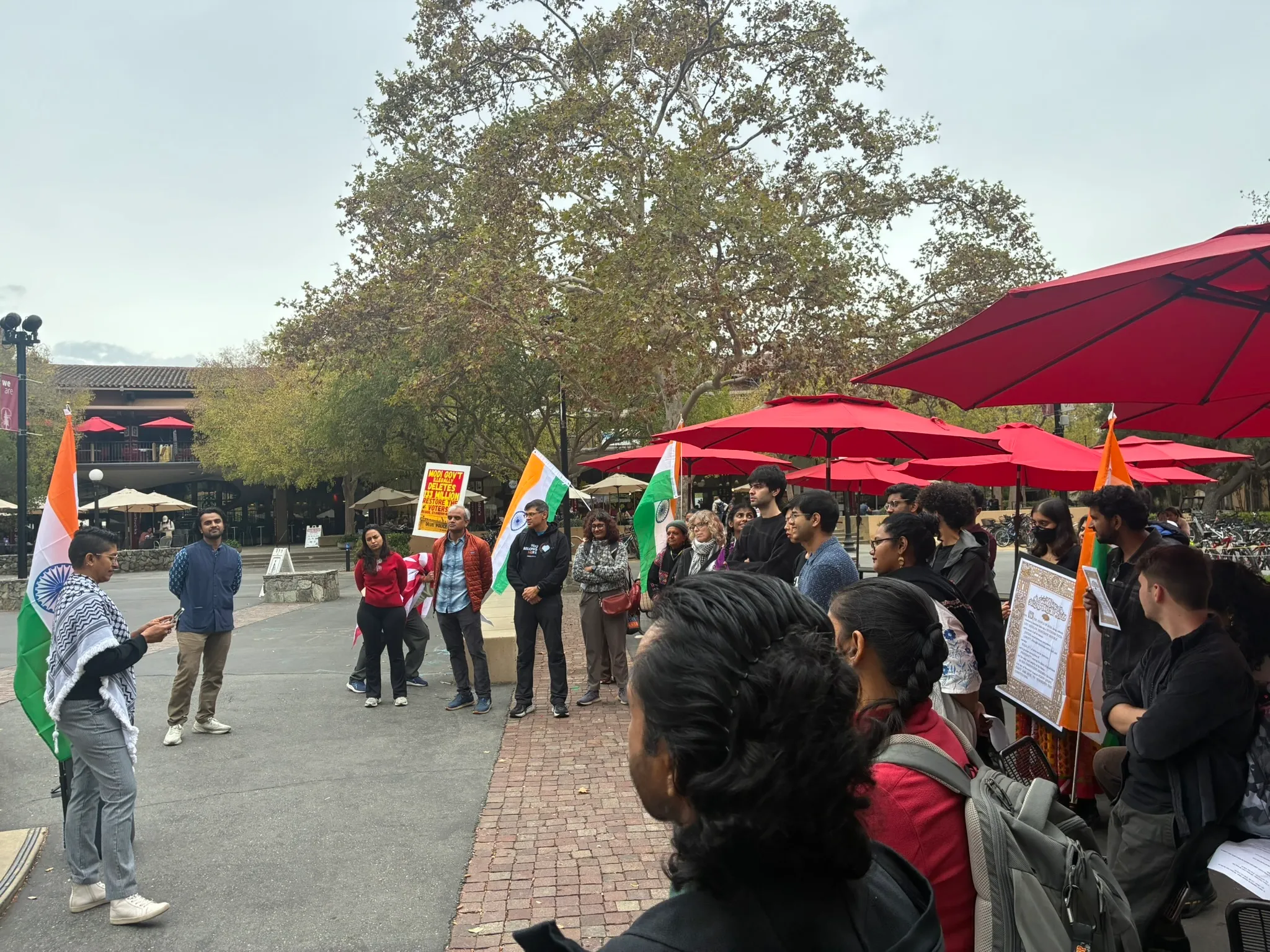
Students, faculty and supporters gathered in White Plaza on Wednesday to protest Narendra Modi’s Bharatiya Janata Party (BJP) government.
The Stanford protests come in response to large protests that have shook India’s capital, New Delhi, after the country’s National Eligibility cum Entrance Test (NEET) was cancelled following a leak of the exam questions. The protest movement grew to encompass a wider critique of the incumbent, right-wing BJP government.
The solidarity gathering was originally scheduled for Oct. 16, but was rescheduled after organizers said they were told by a professor at the last minute that tabling was not allowed during Reunion Homecoming.
Pete Cerneka, Associate Director of Student Organizations, told The Daily that protests are not discouraged during New Student Orientation (NSO) or Reunion Homecoming. He said, however, that “[the university] wouldn’t allow a protest to bump an event that had already booked White Plaza.”
When Cerneka communicated to the organizers that White Plaza was being used on Oct. 16, organizers mentioned rescheduling the event for Wednesday. He told the organizers that the space would likely remain unbooked on that day.
The protest at White Plaza opened at noon with protest chants in Hindi and drumming. Organizers and attendees brought signage — some handmade, some seemingly AI-generated — which criticized the Modi government. Protesters particularly focused on election minister Gyanesh Kumar, who has come under fire for expunging names from India’s voter roll. One sign read, “Modi Gov’t illegally deletes 133 million – restore the voters, resign Gyanesh Kumari.”
Ankita, an organizer who requested her last name be omitted citing fears of retaliation against international students, thanked the 30 or so attendees.
“Just showing up is an act of resistance. We are gathered here today to express our solidarity with the protests ongoing in New Delhi, against the [Special Intensive Revision (SIR)] electoral process, which has been recognized as disenfranchising millions of eligible voters and undermining the electoral process in India,” Ankita said to the crowd. The SIR is Kumar’s process of updating the electoral rolls, a change which has led to more than 130 million Indians being removed from the voter rolls.
Another organizer, a San Jose resident named Raj Pariyar, came swaddled in a U.S. flag and sporting a baseball cap that read “America.”
“I came because we have to stand up for democratic rights and because the U.S. and India need to support each other as fellow democracies,” he said.
Ankita told The Daily that the protest hadn’t been organized by a formal group but rather by concerned South Asian students looking to express solidarity. Though the protest was specifically in support of the Indian “cockroach” movement, Ankita said that “we feel these issues of oppression and discrimination are global issues and that fascism is a global issue.”
Confusion over scheduling led the protest to be delayed from its original date. One student organizer, who asked not be named out of fear of retaliation against international students, said that organizers made the decision to reschedule the protest after a professor told him that tabling was not allowed during Reunion Homecoming.
On Oct. 16, the day scheduled for the original protest, organizers found White Plaza was being used by a DJ. Protestors who had traveled to Stanford from other areas in the Bay Area had to be turned away.
After communicating with a representative from the Office of Student Engagement (OSE) the following Monday, organizers decided to reschedule to Wednesday. The representative explained that the space was free for protests or vigils as long as it was not booked. One organizer explained that the representative said he would put anybody who might book the space in touch with the student organizers.
The student told The Daily that while he was grateful for the support of the representative of the OSE, “it was interesting that the practice of free speech in the dedicated zone for free speech is not unconditional.”
Ankita told The Daily that she hoped that “the rescheduling challenges do not overshadow the larger purpose of this initiative” to “express solidarity with those fighting for democratic rights and resisting state oppression in India.”