
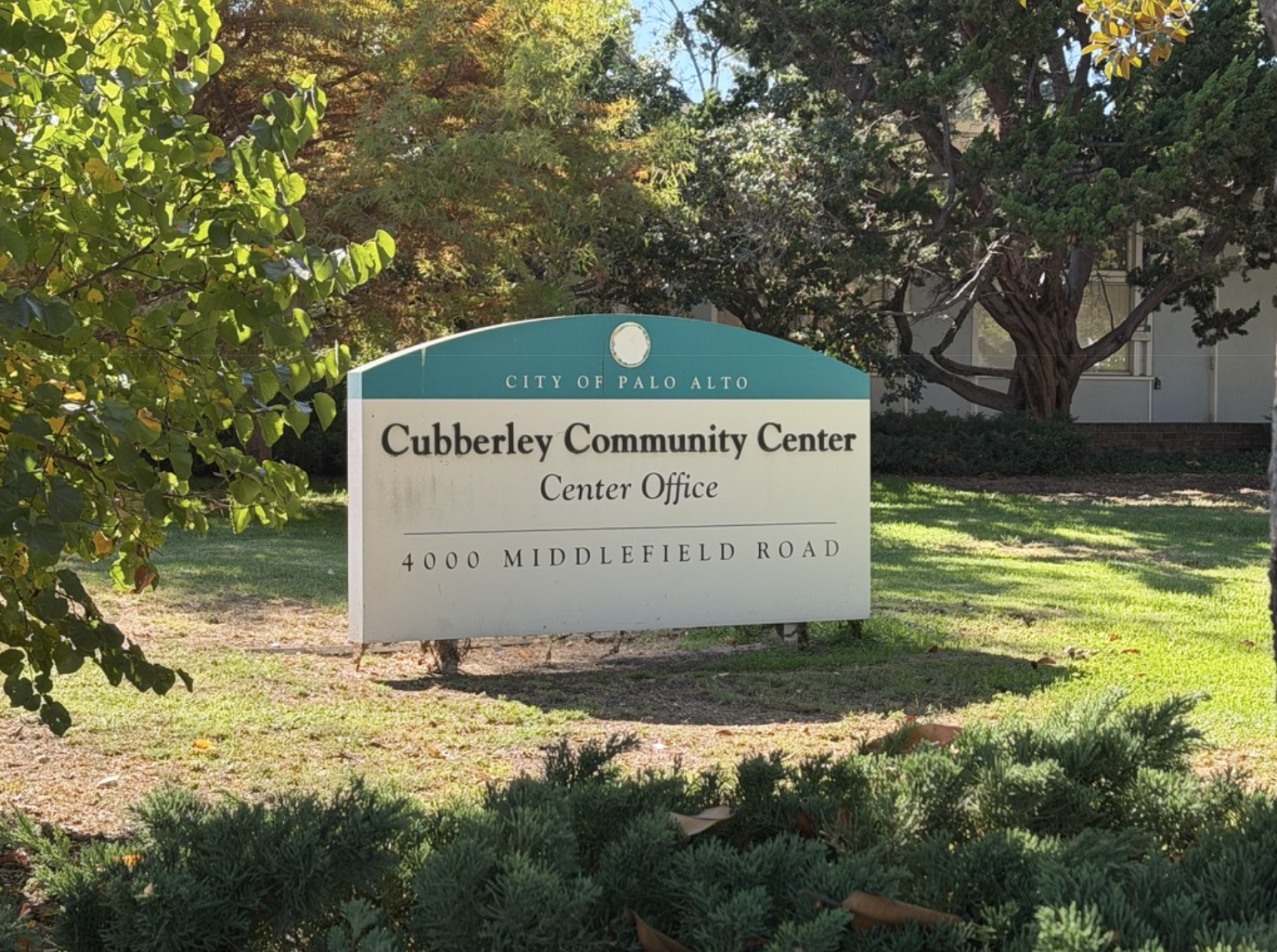
At Palo Alto’s Cubberley Community Center, an average weekday afternoon can be hectic.
“There’s dance schools down there, these rooms are typically Chinese schools, and these are actual schools over here,” said Bella Urizar, a behavioral technician with Play ABA, a behavioral therapy center located at Cubberley.
On election day, Palo Alto residents will vote on Measure J, which would place a half-cent sales tax within city limits to fund the purchase of Cubberley Community Center’s land and renovate the facility.
The Cubberley facility first opened in 1956 as a Palo Alto Unified School District (PAUSD) high school and reopened as a community center in 1990. Twenty-four businesses currently have long-term leases at the community center, ranging from a used bookstore to a Taekwondo school to a local historical society. Today, the building has begun to show its age.
“People tend to go instead to Mitchell Park in that area […] especially people studying in the library there,” said Samhita Laxman ’30, who attended nearby Henry M. Gunn High School. “Cubberley just doesn’t have enough events.”
The measure would raise $15.6 million annually for Palo Alto to purchase PAUSD’s portion of Cubberley, appraised at $65.5 million, as well as subsequent retrofits. The building “requires extensive repairs to meet modern-day earthquake, fire safety and accessibility standards,” according to the City of Palo Alto’s Cubberley project webpage.
“This dilapidated but beloved destination known as Cubberley, which has been home to so many organizations for young children through seniors for decades, is in danger of falling apart,” said Palo Alto city councilmember Julie Lythcott-Haims ’89. “These buildings, we’re told, are nearing the end of their useful life.”
However, Palo Alto voters have already expressed their hesitation this year to pass new taxes. In the June 2 primary elections, Measure B, a parcel tax directed towards funding PAUSD operations, narrowly missed the two-thirds threshold for passage, sending the district into a $33 million budget crisis. The measure would have renewed an already-existing parcel tax to fund local schools for four more years at a slightly lower rate than present.
Chris Robell, a board member of the Silicon Valley Taxpayers Association, said people are becoming “more sensitive to tax increases,” as well as towards “trust in government and that they’re managing the money wisely.” He specifically described Measure J’s language as “deceptive,” saying its structure as a general tax as opposed to a special tax meant revenue could also flow to non-Cubberley projects.
Cubberley faces a crowded ballot this year on taxation and taxation policy. Among the other measures on this year’s Santa Clara County ballot is Measure RTM, a sales tax going towards regional public transit funding. Within Palo Alto, passage of both Measure J and RTM would leave the city at a 10.25% sales tax, among the highest in Santa Clara County.
At the statewide level, tax reform is taking center stage. Proposition 43 seeks to overhaul how citizen-initiated local special taxes are approved, raising the required passing threshold from a simple majority to a two-thirds majority. Robell pointed to a California Supreme Court ruling, “California Cannabis Coalition v. City of Upland,” for allowing “bogus citizens’ initiatives,” as he described Measure RTM, to enter the ballot.
The city insists, however, that this exchange with PAUSD is necessary for the community center. A 2024 Memorandum of Understanding between PAUSD and the City of Palo Alto set terms for the City’s eventual purchase of the land by 2027. The memorandum explicitly calls for a measure to fund the land purchase to be placed on the ballot in 2026, with both parties returning to the drawing board if it doesn’t pass.
Part of the difficulty in maintaining Cubberley, Lythcott-Haims said, was the space’s ownership between two parties. “How do you deal with the wiring that cuts across and the plumbing and the seismic upgrades when you have two completely different owners who have different interests?” they said. “The buildings are 70 years old. They are not up to code seismically, [with] plumbing, wiring and [have] two owners!”
“Ultimately, government is tasked with the role of caring about the things that bind us all together, the things that we all need,” the councilmember said. “A proper functioning community center that is a destination is what is needed to support humans in thriving in an era of loneliness.”