
Editor’s Note: This article is a review and includes subjective thoughts, opinions and critiques.
There aren’t many chances at Stanford for a night out at the opera, so when the Structured Liberal Education program (SLE) announced tickets to the San Francisco Opera’s production of “Manon,” I was thrilled. Accompanied by my classmates, many of them first time operagoers, I felt confident that we would all return to campus loving the art form more than others expected.
First performed in 1884, “Manon” is widely considered to be Jules Massenet’s greatest opera. It tells the story of a common woman, Manon (Amina Edris), who falls in love with the Chevalier des Grieux (Pene Pati), only for their relationship to fall apart due to betrayal and Manon’s obsession with wealth and pleasure.
Some overly cloying excerpts aside, Massenet’s score contained much beauty, especially in the overture. Conductor Eun Sun Kim led an electrifying orchestra, and the string solos were excellently played.
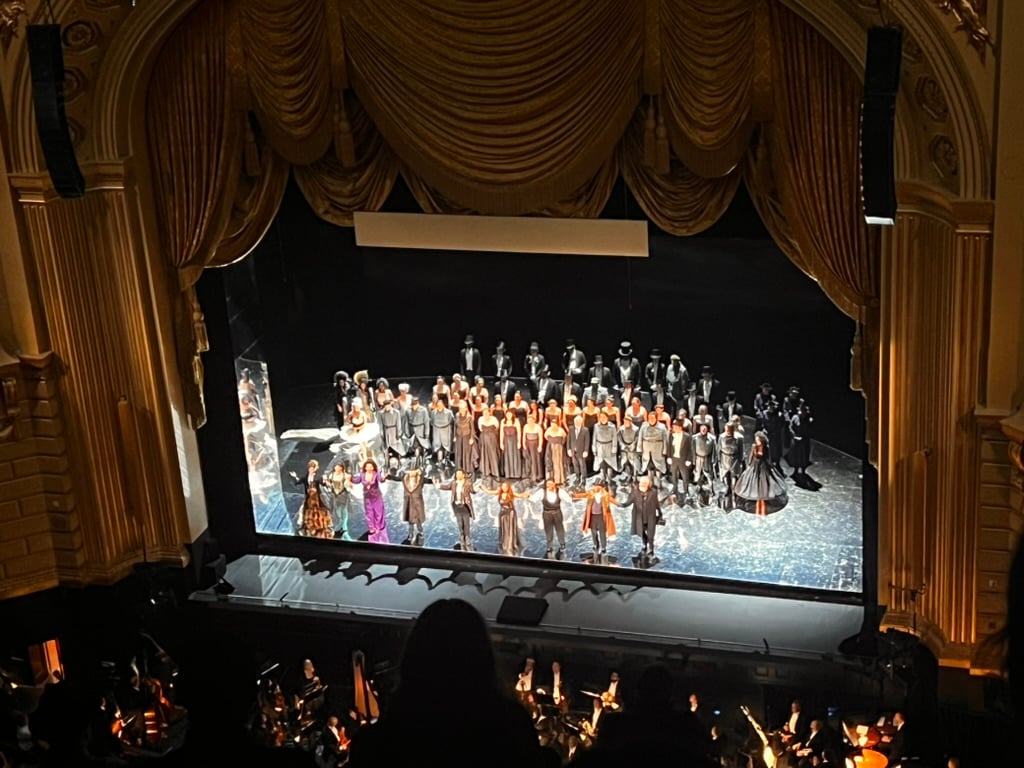
After the overture was where the problems began. Director and costume designer Vincent Boussard’s work proved garish and unappealing. It was all well and good for the characters to sing praises of Manon’s beauty, but when the soprano came onstage donning a pale orange sash and a scrunched mesh skirt dotted with neon green flowers, I was stunned. Then, in a scene meant to depict busy, joyful festivities, Boussard dressed the chorus in all black, holding black gift bags. Where were the baked goods, the colorful trinkets, the tokens of delight?
Those weren’t the only visual missteps. The set, designed by Vincent Lemaire, was largely cold and empty. An asymmetrical white wall in the background reminded me of a similar wall that Wolfgang Gussman designed for Verdi’s “La Traviata” at the 2005 Salzburg Festival. Similar to the Verdi performance, Massenet’s charming melodies clashed with such geometric emptiness. It was avant-garde to a fault: Manon sang of love and excitement in a hotel that looked absolutely miserable; with all the backgrounds appearing prison-like, the actual prison setting later on lost any shocking effect.
Every rendition of an opera will contain some level of experimentation and personal interpretation, but this approach was completely mismatched with the luscious music. Only Gary Marder’s lighting saved the set from complete misfortune. From my vantage point at the back of the balcony, his strategic placement of dark, kaleidoscopic shadows lent the action on stage some much-needed clarity.
Between the unappealing costumes and set, I found myself increasingly bored whenever the music waned and the visuals could no longer support the drama. I was also confused by some onstage mishaps. A stray, toppled wine glass rolled back and forth on stage at the end of Act III. Two balloons popped disruptively in a later scene. I also noticed that the accompanying translation failed to mention core details, such as the fact that Manon is only 17 years old. Although there was a limited amount of space on the screen, her youth and naivete are central to the plot, making it a strange omission.
Yet “Manon” did have one undeniably redeeming feature: the cast. Pati’s warm tenor absolutely carried the night. His subtlety and tenderness were so touching that I found myself leaning forward in my seat whenever he opened his mouth. I was especially fond of “Nous vivrons à Paris,” a duet between Pati and Edris. Though Edris occasionally lacked Pati’s delicate delivery, the couple was nevertheless compelling. Their pure, effortless intonation in chords and ensembles made me shiver. Unlike the set and costume design, their voices were well-suited to the gentility of Massenet.
By the end of the opera, I couldn’t quite decide if I was more exhausted or impressed. Ultimately, though, I felt that this production of “Manon” was a poor starter opera for my SLE classmates. Long runtimes and language barriers make venturing into opera challenging enough. Compounded by its uniquely gloomy visuals, the San Francisco Opera’s “Manon” may discourage newcomers from further exploring the art form before they can truly get a feel for it.
I hope another opportunity arises for my friends to hear the beauty of Massenet … and with any luck, they’ll get to see the beauty, too.