
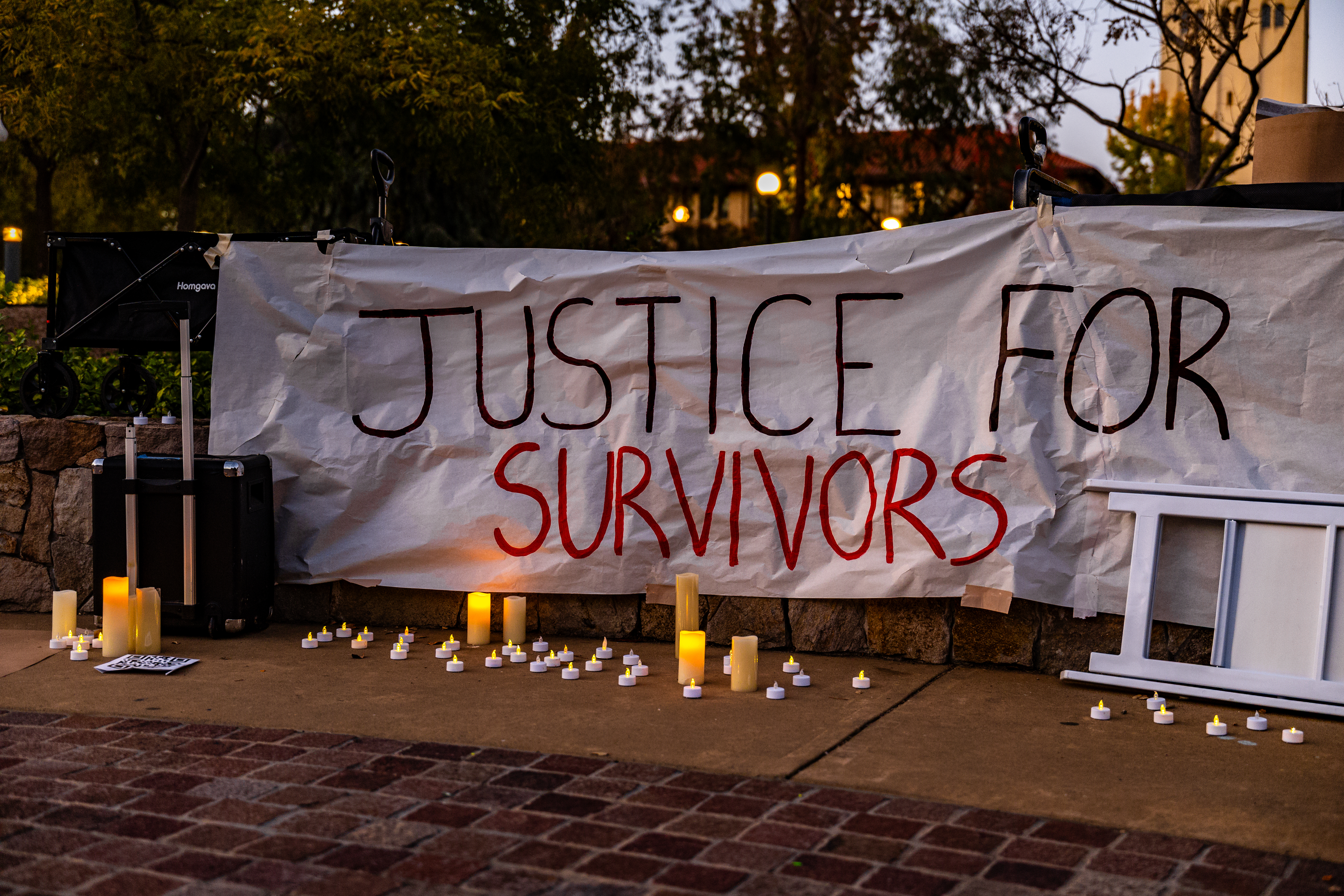
Students gathered to honor Jane Doe — the plaintiff in the Cornell Seven sexual assault case — and campus sexual assault survivors more broadly during a vigil at Meyer Green on Monday.
The event came less than two weeks after a student spoke out about her experience with the Title IX process in a Stanford Daily op-ed, writing that the University mishandled her rape case. The University has since responded, acknowledging that the case took too long.
The vigil was organized by Resisting Rape Culture at Stanford (RRCUS), a student group founded in October following the Cornell Seven controversy and recent changes at the Title IX and Title VI Office. The event formed part of a weeklong event series hosted by RRCUS (pronounced “ruckus”), which will culminate in a National Take Back the Night rally, a march against sexual violence, at White Plaza at 5 p.m. this Sunday, Nov. 1.
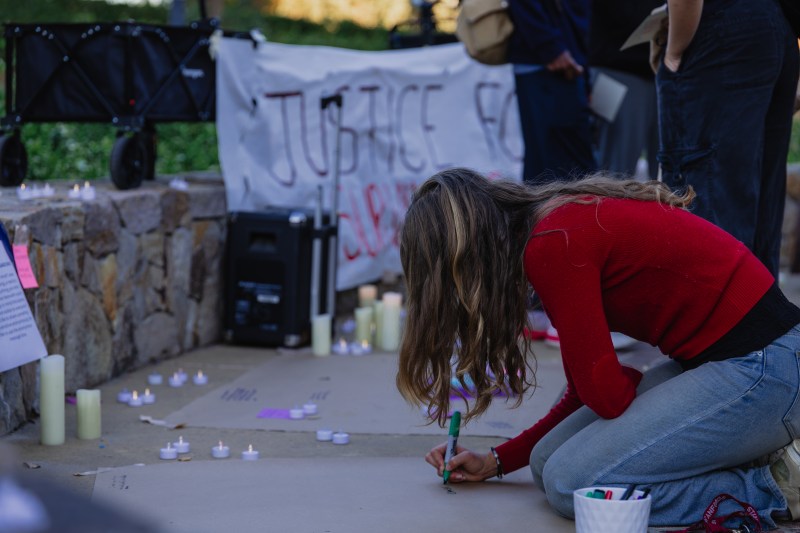
Around 40 students attended the vigil, which included speakers, banner-making and an anonymous submission box for survivor testimonials to be read out during Sunday’s rally.
“Jane Doe’s pain needs to be our pain. Jane Doe’s anger needs to be our anger. Until there are no more Jane Does, Jane Doe’s fight is our fight,” said Nini Khanna, ’27, a leader of RRCUS and a peer advisor at Stanford’s Sexual Health Peer Resource Center and Women’s Community Center.
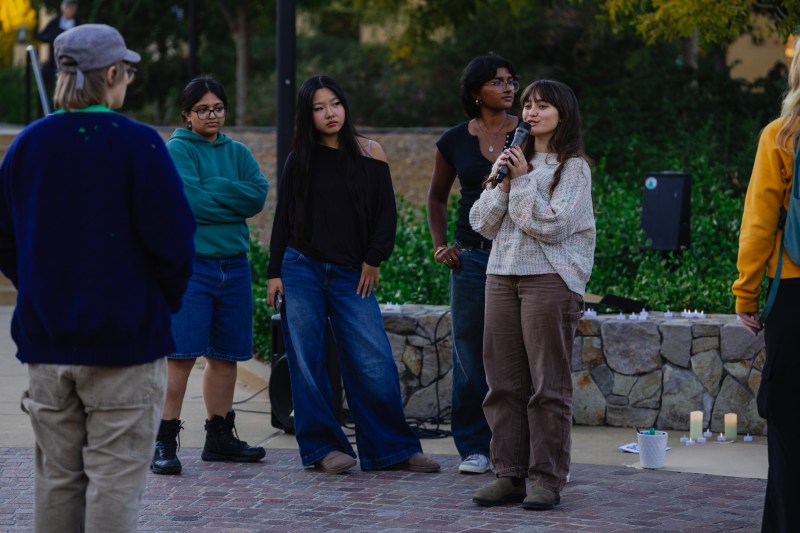
Pelagia Martin ’27, a leader of RRCUS, told The Daily that the group organized the vigil with the hope of providing a space to come together and “share collective grief” in the aftermath of the Cornell Jane Doe case.
“The University never honored its importance or the weight of it,” she said.
Speakers Cindy Chen ’29, Kirsten Lees ’27 and Khanna gave speeches emphasizing the importance of solidarity with all Jane Does and the need for institutional change in Stanford’s response to campus sexual violence.
“We need to understand that rape culture is not simply about individual perpetrators,” Chen said. “It is about power. It is about patriarchy and the social and institutional structures that have historically afforded men authority over women’s bodies, credibility and autonomy.”
Chen pointed to several issues within Stanford’s culture that she said demand systemic change.
“We cannot claim to stand with Jane Doe while refusing to confront these same dynamics in our own community,” she added. “It exists in the jokes that we laugh along with, and the friends whose behavior we excuse. It exists in our dorms, our classrooms and our clubs, and definitely exists in our fraternities.”
Membership in a fraternity is correlated with disproportionately higher rates of perpetrating sexual violence.
Others expressed frustration with Stanford’s institutional response to campus sexual assault.
“I’m frustrated with the flippancy in which these cases are regarded, and the way that survivors’ lives are regarded,” Lees said in her speech. The sole official communication that students received acknowledging the Cornell case came from the ASSU Undergraduate Senate (UGS), who shared resources for sexual violence survivor support on Oct. 1.
“Acknowledging something is nice, but it needs more than acknowledgement. It needs encouragement for change. People need to feel empowered,” Martin said.
Attendee and RRCUS member May-Jann Wong ’27 said that “it’s only in these horrible moments, do we see that the University or the system gives any attention at all to these kinds of things that just happen in the day to day at Stanford,” referring to the discourse surrounding the Cornell Seven case.
Martin stressed the importance of showing up to events like the vigil and Take Back the Night.
“We are living in a unique moment where survivors have a space to speak and are being heard, and our voices have power,” she said. “When we show that we take up physical space… that shows the university that we care and that we are not okay with sacrificing our well-being for the sake of our prestigious degree.”
Attendee Michael Tsai ’29 reiterated the event’s call-to-action.
“The patriarchal system we live in,” he said, “doesn’t change unless we take action. You have to be willing to challenge the institution you’re living in.”