
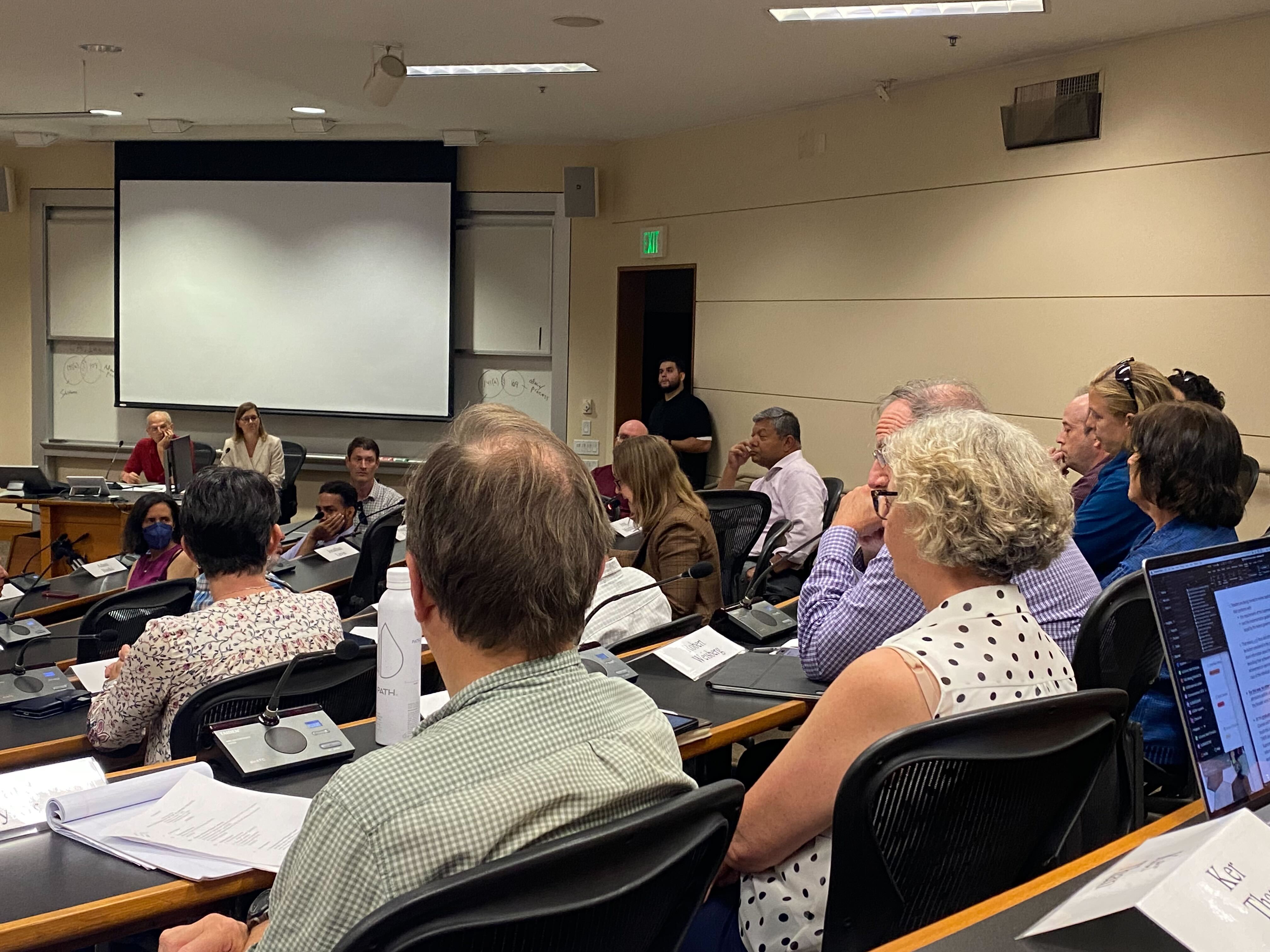
Stanford continues to restrict recording at faculty meetings
Throughout the Faculty Senate’s 59-year history, recording during meetings has not been allowed, according to Adrienne Emory, associate academic secretary of the Senate. However, the policy is neither found in the Senate’s bylaws nor listed in the Senate’s procedures and is instead repeated at their biweekly meetings.
During sessions, members, observers and journalists are allowed to type or take notes by hand. The Senate announces the policy before every meeting and “no recording” signs are posted on the door.
Emory said to The Daily that this “gives flexibility to each Steering Committee to decide what they want to do” with the policy each year. By keeping the policy verbal, the Senate does not have to vote and approve a new law each time they want to make changes to the current protocol.
For this academic year, the policy is “no recording or photography of any kind is allowed, including AI transcription,” according to Emory. The restriction of AI transcription is a new addition this year.
While the Senate votes and approves the meeting minutes, this doesn’t occur until the next meeting two weeks later.
Daily reporters cover the Faculty Senate using notes taken during the meeting and occasionally reaching out to speakers afterward for further clarification.
Stanford’s policies are not unique among peer institutions. In May, Princeton joined several elite universities, including Stanford, Columbia, Brown, Harvard and Dartmouth in prohibiting reporters from recording and photographing faculty meetings.
Dustin Schroeder, chair of the Faculty Senate, said that they try to make a space where senators can participate in “deep and grappling and informative” discussion.
“Whether or not they’re being directly recorded might shape the way they say things,” Schroeder said. “If they were being recorded, and felt those recordings were going out into the world, they might be trying to speak in sound bites, which might not be what one would choose for a deliberative process.”
Princeton and other institutions also cited a goal of increasing open discussion among faculty members as a reason for their recording policy.
Despite these priorities, Stanford’s Senate also hosts executive sessions, where only members are permitted to attend, effectively barring all members of the press and other attendees.
The Faculty Senate’s policy differs from that of Stanford’s Undergraduate Senate (UGS) and Graduate Student Council (GSC), which do not prohibit recording during their meetings.
“The Undergraduate Senate records all of its meetings because we represent the student body, and we believe students should always have access to our meetings, discussions and decisions,” Laila Ali ’28, the current UGS co-chair, wrote in an email to The Daily.
Ali said that UGS provides public Zoom links and records all meetings to allow students to view them later. She added that UGS prioritizes “accessibility, transparency and accountability to the students [they] represent.”
Faculty Senate happens every other week, typically on Thursdays at the Stanford Law School. The next meeting is scheduled for Nov. 5.